
This section is The content in this section is supplied by GlobeNewswire for the purposes of distributing press releases on behalf of its clients. Postmedia has not reviewed the content. by GlobeNewswire Article content
VANCOUVER, British Columbia, Sept. 10, 2026 (GLOBE NEWSWIRE) — Zacatecas Silver Corp. (TSXV: ZAC | OTCQB: ZCTSF | FRA: 7TV) (“Zacatecas Silver” or the “Company”) is pleased to announce assay results from the second phase of rock chip sampling at its Oso Negro project in Sonora, Mexico. Phase Two returned individual grab samples grading up to 20.3 g/t gold and 3,480 g/t silver, extended the mapped vein system to more than 3 kilometres, and confirmed continuous gold-silver mineralization along the full 600 metre strike length of the Prospecto vein. Both the Prospecto and Tere veins are now drill-ready with drill plan designs and permitting underway.
Sign In or Create an Account
or View more offersArticle content
Story continues below
This advertisement has not loaded yet, but your article continues below.
Article content
Highlights
Article contentWe apologize, but this video has failed to load.Try refreshing your browser, or
tap here to see other videos from our team.Article contentArticle content
- 354 rock chip samples were collected and assayed in Phase Two, bringing the total to 510 samples across the two programs completed to date.
- 63 Phase Two samples assayed between 1 g/t and 20.3 g/t gold, and 58 samples assayed between 100 g/t and 3,480 g/t silver. 20 samples returned over 1% lead or zinc.
- Mapped vein strike length has been extended to over 3 kilometres, up from the 2 kilometres reported after Phase One, with new vein extensions identified at both the Prospecto and Tere systems.
- The Prospecto vein and its southeast splays are gold-silver mineralized along their entire 600 metre mapped strike length.
- Veins are up to 3 metres wide, multiphase, and carry textures and geochemical signatures typical of the uppermost levels of a low sulphidation epithermal system — indicating that the boiling zone, which hosts the highest precious metal grades in these systems, may be preserved at depth.
- Prospecto and Tere are drill-ready. The Company will provide an update on the planned diamond drill program shortly.
Article content
Sampling Program
Article content
A total of 156 rock chip samples were collected during Phase One (see news release dated July 9, 2026), of which 134 were vein samples. A further 354 rock chip samples were collected and submitted for assay during Phase Two, which was completed in the first week of July 2026. All samples were cut for reference, photographed and dispatched to ALS for gold, silver and base metal analysis.
Article content
Story continues below
This advertisement has not loaded yet, but your article continues below.
Article content
Of the 134 vein samples collected in Phase One, 39 assayed between 1 g/t and 14.8 g/t gold, 35 assayed between 100 g/t and 2,340 g/t silver, and 11 assayed over 1% combined lead and zinc. Of the 354 samples assayed in Phase Two, 63 assayed between 1 g/t and 20.3 g/t gold, 58 assayed between 100 g/t and 3,480 g/t silver, and 20 assayed over 1% lead or zinc. Phase Two therefore returned both a higher number and a higher tenor of anomalous gold and silver samples than Phase One.
Article content
Geology and Results
Article content
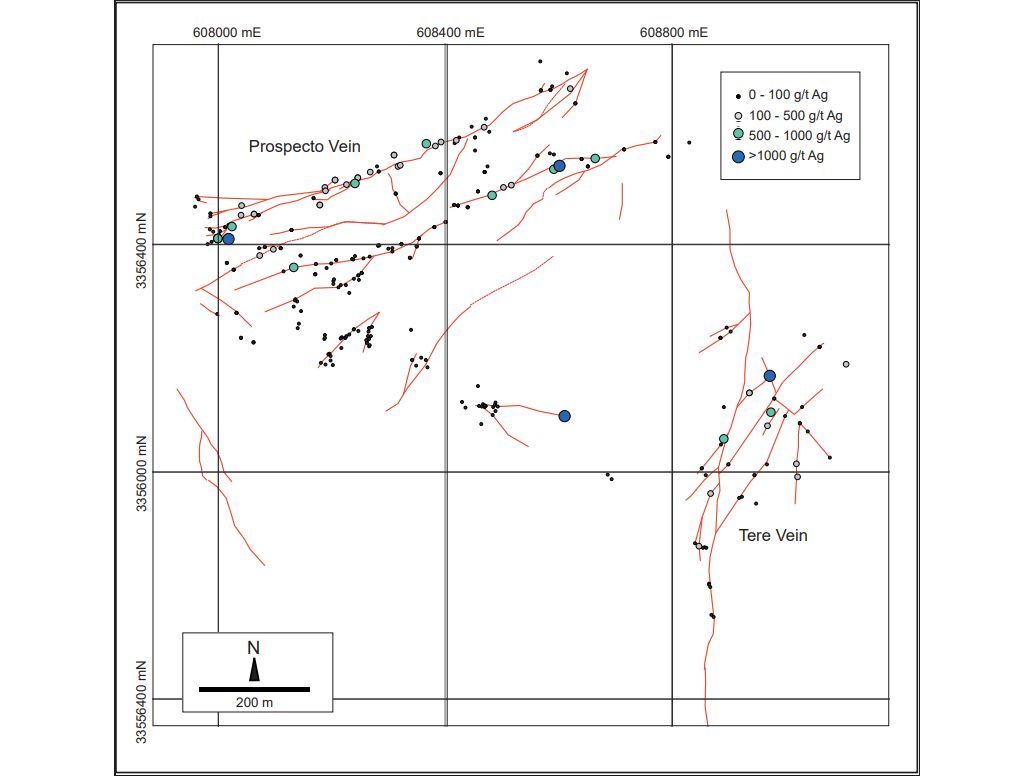
Geological mapping during Phase Two identified additional vein extensions at both the Prospecto and Tere vein systems (Figures 1 and 2), and the Company has now mapped over 3 kilometres of veins. Veins are up to 3 metres wide and multiphase, with common vein breccias and pervasive iron oxides after sulphides. Vein textures and geochemical signatures are consistent with the uppermost levels of a low sulphidation epithermal system, which suggests that the boiling zone and associated precious metal mineralization may be preserved at depth.
Article content
Gold and silver assays confirm that the Prospecto vein and its splays to the southeast are strongly gold-silver mineralized along the entire 600 metre mapped strike length (Figures 1 and 2).