
Opera House Drama Theatre, September 9, until October 17.
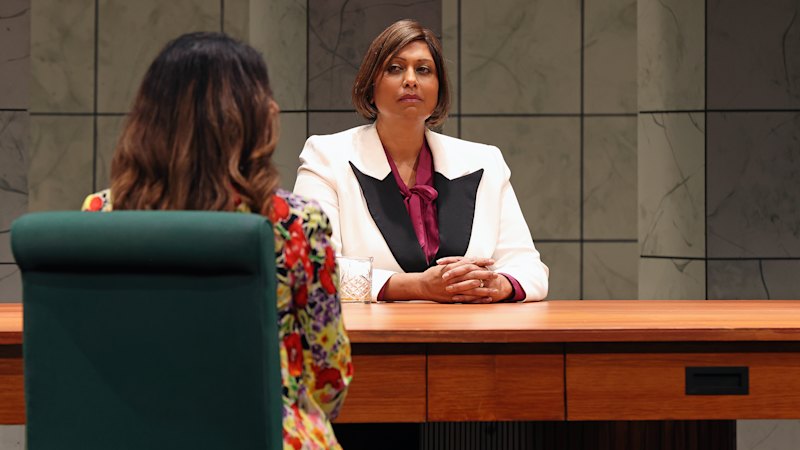
Politics is a harsh business. As brutal as a set dominated by cold marble columns – the pillars of democracy – where a lone woman vacuums as the audience enters.
Canberra’s Parliament House has hardly been a welcoming workplace for women, as countless news stories in recent years have made clear. Why, you might wonder, would you want to work there?
Playwright Emily Steel has taken a light-hearted approach with a satire that focuses on three women drawn to Canberra’s limelight: first-time government MP Ruth (Susie Youssef), her jaded chief-of-staff Anna (Emily Taheny) and naive junior staffer Kelly (Franca Lafosse).
Ruth is determined to make a splash with healthcare reform. Anna wants to hold together her stressful job and her unravelling home life. Starry-eyed Kelly just wants approval. She is so incompetent and lacking in initiative that it’s hard to see why she was hired.
Yet she proves pivotal. When she spends a night with the science minister, Kelly unleashes a Pandora’s box of ambition, compromises, betrayals and all-round Machiavellian behaviour.
These shenanigans become so labyrinthine in the second half that one can get lost in the maze. But it’s clear that no one emerges unscathed.
The strength of the play is that there are no black-and-white characters. All are flawed, which allows scope for ambiguity and nuance about their actions.
It’s not only male attitudes to female colleagues that are in the spotlight. Female solidarity has gone AWOL. Ruth accuses Anna of not being up to the job if she won’t sacrifice her family for it. And Anna accuses Ruth of throwing Kelly under a bus to get the science minister’s backing for the health bill.
Despite an early sight gag involving bad hair, the play relies for its comedy not on slapstick but on witty dialogue and good comic timing.
Taheny as the overburdened Anna has the lion’s share of these lines, which she delivers to incisive effect. She is the core of the play, the woman who has soldiered on even as she’s watched her dreams die. Lafosse is a spirited Kelly. Despite her implausible character, she manages to evoke sympathy as the scales fall from her starry eyes.
Youssef’s backbencher Ruth is part idealistic campaigner, part prima donna, with the dial on opening night leaning towards the latter. Indira Naidoo doubles as prime minister and a cleaner, who provides a witty analysis of what changes after an election. Johnny Nasser as the science minister gives a rounded performance of a man in crisis.
Director Shannon Rush directs with unflagging energy and draws out the comedy. Early scenes could dial back the frenetic pitch to allow pace to build. Ailsa Paterson’s set evokes the impersonal feel of parliament house, the chamber and a serviced apartment, aided by Nigel Levings’ stark lighting. Composer Andrew Howard utilises a driving percussive beat, like troops marching to war.
This is a breezy, behind-the-scenes look at the workings of political power. While it offers few fresh insights, it reinforces the adage that if you want a friend in politics, get a dog.