
This section is The content in this section is supplied by GlobeNewswire for the purposes of distributing press releases on behalf of its clients. Postmedia has not reviewed the content. by GlobeNewswire Article content
By adding PCB manufacturing and assembly to its established mechanical manufacturing capabilities, RapidDirect is expanding its support for hardware development from prototype to production
Sign In or Create an Account
or View more offersArticle content
SHENZHEN, China, Sept. 10, 2026 (GLOBE NEWSWIRE) — RapidDirect, a leading global provider of custom on-demand digital manufacturing, today announced the official launch of its new Printed Circuit Board (PCB) division. This strategic expansion empowers full-stack electromechanical development, accelerating product iteration cycles and enabling engineering and procurement teams to launch market-ready hardware faster and with fewer design conflicts.
Article contentWe apologize, but this video has failed to load.Try refreshing your browser, or
tap here to see other videos from our team.Article content
Story continues below
This advertisement has not loaded yet, but your article continues below.
Article contentArticle contentArticle contentArticle content
How Separated Manufacturing Delays Hardware Development
Most hardware projects face delays due to separated manufacturing work. Engineers usually source mechanical housings and PCB electronics from different suppliers. This split process causes inconsistent design checks, mismatched parts and costly last-minute changes.
This common issue exists in traditional OEM and ODM models. OEM only builds parts based on finished customer designs, with no design support. ODM provides ready-made factory designs with little room for custom development. Neither model supports simultaneous electronic and mechanical updates, which often leads to the common issue where PCBs cannot fit device enclosures.
Modern hardware developers no longer need separate part production. They need unified design checks, synchronized manufacturing feedback and smooth iteration to avoid cross-supplier errors.
Article contentArticle content
Unified PCB & Mechanical Manufacturing Workflow
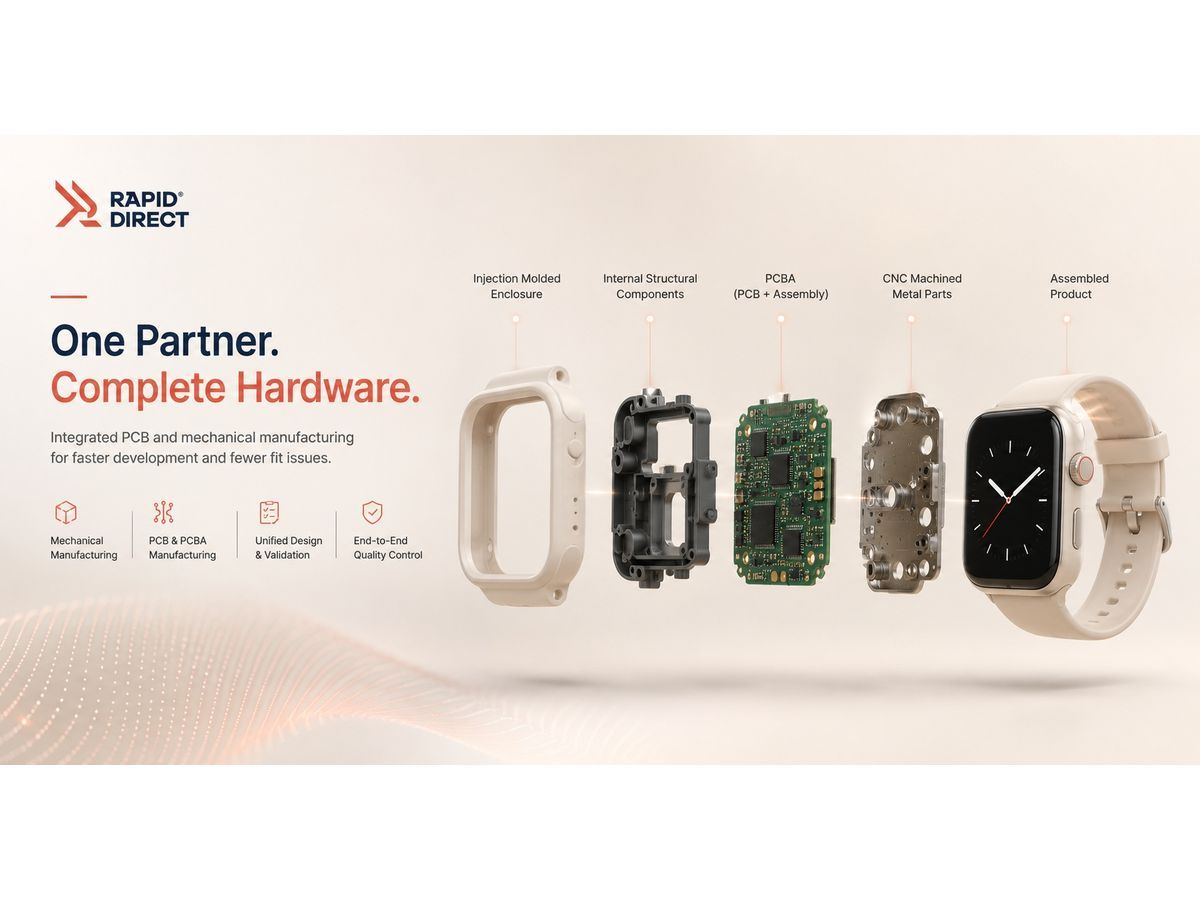
RapidDirect now combines all core manufacturing services in one workflow, including PCB production, PCBA assembly, CNC machining, injection molding, sheet metal and 3D printing. This unified system breaks electronic and mechanical processing barriers, enabling parallel design reviews, unified production checks and early fit testing.
Beyond standard manufacturing, RapidDirect offers professional ADM and JDM services for higher customization needs. Unlike passive OEM and ODM production, ADM optimizes your finished designs for better assembly and production. JDM supports full-cycle joint development, helping you refine product solutions, fix design flaws and finish mass-production-ready validation from the early stage.
For example, when developing wearable devices like neck massagers, our teams design and test plastic enclosures and internal PCBA boards at the same time. All ports, buttons and assembly structures are verified early, avoiding late-stage mismatches and cutting rework costs.
Article content
Story continues below
This advertisement has not loaded yet, but your article continues below.
Article content
Expanding RapidDirect’s End-to-End Hardware Manufacturing Capabilities
“RapidDirect is moving beyond the role of a traditional parts supplier to become a true digital manufacturing partner,” said Leon Huang, CEO of RapidDirect. “Our goal is to make increasingly complex hardware programs easier to execute as mechanical and electronic requirements become more closely connected.”
Article content
Core Integrated Electromechanical Advantages
Article content
- Full Electromechanical Process Coverage
We combine full mechanical and electronic manufacturing capabilities, supporting seamless hardware development from prototyping to mass production. - Unified BOM & AI DFM Synchronization
Unified BOM management and AI-powered DFM reviews synchronize mechanical and electronic design checks, spotting fit and manufacturing risks early. - Synchronized Cross-process Quality Validation
Unified quality and assembly standards apply to all components. Continuous cross-process verification ensures perfect electromechanical compatibility and stable product quality.
Article content
Strategic Benefits