
Article content
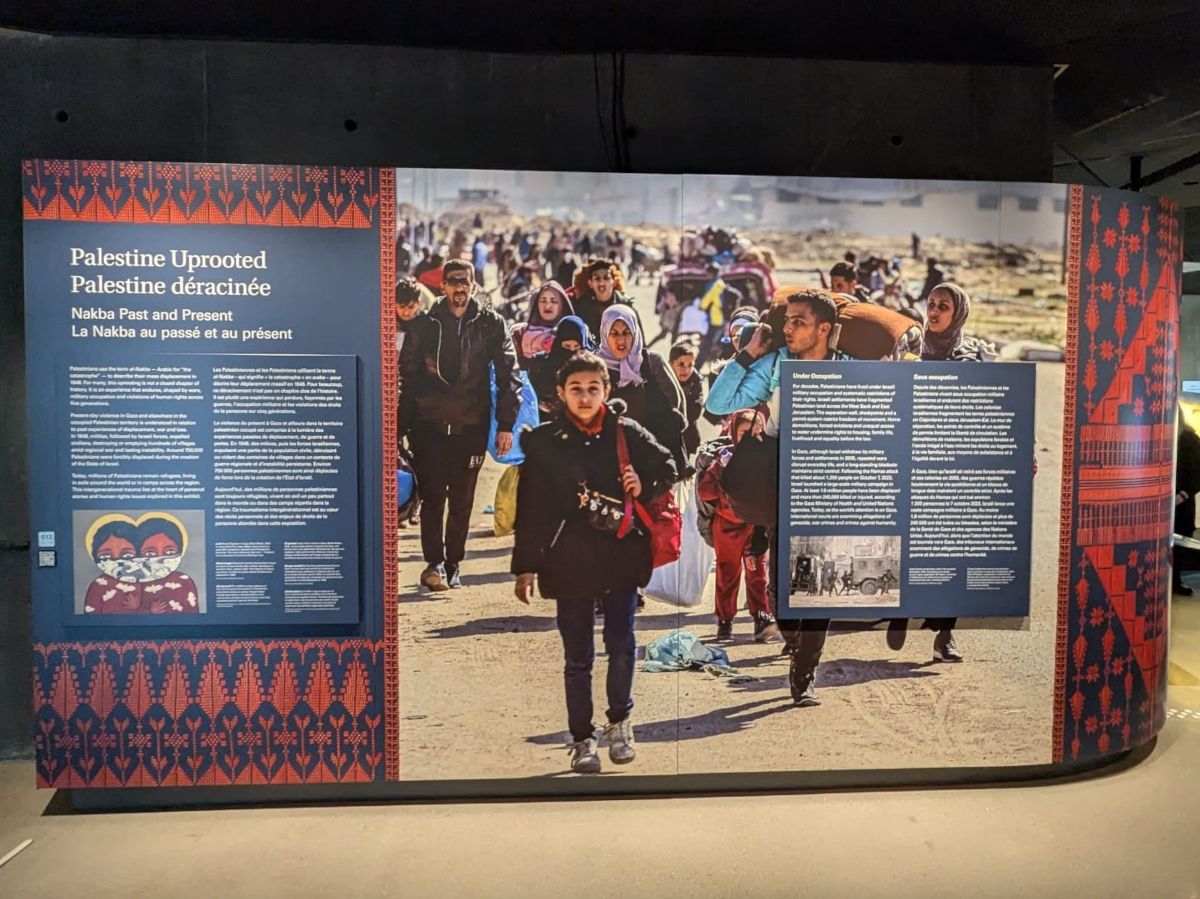
The “Palestine Uprooted: Nakba Past and Present” exhibit at the Canadian Museum for Human Rights” (CMHR) brings the propaganda of the Palestine Liberation Organization (PLO) of the 1970s into an institution that receives substantial funding from federal, provincial and municipal governments.
Sign In or Create an Account
or View more offersArticle content
The Network of Engaged Canadian Academics invited me to Winnipeg to view the exhibit, drawing on my expertise as a historian who, in works including “Israel’s Moment” and “Three Faces of Antisemitism,” has studied the establishment of the State of Israel, the impact of Nazism and communism on antagonism towards Zionism and Israel both before and after 1948, along with hostility toward the Jewish state in both secular leftist and Islamist circles.
Article content
Recommended Videos
We apologize, but this video has failed to load.Try refreshing your browser, or
tap here to see other videos from our team.We apologize, but this video has failed to load.Try refreshing your browser, or
tap here to see other videos from our team.Article content
Story continues below
This advertisement has not loaded yet, but your article continues below.
Article content
“Palestine Uprooted” repeats a version of events articulated by the PLO member and writer Mahmoud Darwish in a speech he wrote that was delivered by PLO chair Yasser Arafat to the United Nations General Assembly in 1974. According to Darwish and Arafat, Palestinian innocence and Israeli perfidy justified decades of PLO terrorism and rejection of compromise.
Article contentArticle content
The current exhibit repeats the same version of events they offered 52 years ago. The only new element is that what originated as part of a propaganda campaign to delegitimate the State of Israel and justify the use terror to destroy it is now receiving credibility and legitimacy from a government-affiliated museum in Canada.
Article content
The exhibit claims that, “Around 750,000 Palestinians were forcibly displaced during the creation of the State of Israel.” This is not true. Historians such as Efraim Karsh in his book “Palestine Betrayed” and Yoav Gelber in “Palestine 1948: War, Escape and the Emergence of the Palestinian Problem” have demonstrated that many thousands left their homes, some at the urging of Arab leaders, in expectation that the Arab states would soon invade and destroy the new Jewish state.
Article content
Story continues below
This advertisement has not loaded yet, but your article continues below.
Article content
As the historian Benny Morris documented in “1948: The First Arab-Israeli War,” thousands of others became refugees as a result of battles in particular towns and villages — battles that Israel had to fight and win to ensure its survival.
Article contentRead More
- Terry Newman: Consultants for human rights museum’s ‘Nakba’ exhibit are hardened anti-Israel activists
- Kevin Klein: Human rights museum can no longer avoid questions over Nakba exhibit
- Story continues belowThis advertisement has not loaded yet, but your article continues below.
Article content
The exhibit fails to inform viewers that in November 1947, Canada joined a two-thirds majority at the UN supporting a resolution that called for the establishment of two states — one Jewish, and one Arab — in parts of the former British Mandate for Palestine.
Article content
The Palestinian Arabs, represented at the UN by the Arab Higher Committee, rejected the partition plan, insisting that there should be no Jewish state in the territory whatsoever. The Jewish community in Mandate Palestine, represented at the UN by the Jewish Agency, accepted what became known as “the two-state solution.”
Article content
The votes in favour of the resolution came from the Soviet Union, the communist regimes of Eastern Europe, the democracies of Western Europe, the United States and Canada, among others. On Dec. 2, 1947, Mohammed Amin al-Husseini, leader of the Arab Higher Committee, responded to the UN resolution by calling for a general strike to reject it, and in the following months, the committee launched a civil war against the Jewish community to prevent its implementation.