
It’s a remote, roofless ruin in a Tasmanian ghost town – and it just sold sight unseen for $300,000
Historic Royal Hotel bought by Perth couple who have never set foot in Tasmania, with hopes its story will become a tourism drawcard
-
Get our breaking news email, free app or daily news podcast
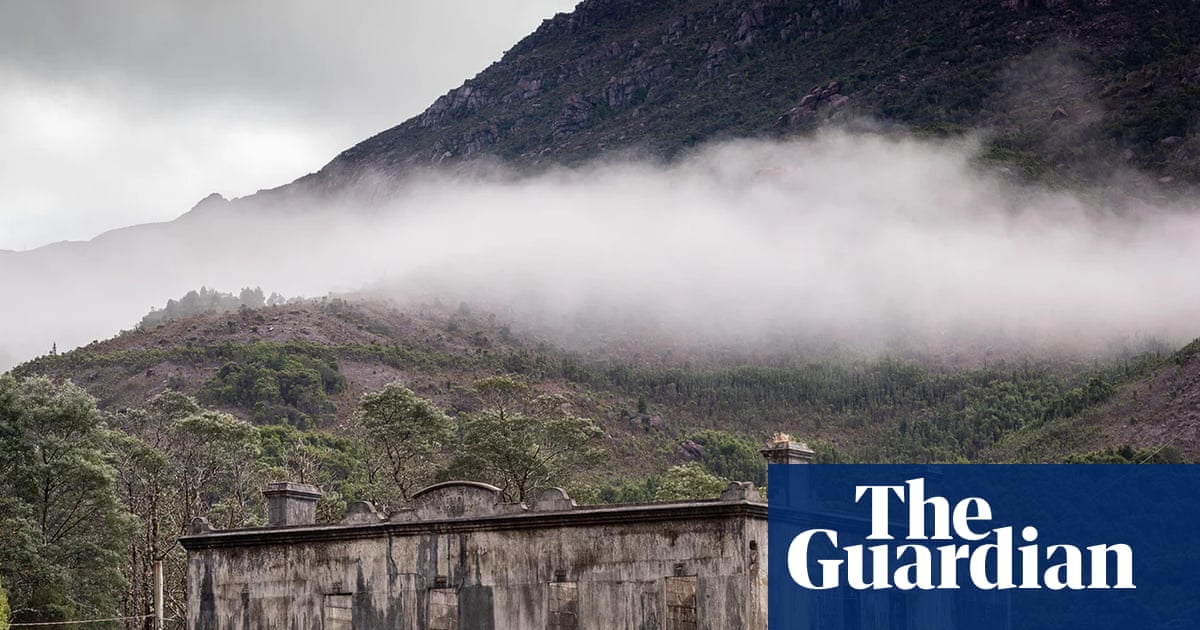
On the edge of the main highway winding from Hobart to Tasmania’s west coast, the concrete shell of the Royal Hotel stands like a spacecraft lingering on otherworldly terrain.
One of the few official ruins in Tasmania, the old building is roofless, weathered by the elements – and has just sold for $300,000.
Located in the ghost town of Linda, near Gormanston, the historic property was snapped up sight unseen by Perth chef Naiche and his partner. They plan to explore opening an eatery in the adjacent (functional) building.
Set on a stretch of road where the town’s welcome and goodbye signs sit barely a kilometre apart, the property comprises the abandoned hotel and adjacent building equipped with a commercial kitchen, living room, bathroom and bedrooms.
From a bird’s eye view, the roofless concrete walls expose the ruin’s layout like a dollhouse. Its smooth, human-made edges stand out against surrounding mountainous landscape, laden with jagged boulders and low-hanging clouds.
When the sun hits the muted greys of the country, the colours turn into warm hues of brown, orange and green.
Originally constructed from timber in 1901, the hotel was destroyed by fire nine years later before being rebuilt in reinforced concrete. It catered to prospectors drawn by gold at the nearby North Lyell mine, where a 1912 fire claimed 42 lives. Over subsequent decades, the hotel serviced local copper miners and earned a reputation for brawls – including a fatal stabbing in 1925 – before the mines emptied and the pub was abandoned in 1952.
Sign up for the Breaking News Australia email
In recent years, the dark grey shell has served as a pit stop for road trippers seeking ghost-town photo opportunities. It has also been used as a backdrop for light projections during the Unconformity arts festival.
The adjacent building previously operated by vendor Zara Trihey as Linda Cafe – catering to visitors that included hikers, cyclists and rafters heading towards the Franklin River and Strahan.
‘Buying a wreck’
Dominic Romeo, a historic property agent who handled the sale, says the listing attracted interest across Australia, the UK and US.
An elsewhere world: the sleepy Tasmanian mining town that became an arts meccaRead more
Romeo, who has spent 40 years restoring historic country houses, described the Royal Hotel as a “huge historic shell”.
“Buying a wreck, sight unseen, is another level,” he says. “I love these types of buyers, they have a sense of adventure and purpose.”
“The purchasers are from Perth, WA. They did not inspect the property, but what makes it even more interesting is that they have never been to Tasmania.”
According to the West Coast council mayor, Shane Pitt, the region’s scenery is unique to the rest of Tasmania, with dense natural growth rainforests, rolling peaks and freshwater lakes filled with rainbow, brown and brook trout.
“We class the whole west coast as remote,” he says, estimating the hotel to be 15 minutes’ drive from the major town of Queenstown, two hours from Burnie and three and a half hours from Hobart.
skip past newsletter promotion
after newsletter promotion
The region surrounding Queenstown, Gormanston and the Linda Valley has a distinctive “lunar landscape” from a legacy of historic mining and timber harvesting, that has “started to be overtaken by floral growth”.
‘Visitors want to know the history’
Tourism Industry Council Tasmania chief executive, Amy Hills, says sites like the Royal Hotel spark curiosity among travellers.
“There is a rawness to the west coast that draws visitors in,” Hills says. “Buildings like this help tell those stories and connect visitors to the history of the community. The new owners have the potential to give visitors a reason to stop and engage with the hotel’s story.
“Visitors want to know the history – what was it like before it closed in the early 1950s? Who spent time there, and what did its presence bring to the area at that time?,” she says. “There is something exciting about discovering an unexpected place on a road trip.”
Hills says that tourism is vital to the state’s economy, particularly in regional areas.
“The industry directly and indirectly supports approximately one in six jobs across the state,” she says. “In regional communities that flow-on impact can be particularly significant.”
Pitt says a there has been a surge in adventure tourism on the west coast, driven by wilderness cruises, heritage railways and the nearby Mount Owen mountain bike trails, some of which end in the Linda valley.
“Those riders may be attracted to the eatery,” he says, if it offers something distinct from nearby Queenstown.
The local community “is one that is willing to support those having a crack,” Pitt says.
“It would be good to see the old Royal Hotel renovated back to its former glory, but this will take a lot of time, money and hard work. Telling the story of the building would certainly be a great start.”
Explore more on these topics