
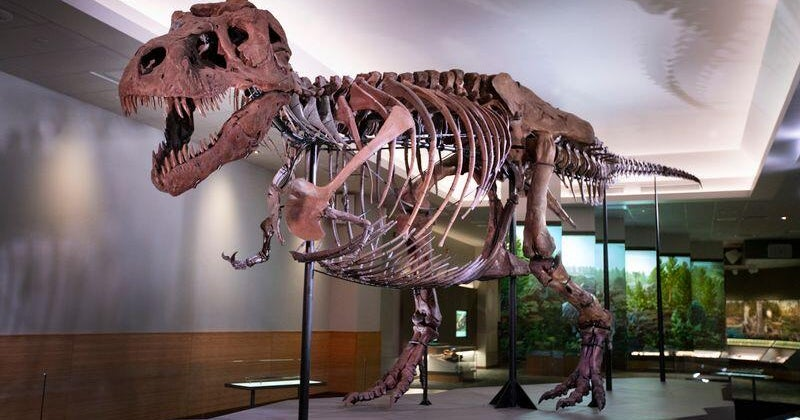
Paleontologists have discovered the first known trackway made by a full-grown Tyrannosaurus rex: four connected footprints found in the badlands of southwestern North Dakota, not far from the Montana border.
The find is described in a new paper published this week in the Journal of Vertebrate Paleontology. Before it, only two isolated adult T. rex footprints had ever been confirmed anywhere in the world, one in New Mexico and one in Montana. Neither showed how the animal was moving.
“Bones tell us an enormous amount about these animals, but footprints capture a moment of behavior,” said Dr. Tyler Lyson, senior curator of vertebrate paleontology at the Denver Museum of Nature & Science. “With a trackway, we can actually follow an animal as it moved across the landscape. That is incredibly rare for T. rex.”
The trackway was found in 2025 on U.S. Forest Service land near Marmarth, North Dakota, by Kent Hups, a high school teacher and amateur fossil hunter who was volunteering on one of Lyson’s digs.
“As a teacher, I’m always telling my students that science starts with curiosity, passion and careful observation,” Hups said. “I never imagined that could lead me to a discovery like this.”
The trackway runs about 23 feet long and consists of four three-toed footprints, each roughly 3 feet long. Researchers used the spacing between the prints to estimate the animal was walking about 3.5 to 4.5 mph, despite weighing more than seven tons.
Researchers attributed the tracks to T. rex based on their size, their shape, and the fact that the surrounding rock has produced an unusually high number of tyrannosaur bones, including a juvenile specimen nicknamed “Teen Rex,” discovered in the same badlands by three boys on a family hike in 2022.
The site was scanned in 3D by Denver Museum researchers, and lead author Peter Falkingham of Liverpool John Moores University in England analyzed the data and wrote the paper without visiting North Dakota in person.
Three of the four footprints are set to be airlifted out by helicopter this fall and taken to the Denver Museum of Nature & Science.
The tracks date to about 66.5 million years ago, near the very end of the Cretaceous period, one of the last walks any T. rex is known to have taken before scientists believe an asteroid impact wiped out the dinosaurs.
In: