
Advertisement
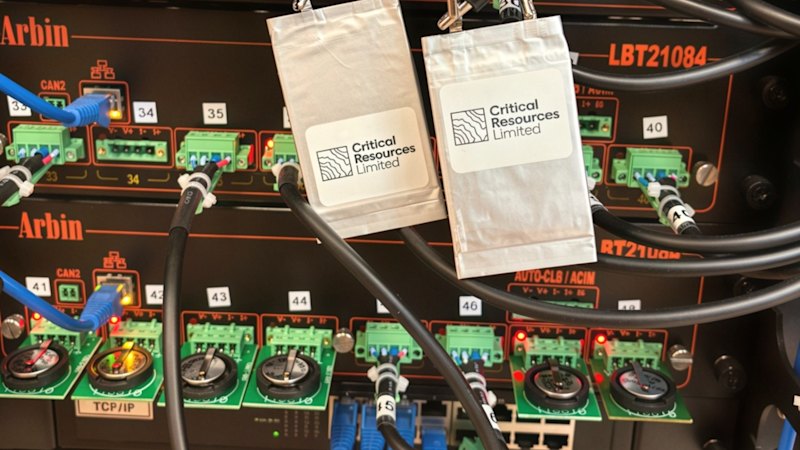
ASX-listed mining and technology player Critical Resources has chalked up a significant milestone in its solid-state battery program, with a full-format laboratory pouch cell holding firm for more than a month of continuous charge-discharge cycling.
The test cell was cycled at 0.2C – an industry-standard that involves a five-hour charge and a five-hour discharge and tests how well the cell holds its charge. The test delivered an initial specific capacity of a solid 145 milliamp hours per gram, a measure of the maximum electrical charge a battery material can store per gram of its weight during its first cycle. Notably, the cell maintained its characteristic lithium iron phosphate voltage level of between 3.4 and 3.5 volts throughout the test.
The hand-assembled test cell, built using the company’s solvent-free Dry Supersonic Deposition (DSD) manufacturing process, completed 780 hours of testing and retained 75 per cent of its initial capacity after 65 full cycles. The DSD process throws out the playbook, removing the solvent, binder and drying oven used in the conventional wet-slurry process. Instead, it accelerates cathode and electrolyte materials to supersonic speeds and deposits them dry in a single step.
Importantly, the company says the observed capacity fade, which was gradual through 55 cycles and more pronounced over 58-65 cycles, does not appear to be the limiting factor of its core DSD-deposited material. Instead, management has pinned the drop-off principally on the rough edges of its unoptimised cell build. Importantly, the cell never lost its electrochemical identity, as chemical failures show up quickly and are easy to spot.
Advertisement
‘Every battery manufacturing process in commercial use today has had to make this same journey.’Critical Resources managing director Tim Wither
The company says this indicates the capacity loss is an engineering challenge, not a fundamental material failure. It points to previous peer-reviewed results from its smaller coin cells, where the pure DSD-deposited LFP material held 85 per cent of its capacity over an impressive 500 cycles.
To isolate the performance of its DSD-built cathode, the company used two off-the-shelf reference components, a standard liquid electrolyte and a lithium-metal anode. A post-test inspection showed the DSD cathode remained stable and intact, while the lithium-metal anode showed heavy degradation, a well-known reaction when paired with a liquid electrolyte.
Critical Resources managing director Tim Wither said: “More than a month of continuous cycling in a full-format, hand-built laboratory cell, with the cathode chemistry active in every single cycle, is exactly the result this stage of the program needed. The results point our research scientists to the cell build and the reference components around our cathode – the liquid electrolyte and the lithium anode rather than the cathode itself.”
The result is a key step in the company’s scale-up path as it works to prove out a technology that could slash the cost and complexity of producing next-generation batteries. Dry-electrode processing is a major focus in the global battery industry because it removes the need for toxic solvents and massive, energy-intensive drying ovens, which could dramatically simplify manufacturing.
Advertisement
The evaluation program is being run at the South Dakota School of Mines & Technology within the US National Science Foundation-supported Centre for Solid-State Electric Power Storage.
With the core material’s durability demonstrated, the company says its focus now shifts to engineering optimisation. This will involve refining how the cell is put together, how it is initially prepared and how its key components interact. The work will run in parallel with a “Digital Twin” modelling collaboration with Australia’s national science agency, the CSIRO, designed to fine-tune the DSD process itself.
The next major technical step will be to replace the liquid electrolyte baseline with Critical’s own proprietary Amorphous Solid-State Electrolyte (ASE). The company has previously benchmarked its ASE material in a “superionic-class”, with conductivity of 3.2 millisiemens per centimetre – a measure of how fast the ions move through the electrolyte – putting it in the same league as some of the leading sulphide-class electrolytes, but without using sulphur.
The company’s business model centres on developing and licensing its intellectual property, rather than becoming a battery manufacturer. Each successful test de-risks the technology and builds a data package for potential licensees in high-value markets such as defence, aerospace and industrial infrastructure.
Critical holds an exclusive option over a portfolio of five granted US patents and one pending application developed at the South Dakota School of Mines & Technology, with new developments from the current program being protected by provisional patents.
Advertisement
Away from the lab-based battery evaluation, the company says it remains focused on a diversified critical metals portfolio, including its flagship Mavis Lake lithium project in Ontario, Canada, which hosts an eight-million-tonne resource grading 1.07 per cent lithium oxide. Additionally, Critical holds the Halls Peak base metals project in New South Wales and a developing gold exploration portfolio in New Zealand.
Now that Critical has demonstrated that its DSD-built cathode can keep ticking in a full-format cell for a month, the next steps appear clear. The focus shifts from proving the material works to engineering the package around it, a challenge with well-understood solutions. With each technical box it ticks, Critical appears to be steadily building the battery data package that could ultimately catch the eye of a future licensing partner.
Is your ASX-listed company doing something interesting? Contact: [email protected]
You have reached your maximum number of saved items.
Remove items from your saved list to add more.
More:
AdvertisementAdvertisement