
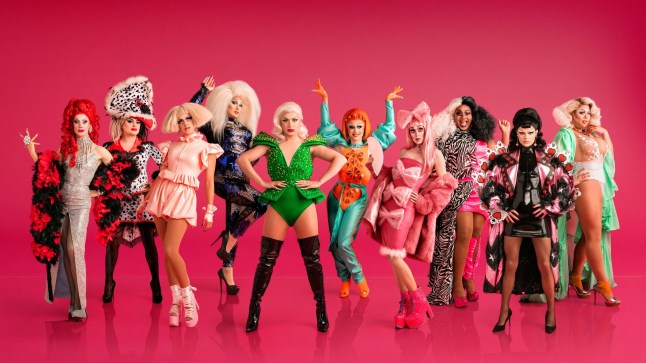
Few television shows can boast being as life-changing as Drag Race UK.
RuPaul’s reality TV juggernaut came and conquered British shores in 2019 after more than a decade of being a colossal hit across the pond.
It has undeniably done more for queer visibility on screen than anything before it – the world quite literally looks and feels different as a queer person because of the Drag Race franchise.
With countless drag brunches appearing around cities, the abundance of drag queens on television; drag has become more accessible, visible and lucrative than ever before.
But even for a queer person like me who has never set foot in a pair of heels bigger than one inch because I know full well it’s a black eye or concussion waiting to happen – I felt more attuned with my community and got a sense of belonging because of Drag Race.
Now I believe that the cancellation of its UK spin off is the biggest blow to queer television yet.
This majorly successful reality TV show about queer people comes from an established franchise and pulls the thread that binds the community together. I truly believe that it has taught me more about myself in eight series, than a lifetime of therapy ever could.
I’ll never forget when, in Season 2 of UK Drag Race, Ginny Lemon and Bimini Bon-Boulash discussed feeling like ‘outsiders’ while navigating their non-binary identities, and seeing floods of people say that their conversation helped them come out to their own families.
Personally, hearing so many stories from all walks of life taught me the important lesson that there is no one way to be LGBTQ+.
For so much of my life I’ve been so reliant on television to access queer people, with so few in my inner circle, I too felt like an outsider. I had no idea where I belonged, not quite feeling like any of my friends but not really understanding how to participate in the LGBTQ+ community either.
{“@context”:”https://schema.org”,”@type”:”VideoObject”,”name”:”Drag Race UK: Reason why RuPaul can’t get in touch with contestants”,”contentUrl”:”https://videos.metro.co.uk/video/met/2021/03/17/8868732870360583569/480x270_MP4_8868732870360583569.mp4″,”description”:”Drag Race UK: Reason why RuPaul can’t get in touch with contestants is due to remaining impartial.”,”duration”:”T16S”,”height”:270,”thumbnailUrl”:”https://i.dailymail.co.uk/1s/2021/03/17/17/40597218-0-image-a-1_1616000691579.jpg”,”uploadDate”:”2021-03-17T17:04:05+0000″,”width”:480}
Up Next
Previous Page
Next Page
window.addEventListener(‘metroVideo:relatedVideosCarouselLoaded’, function(data) {
if (typeof(data.detail) === ‘undefined’ || typeof(data.detail.carousel) === ‘undefined’ || typeof(data.detail.carousel.el_) === ‘undefined’) {
return;
}
var player = data.detail.carousel.el_;
var container = player.closest(‘.metro-video-player’);
var placeholder = container.querySelector(‘.metro-video-player__up-next-placeholder’);
if (placeholder) {
container.removeChild(placeholder);
container.classList.add(‘metro-video-player–related-videos-loaded’);
}
});
Drag Race was absolutely a gateway to helping me metaphorically touch and feel what it felt like to be in that community. It was affirming to see queer people hold each other, wrapping each other in their arms as they discussed their individual traumas or the families that abandoned them because of their identity.
For me, the most important part of Drag Race has been watching queer friends support each other; there has quite simply never been a stronger display of LGBTQ+ friendship that is real, impassioned and enduring.
I don’t know if I’d ever seen queer friendships like it until then, but now I’m surrounded by it all the time. Drag Race showed what it means for us to be allies to other identities within the community first and foremost – and now, allyship is stronger than it’s ever been.
Thank God, because at the other end of the scale our opposition – the homophobes and transphones – are more emboldened and determined than I’ve seen in my lifetime too.
But that allyship, between queer and straight people, is strong because of representation like in Drag Race. It has normalised queer language and culture, creating a connection that we’ve never had before.
Now cancelling the show will take that away from the community.
The production company behind Drag Race – World Of Wonder – has announced the spin-off of the show Drag Race UK: All Stars, which bring back queens from past series to compete against each other, will be available on the streaming service devoted to LGBTQ+ content.
But as exciting as that is, won’t get anything like the reach or impact it would have on the BBC.
POLL
Poll
What do you think about the impact of shows like Drag Race UK on queer representation?
-
They are crucial for visibility and understanding.Check
-
They have some impact, but more is needed.Check
-
I don’t think they make much difference.Check
If anything, it’s an even bigger kick in the teeth that the BBC wouldn’t even commit to ending its Drag Race chapter with the perfect swansong that an All Stars series would have brought.
Now, without Drag Race UK, this is the most concerned I’ve really been for queer representation on TV.
I hope I’m not confined to the one same-sex couple on Strictly Come Dancing every year.
Earlier this year, the BBC axed I Kissed A Boy and I Kissed A Girl, which was another seismic blow for the LGBTQ+ community. It’s hard to believe the broadcaster truly believes in the power of queer television.
I wonder if it’s a coincidence that the BBC has been facing increasing pressure from powerful right-wing voices and circles to soften its drive for LGBTQ+ television, or even better get rid of it entirely.
What It Feels Like For A Girl, the televised biopic of trans activist and author Paris Lees, was easily one of the best shows of this decade. And it was a success, getting glowing reviews and winning awards – proof that the BBC can make exceptional queer TV.
I can’t fault the BBC when it comes to queer drama and this was exceptional but reality TV, while it so often gets a bad rep, is arguably even more important for honest, authentic, and truly diverse representation.
Without the third series of the criminally underrated and utterly brilliant Smoggie Queens – a slapstick sitcom set in Middlesbrough that follows the lives of a fiercely loving LGBTQ+ chosen family – set for 2027, the BBC hasn’t announced any other queer television in the pipeline.
I don’t want us to be a tick-box exercise for television screens; I want us to be reflected accurately, proportionately and with the care we deserve.
Drag Race UK is that and then more; if its ratings have dwindled that’s on the BBC, not the format.
The quality of Drag Race UK has never faltered, in fact the only thing that appears to have changed is the BBC’s enthusiasm for it.
This is sad news, but I hope we get more queer shows out of it.
In the meantime, I’ll be streaming all seasons of Drag Race before they Sashay away.
Do you have a story you’d like to share? Get in touch by emailing [email protected].
Share your views in the comments below.
Comment now
Comments
Add Metro as a Preferred Source on Google
Add as preferred source