
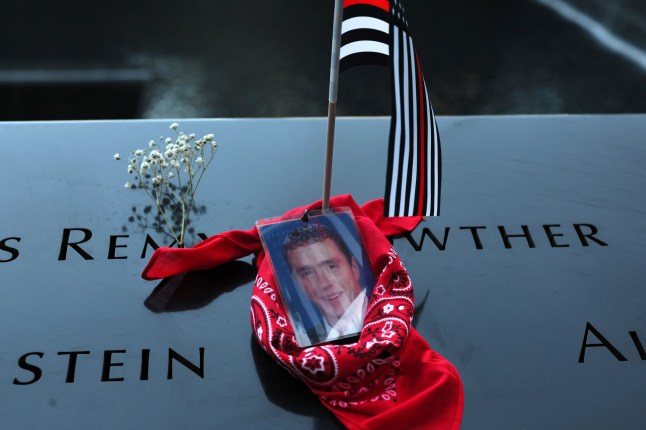
For months after the September 11 attacks, nobody knew the identity of the mysterious ‘red bandana man’ who repeatedly guided people to safety inside the South Tower of the World Trade Center.
The answer came when Alison Crowther read a newspaper article describing survivors’ encounters with the stranger.
The details were instantly familiar. The man they were talking about was her son, 24-year-old Welles Crowther.
An equities trader who worked in the South Tower, Welles made repeated trips through smoke-filled stairwells helping injured and trapped people escape before the building collapsed. He saved numerous lives but did not survive himself.
At the age of 16, Welles followed in his father’s footsteps, training to join the Empire Hook & Ladder Company as a junior firefighter.
The red bandana had been with him since childhood after it was given to him by his father, Jefferson.
It became a fixture of his life, and friends remember him carrying it with him everywhere for ‘messy things’.
When she asked him why he carried the red bandana, Welles replied: ‘With this red bandana, I’m going to change the world.’
Two years before he died in the South Tower, he graduated with a degree in economics from Boston College, where he was a keen player of lacrosse.
{“@context”:”https://schema.org”,”@type”:”VideoObject”,”name”:”New York City attacked on September 11, 2001″,”contentUrl”:”https://videos.metro.co.uk/video/met/2026/09/09/5634734759576748389/480x270_MP4_5634734759576748389.mp4″,”description”:”Thousands of people will gather in New York City, Washington and Shanksville, Pennsylvania, to mark the 25th anniversary of the attacks that killed nearly 3,000 people in 2001.nnIn New York, victims’ relatives will gather at the National September 11 Memorial Plaza for the annual reading of the names of those killed in the September 11 attacks and the 1993 bombing of the World Trade Center.”,”duration”:”T7M29S”,”height”:270,”thumbnailUrl”:”https://i.dailymail.com/1s/2026/09/09/11/111138393-0-image-a-1_1788949786832.jpg”,”uploadDate”:”2026-09-09T11:27:23+0100″,”width”:480}
Up Next
Previous Page
Next Page
window.addEventListener(‘metroVideo:relatedVideosCarouselLoaded’, function(data) {
if (typeof(data.detail) === ‘undefined’ || typeof(data.detail.carousel) === ‘undefined’ || typeof(data.detail.carousel.el_) === ‘undefined’) {
return;
}
var player = data.detail.carousel.el_;
var container = player.closest(‘.metro-video-player’);
var placeholder = container.querySelector(‘.metro-video-player__up-next-placeholder’);
if (placeholder) {
container.removeChild(placeholder);
container.classList.add(‘metro-video-player–related-videos-loaded’);
}
});
He hoped to join the New York Fire Department while building a career in finance, working for Sandler O’Neill & Partners, whose offices were on the 104th floor.
United Airlines Flight 175 struck between floors 77 and 85 of his building at 9.03am.
Nine minutes later, he called his mum and left a message that said: ‘Mom, this is Welles. I wanted you to know that I’m okay.’
That was the last time Alison would hear his voice.
Grieving their loss, the Crowther family had no idea what happened to Welles between that phone call and the collapse of the tower nearly an hour later at 9.59am.
That was until Alison read Judy Wein’s account of being saved by a man in a red bandana in The New York Times in May 2002 – two months after his body was found.
According to survivors, Welles had managed to get to the 78th-floor sky lobby where he found a group of people waiting for an elevator down.
Survivors said there were a group of 17 people from within or above the impact zone. Ling Young, who was badly burned, remembered seeing Welles with a woman on his back.
He guided them to a stairway that had not been blocked in the impact and escorted them 17 floors down to clearer air.
He dropped off the woman he was carrying and then went back up to the 78th floor, wearing his distinctive red bandana to breathe through the thick smoke.
Ling told CNN in 2003: ‘He’s definitely my guardian angel… because without him, we would be sitting there, waiting [until] the building came down.’
It was after that return trip that Judy Wein saw him asking for a fire extinguisher and tending to the injured before saying: ‘Anyone who can walk, get up and walk now. Anyone who can perhaps help others, find someone who needs help and then head down.’
Again, he led a group of people down the stairs. But instead of joining them, he went back up the stairs, the last time survivors reported seeing him, alongside FDNY firefighters.
His body was found in March 2002 near those of several firefighters. It is believed that he was helping them at a command post in the lobby as a civilian usher.
After his death, his family found an application form for the FDNY in his apartment.
In 2006, Crowther was posthumously named an honorary New York City firefighter.
His parents later established a charitable trust in his name, while Boston College continues to honour him through its annual Red Bandana Run and the nationally recognised Red Bandana Game.
In May this year, he was posthumously awarded the Presidential Medal of Freedom.
Welles’s bandana is now a monument at the National September 11 Memorial in New York. During his dedication of the museum, then-President Barack Obama said: ‘They didn’t know his name. They didn’t know where he came from. But they knew their lives had been saved by the man in the red bandana.
‘He tended to the wounded. He led those survivors down the stairs to safety, and carried a woman on his shoulders down 17 flights. Then he went back. Back up all those flights. Then back down again, bringing more wounded to safety. Until that moment when the tower fell.’
Judy Wein, who was saved by Crowther, said: ‘People can live 100 years and not have the compassion, the wherewithal to do what he did.’
Get in touch with our news team by emailing us at [email protected].
For more stories like this, check our news page.
Comment now
Comments
Add Metro as a Preferred Source on Google
Add as preferred source