
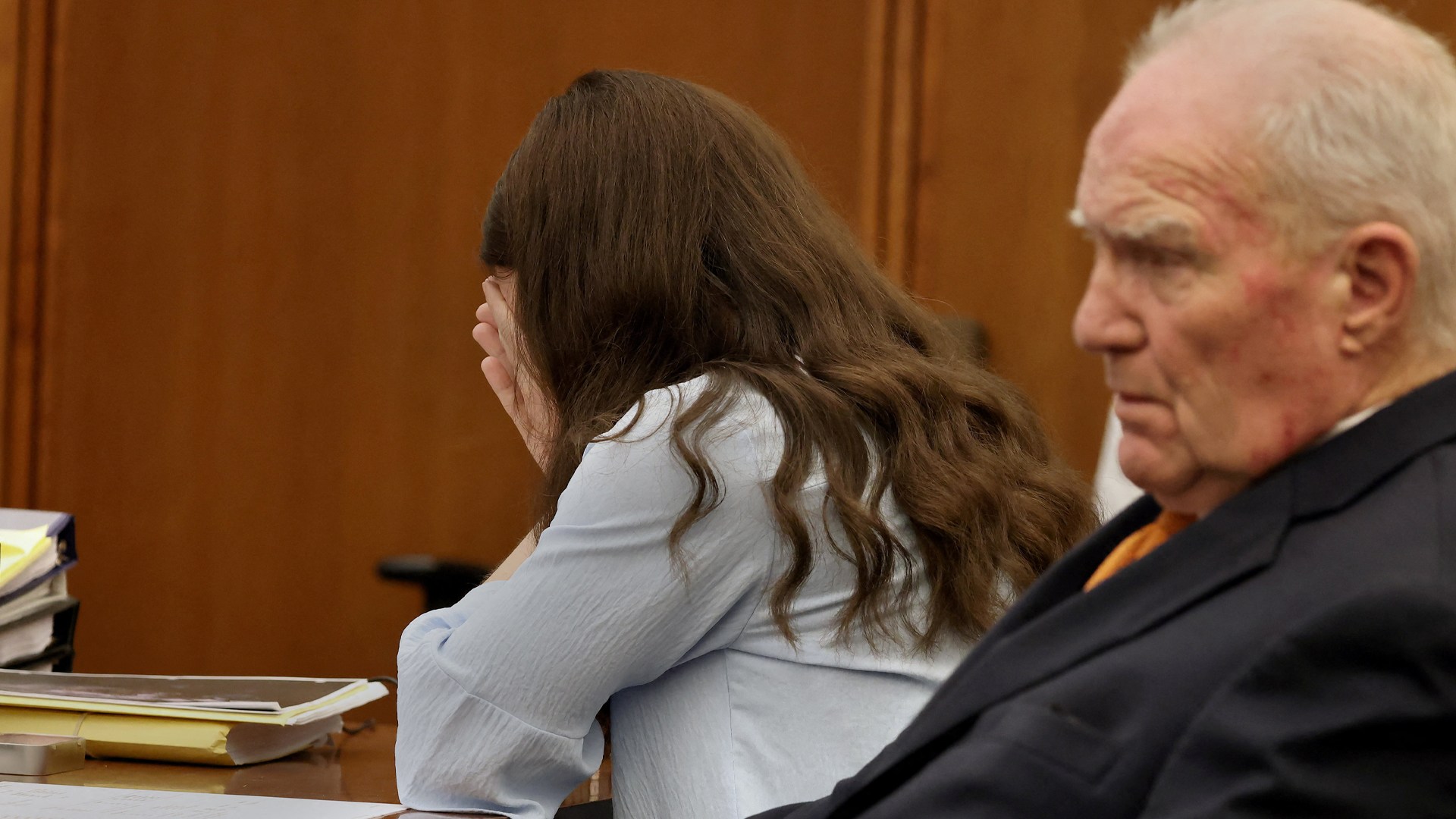
AWAY from the cameras and courthouse frenzy surrounding Lindsay Clancy’s sensational murder trial, I saw firsthand how the deaths of three young children had shattered a tight-knight community.
The killer mom’s case was inescapable almost as soon as I arrived in Massachusetts.
10
10
10
10
Shopkeepers, waitresses and even staff at the Hertz rental desk wanted to discuss the evidence and extraordinary attention surrounding the case, while several were frustrated by the wild internet conspiracy theories engulfing Clancy’s ex-husband Patrick.
I spent nearly two weeks covering the final stages of the trial, moving between Plymouth Superior Court and Duxbury, where the tragedy unfolded.
Once in the state, I headed straight to the courthouse and got there just minutes before Clancy’s defense attorney, Kevin Reddington, emerged to face a mob of reporters.
The scene was far more controlled than the frenzy it would become.
Read more on Lindsay Clancy
TRIAL AGONY
Lindsay Clancy jury’s hellish 6-week trial as 12 put lives on hold for 28 days
DEADLY INHERITANCE
Lindsay Clancy lawyer’s next case as woman accused of killing grandma
I’d already watched Reddington’s distinctive Boston “side-bahs” go viral, turning the veteran lawyer into an unlikely internet celebrity with memes.
Later, as the crowd thinned, I muscled in for some one-on-one questions as he walked towards his distinctive green Ford Bronco, its personalized “NG” plate shorthand for “not guilty.”
But some of the moments that stayed with me most happened away from the courthouse, on the quiet streets of Duxbury, where I pulled up as close as I could to the Clancys’ former home.
I had to park half a mile away and trek across the grass, with only rustling trees and the occasional car breaking the silence.
Most read in The Sun
BELGIUM PACT
Britain strikes breakthrough deal with Belgium to stop people smugglers
‘DANGER’
PC Harper killer is also sex offender – yet STILL deemed fit for early release
RESURGENT THREAT
Al-Qaeda is ‘stronger than before 9/11’ – & Britain is in its crosshairs
THE SUN SAYS
PM has taken two months to prove he’s as weak as Starmer on welfare & defence
I’d seen countless photographs of the house, but seeing it in person was completely different.
The large New England-style property sat behind a sprawling lawn and trees, but my thoughts immediately went to the basement where three young children had been strangled with exercise bands.
It made me feel sick to my stomach.
The house had already been sold a year after the murders, but standing there, it was impossible not to picture the ambulances and police descending on the street on January 24, 2023.
How could anyone make that room feel ordinary again?
Following the case from afar could sometimes feel like watching a Netflix documentary before one had even been made, complete with viral clips, memes, and competing theories.
10
10
10
10
But looking at the house, all of that suddenly fell away.
I then walked the neighborhood, speaking to people who had actually lived through what happened, including Mark Shortt, 62, who lives two doors down.
His neighbor’s son was among those who saw Clancy after she jumped from the second-floor window, and Shortt told me he believed she was severely mentally ill and belonged in a psychiatric hospital rather than prison.
A new homeowner whose property backed onto the house was unnerved to learn its history, until Shortt reassured him that serious crime was rare in Duxbury, where even a bar fight was unusual.
From the neighboring properties, I could see through the trees what appeared to be the eerie remains of children’s play equipment near the garden, as well as the window from which Clancy jumped.
Across the road, Ruth Hearson, 81, recalled four ambulances arriving that night and initially believing there had been carbon monoxide poisoning.
I also approached paramedics who were friendly but unable to talk, and watched the blood drain from their faces when I mentioned the trial, a clear sign of how deeply what they had witnessed still affected them.
Hearson told me some first responders had been traumatized: “The police, they were all traumatized. Coming down, seeing the babies, and some of them couldn’t go back to work.”
Most people I spoke to felt Clancy belonged in hospital rather than prison, but one woman opposite the house stood out, looking visibly disturbed as I asked questions.
She said: “I don’t have good feelings about her [Clancy], and what she did. I just want it over with. I don’t want to see her face anymore.”
Like the lone juror who would ultimately prevent a unanimous verdict, she was the exception.
I visited Kingsbury Club & Spa, where the children had gone swimming days before their deaths, and other places around Duxbury, finding many people following the case closely and believing Clancy was not criminally responsible.
As deliberations dragged on in Plymouth, the chaos outside the courthouse intensified, with Clancy supporters booing prosecutors and clashing with protesters.
When Reddington emerged each day, it was the biggest media scrum many of us had ever seen, as I fought to keep my microphone near him while trying not to fall into a concrete trash receptacle.
By the final day, the jurors looked like they had run a marathon and still had miles to go, having been sent back repeatedly to deliberate as they remained deadlocked.
When the judge read out their last message saying “with a heavy heart” that they were still unable to reach a unanimous verdict, the courtroom fell silent.
10
10
Eleven jurors had reached the same conclusion, but one would not budge.
The judge said he had no choice but to declare a mistrial, and gasps rang out around the courtroom.
In the back row of the jury, a woman dressed in pink closed her eyes and leaned forward.
Then, just as we thought it was over, Reddington was given an hour to take an emergency appeal to Massachusetts’ highest court, sending everyone back into limbo.
Reporters returned to the floor outside the courtroom, hammering out updates while constantly darting their eyes towards the door.
Supporters, many dressed in pink, crowded into the back of the floor, still waiting and hoping to get into court for the last moments.
When the appeal was rejected, we were called back in, and the mistrial was formally declared.
The jurors shook their heads as Clancy appeared to stare blankly ahead from her wheelchair.
After weeks of waiting for a verdict, there was a strange flatness to it all, with people looking completely crestfallen.
Reddington appeared disappointed but also as though he had done everything he could, sipping a Dunkin’ coffee and shaking the hands of Clancy’s family.
There was no conviction, no acquittal, and no final answer for the family after more than three years of waiting.
Then we spilled out of the courthouse into the blazing heat, gathering around the podiums as cameras and reporters jostled for position.
Reddington took aim at the lone holdout juror, claiming it had been an 11-to-1 split in favor of finding Clancy not guilty by reason of criminal responsibility.
I asked Reddington how Lindsay was.
“Not good,” he replied.
Tears filled his eyes as he described the former nurse as being like a daughter and said her family had been “robbed.”
But District Attorney Tim Cruz made clear the case may not be over, saying his priority remained to “fight for Cora, Dawson and Callan” as prosecutors consider whether to put Clancy on trial again.
As the cameras packed away, it was strange thinking that after six grueling weeks, we could all be back here again for another trial.
My thoughts returned to that quiet street in Duxbury, and to Cora, Dawson, and Callan, whose deaths changed everything for the families involved, the first responders who found them, and the community they left behind.
RECOMMENDED STORIES
If you or someone you know is affected by any of the issues raised in this story, call or text the 988 Suicide & Crisis Lifeline at 988, chat on 988lifeline.org, or text Crisis Text Line at 741741.