
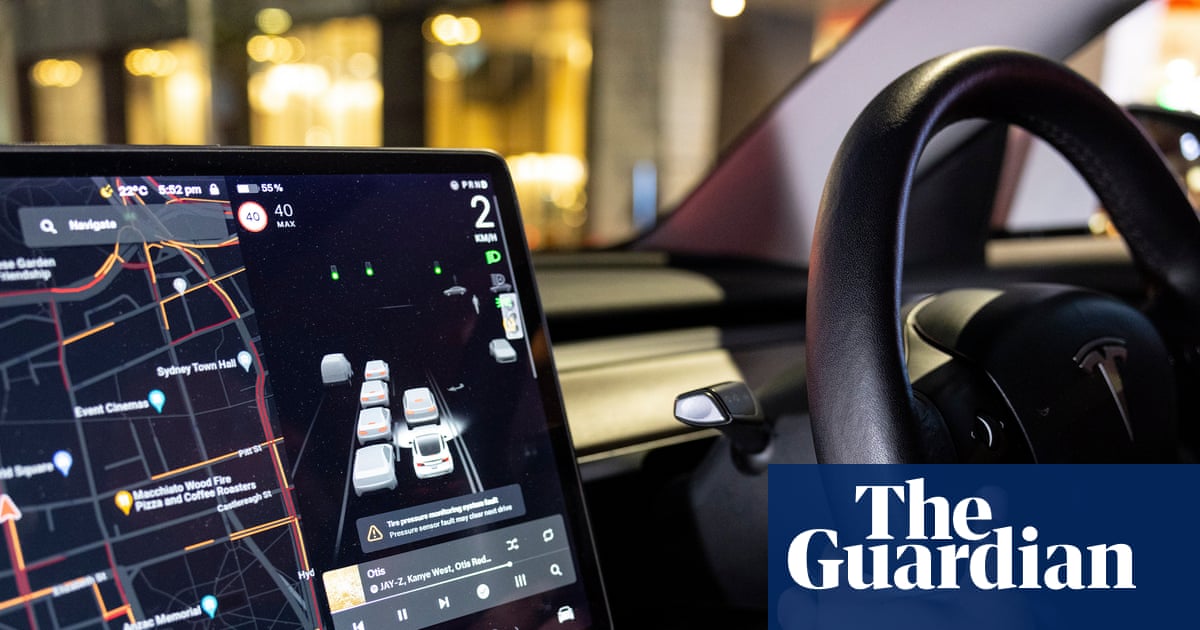
How one woman’s Tesla was remotely controlled – and used to harass her – by an abusive ex-partner
Enrico Pucci was able to control his former partner’s electric car remotely, controlling its speed, temperature settings and lock
Almost a year ago, Stacey* heard her Tesla car alarm sound on three occasions in the middle of the night.
By that point, the Sydney woman had suffered four years of domestic abuse by her former partner and disgraced businessman, Enrico Pucci. When the alarm sounded, she was “too scared” to go outside because she thought he may be damaging her vehicle, according to police documents tendered in court.
The next morning, the car appeared undamaged, but Stacey noticed its electronic dashboard had been reset and a “parental control” profile had been added.
Three days later, Pucci, now 50, followed her in a car and started to yell at her about a man she was dating.
“You thought you’d get away with this. I am in your car. I am in your maps,” he shouted at her, according to the police records.
Over the coming days, Stacey found that the parental control profile, to which she had no access, could almost entirely control the car, including its speed, climate control, lock and curfew hours, determining when the car could be driven.
Between 6 and 12 November 2025, Pucci remotely alternated the car’s temperature setting between extremely cold and extremely hot.
“The victim has not been able to drive certain speeds and on most recent occasions throughout this period, [the accused] has turned on ‘Valet Mode’ which immediately reduces the speed to 40km per hour causing significant safety issues for the victim on the road”, the police documents stated.
“The victim has not had any control of her vehicle since she noticed the parental control profile added on the 1st November 2025.
“The accused has been the only one with access to the vehicle’s controls utilising the Tesla app. This has caused the victim significant stress, mental harm and fears for her physical safety when operating her own vehicle.”
Last Wednesday, Pucci was convicted of 30 domestic violence related charges against Stacey, including using the Tesla car app to harass her.
Judge Peter Feather sentenced the Australian man to two years and three months before Parramatta local court in western Sydney, with a non-parole period of 15 months, after he pleaded guilty to the charges the week before a hearing scheduled in August.
During his sentencing remarks, Feather said Pucci had engaged in “abusive behaviour” towards his former partner over the course of four years. This included “multiple methods to dominate” the woman, including using the Tesla app to control her car, and forging fraudulent employment opportunities to “create dependency” while “also forcing her to pass up other opportunities”.
“When viewed cumulatively, [it] amounts to conduct that’s both coercive and controlling in nature, reflecting a pattern of behaviour designed to entrench power and compliance,” Feather said.
‘Everything went quiet’
The police documents detailed years of abuse. In an incident which led to a conviction of common assault, Stacey in March 2020 told Pucci she wished to separate while they were in the car with the victim’s two-year-old son.
“The accused threatened that would be the last time the victim sees her son if she ended the relationship,” the documents said. “The accused forcibly took her phone and typed a message to the victim’s ex husband stating that she could not care for her son and wished to give him up.”
“The accused forcibly removed the victim from her car and dragged her to a nearby pillar, pinned her against it and said ‘say goodbye to your son’. The accused drove off with the victim’s child, leaving the victim without a phone or a car.”
According to the documents, Pucci returned a few minutes later, then grabbed Stacey’s arm and said, “I hope you comprehend what will happen to you if you break up again”.
Separately, in 2021, after they were married, Pucci strangled Stacey to the point she recalled hearing gurgling noises and “fighting” for her life, the documents stated.
“Everything went quiet, and the victim blacked out,” the documents read.
“The victim believed she was going to die.”
Stacey purchased a Tesla car while they were still a couple, the documents said.
After having trouble navigating the technology, Stacey was offered help from Pucci, who said he would need the car to be registered in his name so “he could take control of the Tesla app to ‘assist her’”.
“The victim agreed, solely for the purpose of assistance with the vehicle technology,” the documents said.
In November 2025, a month after the relationship had ended, Pucci used Stacey’s Tesla car app to harass her, which fell under a charge of using a carriage service to stalk or harass.
This included seven attempts by Pucci to disconnect her car from its charging port via the Tesla app.
History of abuse
Pucci is appealing his sentence for the 30 offences, and is scheduled to face court again in late October.
The offences include eight counts of stalking or intimidation with the intention to cause fear or physical harm, six counts of common assault, two counts of choking a person without consent, one count of using a carriage service to threaten to kill and one count of using a carriage service to menace, harass or offend.
In 2017, the federal court found that a Sydney cleaning firm owned by Pucci had treated some vulnerable foreign workers as “slaves” after refusing to pay them for months and leaving them to go without furniture, food and critical medical treatment.
The fair work ombudsman secured a penalty of nearly $450,000 in the federal court against Grouped Property Services (GPS) Pty Ltd. Pucci, the company’s current owner and sole director, was fined $3,000 for firing a woman when she asked why she had not been paid.
His brother, Rosario Pucci, the former owner-operator of the company, was described by the federal court as being “intimately involved” in the exploitation and fined a further $74,300.
In 2022, ASIC disqualified Enrico Pucci from managing corporations for the maximum period of five years due to his “involvement in the failure of three companies”, which owed almost $10m to creditors.
*Name has been changed for privacy reasons.
Explore more on these topics