
Advertisement
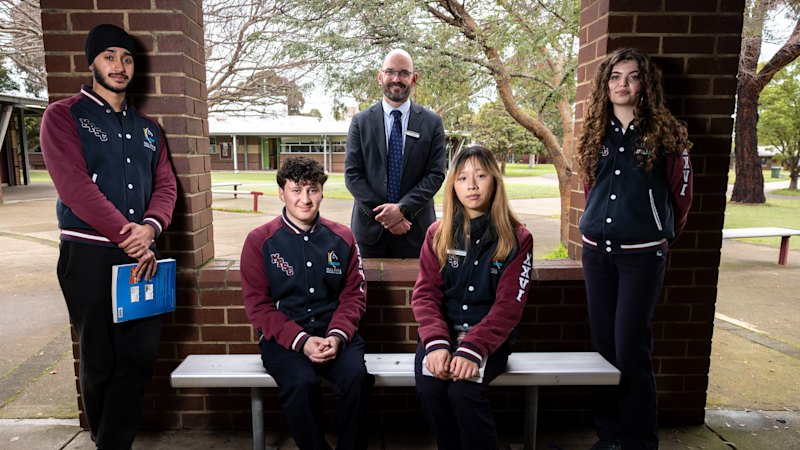
When principal Tim Natoli started at Mill Park Secondary College, the students were burnt out after prolonged coronavirus lockdowns, and their grades were slipping.
Natoli, who began working at the school in 2021, saw an opportunity to re-energise the place.
Under his watch, the school introduced a suite of changes: new trial exams, revision lectures, after-school assessment blocks, masterclasses and tutoring.
Five years on, academic results at the government school in Melbourne’s north show the shake-up has paid off.
Advertisement
Median VCE study scores and year 12 completion rates have both increased, giving the college’s principal the confidence to grant students more autonomy.
Natoli said Mill Park’s academic performance did not paint a picture of ambition for its students when he moved there from Eltham High in 2021.
“I was a bit shocked because all the indicators were low and declining, and it’s not far from where I live and work,” he said.
“There was low aspiration, low performance and not really a sense that there was much to be done about it.”
Advertisement
But since 2021, the percentage of Mill Park students completing VCE has been on an upward curve and 99 per cent of its students completed their studies last year, up from 94 per cent in 2021.
The number of students achieving a VCE study score above 40 has also increased, with 3.7 per cent achieving 40 or above last year, marking the school’s best result in 10 years.
The school has been named The Age’s 2026 Schools that Excel award winner for the northern Melbourne region, based on improvements in its VCE results over the past decade.
The annual series celebrates schools that achieve outstanding advancement in their VCE results.
Natoli said staff had set about creating a “sense of safety” and an “orderly positive environment” at the school.
Advertisement
“At the senior campus in particular, it was around raising aspiration and the academic emphasis,” he said.
Last year’s VCE results show that something is working. There were 19 study scores of 40 or above, including four in health and human development and two in English.
Mill Park achieved a median study score of 26 for the past three consecutive years, lifting it from between 24 and 25 in 2016 and 2022.
VET completion rates at the school have also improved, going from 65 per cent in 2022 (VET completion data was not published in 2021) to 93 per cent last year.
Natoli said students were now given more independence in their spare sessions and encouraged to spend those lessons in the study centre.
Advertisement
“We changed up the level of trust in students and put more onus on the students, but also more resources in there to support them,” he said.
At its peak, Mill Park was a big school, with almost 1800 students enrolled in 2008. It now has just under 1000.
The opening of Marymede Catholic College in 2006, which now has more than 2460 students and is less than four kilometres away in South Morang, accounts for some of the change.
St Monica’s, about five kilometres to the west, and Loyola College, about 10 kilometres to the south, also Catholic schools, have grown significantly since 2008.
Advertisement
Natoli said the year 7 intake had dropped to about 140 kids in 2023. This year, they’ll enrol about 220.
He said that watching the results slowly trending upward over the years had taken patience, but all recent indications were that the changes had paid off.
“It’s about lifting that sense of academic emphasis and what the expectation is around the school,” Natoli said.
Year 12 student Scarlett Yaziji plans to further her study next year and has her sights set on a bachelor of arts degree at the University of Melbourne.
Yaziji chose five VCE subjects in 2026 after completing year 12 health and human development last year as one of the school’s high achievers.
Advertisement
She said keeping a routine and having a “clear space” to study even when her family were busy around her helped her focus.
“I need structure more than anything. It’s not so much the procrastination I struggle with. It’s more so just preventing burnout,” Yaziji said.
Yaziji is a voracious reader, and she said her teachers often reminded her to stay engaged with her hobbies, like her passion for books, to ensure she had some school and life balance throughout the year.
She said the external coaches the school had brought in to teach students healthy study habits had also helped take some of the stress out of year 12.
Advertisement
Mill Park’s teachers had supported her by always making themselves available, and she was looking forward to graduating, Yaziji said.
“I’m a bit anxious about exam period, but mostly just excited,” she said.
Read more of our education coverage:
- Schools Guide: See performance data for schools in your area
- Schools that Excel 2026: Find your school’s VCE results
- Melbourne’s east: Separating boys and girls delivered record VCE scores
- Melbourne’s south: One morning ritual transformed this public school’s results
- Regional Victoria: Students come from across the world to this school
Start the day with a summary of the day’s most important and interesting stories, analysis and insights. Sign up for our Morning Edition newsletter.
You have reached your maximum number of saved items.
Remove items from your saved list to add more.
More:
Alex Crowe is an education reporter for The Age.Connect via X, Facebook or email.Craig Butt is the National Data Editor of The Age and The Sydney Morning Herald.Connect via X, Facebook or email.AdvertisementAdvertisement