
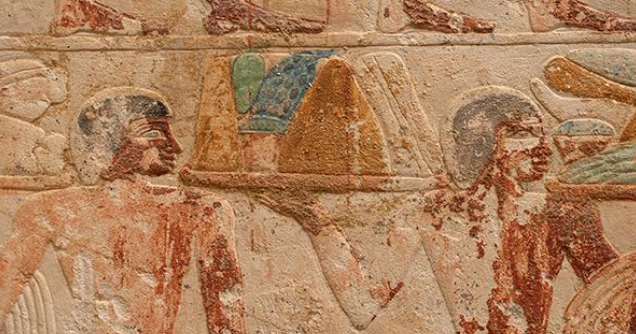
An Egyptian-Spanish archaeological mission has uncovered a 4,300-year-old tomb near Cairo belonging to an ancient judge and his father, local authorities said.
The tomb was found at Saqqara, a sprawling necropolis south of the capital, and dates back to the reign of Pharaoh Djedkare Isesi, one of the most influential rulers of Egypt’s Fifth Dynasty who oversaw a period of administrative reform in the 24th century B.C., the Egyptian tourism and antiquities ministry said.
It was built for Yunmen, a high-ranking official whose duties included listening to the appeals of the kingdom’s subjects and weighing their complaints before the state.
Amr al-Tayeb, director of the Saqqara archaeological site, told AFP that Yunmen’s duties “align with the ancient Egyptian concept of Maat,” the goddess and principle of truth, justice and social order.
The find was discovered during this summer’s excavation season in the Mariette Cemetery area of northern Saqqara, as part of a long-running joint project by the Autonomous University of Barcelona and Egypt’s Supreme Council of Antiquities.
The newly discovered mastaba, a flat-roofed tomb typically built for elite officials, contains two funerary chapels: one for Yunmen and the other for his father, Ity, a senior scribe responsible for overseeing agricultural lands and offerings.
Yunmen’s chapel is adorned with finely carved reliefs depicting farmers at work, servants carrying offerings and scenes associated with funeral rites. Many of the paintings have retained their original colors despite spending more than 40 centuries buried beneath the desert sands, the ministry said.
“It features exceptionally well-preserved scenes,” the ministry said on social media, while posting several images of the site.
Archaeologists also uncovered an ornate facade covered with funeral inscriptions, alongside formal depictions of the tomb’s owner.
In the neighboring chapel, dedicated to Ity, traces of painted offering scenes survive, alongside a false door, a symbolic gateway through which the dead were believed to receive sustenance from the living.
The discovery comes as Egypt seeks to promote new archaeological finds to support tourism, a key source of foreign currency for the country.
In November, Egypt’s government hosted dozens of foreign leaders and dignitaries as it held an official opening ceremony for the Grand Egyptian Museum, a $1 billion project decades in the making.
The plan was originally for the museum to open in 2010, but a series of events, including financial crises, political uprisings, the COVID-19 pandemic and regional wars, delayed the curtain raising.
contributed to this report.
In: