
Advertisement
September 8, 2026 — 6:00pm
You have reached your maximum number of saved items.
Remove items from your saved list to add more.
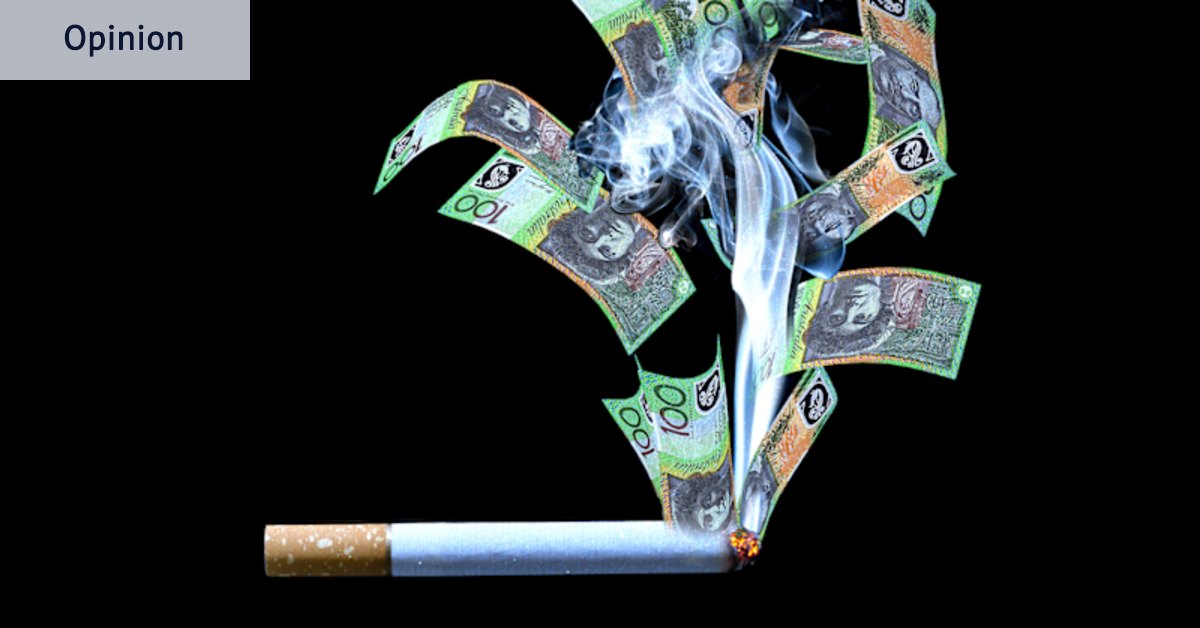
Six years ago, the Commonwealth collected $16.3 billion in tobacco excise. That figure will have collapsed to $4.1 billion this year, Treasury estimates, and by the end of the decade it’ll be just $2 billion. Meanwhile, investigations of wastewater by the Australian Bureau of Statistics suggest that since 2017 nicotine consumption (including from illegal vapes) has increased by 40 per cent.
Let’s face it: the mafia has won the tobacco wars.
The Commonwealth now faces competitors in the form of black market shops on every second suburban strip. Those competitors have 80 per cent market share to the Commonwealth’s 20 per cent. The Commonwealth is a bit player now with the main field of competition between the black market suppliers – and that is why we have seen more than 200 firebombed tobacco shops in Victoria alone.
Let’s be clear about who we are dealing with. Organised crime is run like a business. It has suppliers, logistics, retail outlets and market share estimates. Its product costs a couple of dollars to make and sells for $15 to $20 against a legal price of $40 to $50, of which about $30 is tax. It responds to margins as any firm would, and uses arson the way a legit business uses advertising.
Advertisement
Imagine an organised crime business watching its revenues fall from $16 billion to $4 billion. It would not have watched. It would have organised itself so that the leak was noticed early and made sure that people who could stop it were rewarded for stopping it. If you are going to fight the mafia, you need to think like the mafia. That means thinking like a business, and thinking about incentives.
Ours are wrong. The Commonwealth sets the tax and collects every dollar. The states run the police, the inspectors, the licensing schemes and the courts that actually determine whether the tax gets paid. The states bear all the costs of closing down the mafia but get none of the revenue. Preventing an illegal sale sends $30 to Canberra of which the state governments in Spring and Macquarie Street get nothing. What Spring/Macquarie Street do get is the costs of enforcement: a police taskforce, a licensing bureaucracy, more cops on the beat, more time taken up in courts and space taken up in remand/prison. The revenue they would protect belongs to somebody else.
Nobody should be surprised at what has happened. The Commonwealth kept lifting the tax rate implicitly assuming the states would “do their job” of enforcement without giving them any incentive to do so. The states treated illicit tobacco as somebody else’s problem until the arson made it theirs. The Commonwealth’s answer has been grants, around $98 million so far to fund enforcement costs against a black market worth billions a year. A grant changes a state’s budget but not its incentive. Unless strings are attached, a grant arrives whether or not the enforcement works.
No crime boss would run a territory this way. A boss who set the price but relied on local crews to collect it would make sure they kept some of the proceeds. Each crew gets a cut of its own turf, so that every dollar of leakage is felt where it can be stopped. Legitimate business does the same with its branches. The Australian manager of Toyota is incentivised by Tokyo to sell Toyotas – they don’t just assume the Australian manager will do his best, they monitor and reward them based on performance.
Advertisement
The same should have been done, and should still be done, with tobacco. Give each state a share of the excise attributable to legal sales in its territory. Even a quarter share makes every illegal packet a state shuts down worth $7.50 to its own budget. The police taskforce stops being a cost centre and becomes a revenue driver. Both governments would be looking at the same ledger, which is where the mafia has been looking all along.
Would this have prevented the rise of the black market? Not entirely; a $30 tax on a $2 product invites evasion under any regime. But the black market would have been smaller, noticed earlier and fought by the governments able to fight it, instead of Canberra blaming enforcement while the states blame the excise.
So, should the excise be cut? That depends on what we are trying to achieve. If the only objective is to destroy the illegal market, then yes: slash the tax. Liberal leader Angus Taylor’s proposed 80 per cent cut (taking the tax on a packet from about $30 to $6) would probably do it. The black market would not vanish, but with legal packets selling under $20 the mafia’s margin shrinks from irresistible to barely worth the arson. Under this strategy we beat the mafia by matching its prices. That works, but it surrenders the health policy objective – which needs a high price.
The excise alone cannot deliver the health policy objective because smokers don’t have to pay the legal price, they can choose the lower price on the street. The federal excise sets the price of a legal packet. Enforcement by the states sets the price of an illegal one. Ideally, it raises the mafia’s costs of illegally importing, warehousing and retailing tobacco until the discount they offer isn’t enough for the consumer to risk buying products from a criminal. A high excise with weak enforcement doesn’t make cigarettes expensive; it just lets the mafia collect the tax. So a serious anti-smoking policy needs both: a high excise, and enforcement strong enough to keep the street price close behind it. And the most efficient way to fund that enforcement is to give the states a cut of the excise – and skin in the game.
Advertisement
Dr Tom Hird is an economist and the founder of CEG Asia-Pacific.
The Opinion newsletter is a weekly wrap of views that will challenge, champion and inform your own. Sign up here.
You have reached your maximum number of saved items.
Remove items from your saved list to add more.
More:
Dr Tom Hird is an economist and the founder of CEG Asia-Pacific.AdvertisementAdvertisement