
Still boldly going — meet the Irish ‘trekkies’ celebrating 60 years of Star TrekOn the anniversary of its first episode, Jonathan deBurca Butler talks to Irish ‘trekkies’ about the enduring success of the sci-fi show Tue, 08 Sep, 2026 – 14:16Jonathan deBurca Butler
It’s been 60 years since Star Trek boldly went where no show had gone before, causing a sensation on NBC and giving birth to a legion of dedicated fans who later became known as ‘Trekkies’.
While that first episode, The Man Trap, aired in the US on September 8, 1966, might be viewed today as quaint, it sparked a sci-fi franchise that was groundbreaking for its time. It took four years before it was broadcast in Ireland, and it has remained part of the culture ever since, through various iterations on TV and the big screen.
“I’d never seen anything like it,” says Gary Reynolds, Trekkie and co-founder of Star Trek Éire. “I was about six or seven when I saw The Man Trap. It was so bright and colourful, and that drew me in as a child. It was fantastical and magical. I didn’t grasp the sci-fi side of it fully at that age. But it drew me in, and I wanted to see more.”
By the time he got to college, the Dubliner had consumed everything related to the show, and around the same time he met three like-minded individuals who shared his passion for the trials and tribulations of stoic galactic explorers.
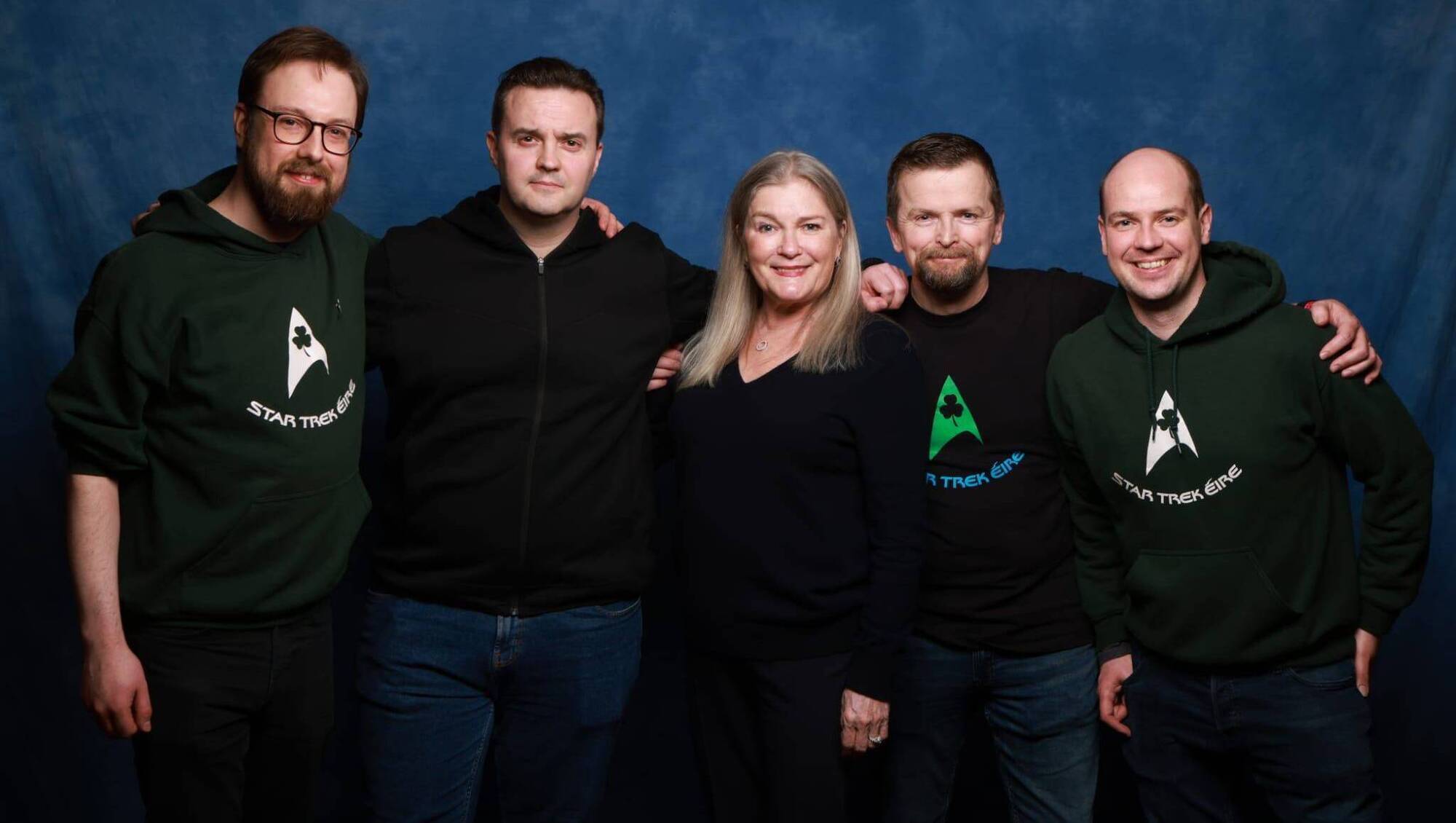
“Star Trek Éire really started as a place for Trekkies to meet,” says Gary. “We liked the idea of having a get-together, nothing major, just a bit of fun, and it carried on from there.”
Though it is not an official fan club, Star Trek Éire has hosted some remarkable events over the years and facilitated meet-and-greets with some of the stars of the show, including Marina Sirtis who played Counselor Troi in The Next Generation, Kate Mulgrew who starred as Captain Kathryn Janeway in Star Trek: Voyager, and Terry Farrell who played Jadzia Dax in Star Trek: Deep Space Nine, alongside our very own Colm Meaney.
Meaney played Chief Miles O’Brien, head transporter operator, in The Next Generation and chief of operations in Deep Space Nine. Though he started as a peripheral figure, O’Brien’s character developed through both series.
“There was a terrific kind of humanity in O’Brien,” said Meaney in a recent interview. It was a quality that fans responded to, and Meaney’s Killarney-born character appeared in no fewer than 225 episodes. While O’Brien’s portrayal of ‘Irishness’ was largely positive, other representations were more questionable.
One episode, Up The Long Ladder, featured a colony of spacefarers from the planet Bringloid V who wore agrarian clothes, drank heavily, and spoke with exaggerated Irish accents. Many fans and critics called the depiction a lazy collection of offensive clichés, and Meaney himself, though in it, openly criticised the episode.
A later depiction, in Star Trek: Voyager, featured a recurring holographic simulation of a 19th-century Irish village called Fair Haven which, though intended as a warm, comforting getaway for the crew, leaned into the old Hollywood tropes of rural Irish life.
Then there was Commander Data’s reference to Ireland’s “2024 unification” in an episode of The Next Generation, which was released in 1990 and ended up being banned by the BBC and edited by both Sky and RTÉ.
“It was a mixed bag,” says Gary. “Chief O’Brien was a positive portrayal of an Irish character, but Up The Long Ladder was notorious for its portrayal of drunks carrying pigs and barefoot children chasing chickens sleeping in hay bales. It wasn’t a nice thing to see. But they carried it through, and it got better over time.
Even the Fair Haven episodes in Voyager, the portrayals were a bit hokey, but it was nothing negative. Chief O’Brien was the stalwart.
The original Star Trek series was created by Gene Roddenberry, a Texas-born policeman’s son who flew over 50 combat missions in the Second World War. When Roddenberry returned home, he followed his father into the police force, where he put speeches together for the LAPD. To supplement his income, he wrote television scripts, and was soon able to indulge his passion for it full-time.
The original series ran on NBC for three seasons from 1966 to 1969, and even back then, its creator wanted to do more than simply entertain.
“Essentially, it’s about where can we go, where can humanity go,” says Ciarán McNulty, co-founder of Star Trek Éire. “Its jumping-off point assumes that humanity gets it together in the next couple of centuries, then it uses other alien races as thin disguises for modern human problems, as a metaphor for issues.
In the 1960s, when it first came out, its creator Gene Roddenberry did refer to them as morality plays. And essentially, they teach fairly broad human lessons overall. It’s basic right and wrong at the end of the day. It always knew what it was, in that sense.
Ciarán, who was born and raised in Dundalk, Co Louth, says while he was always a sci-fi kid, he was more of a Star Wars fan. Star Trek was a slow burn.
“ Star Trek went over my head a little bit at the start,” he recalls. “It wasn’t until I got into my 20s, when I was a bit more socially and politically aware, that I started to watch it and think: ‘Oh wow! This has a lot to say’.”
For Gary Reynolds, Star Trek represents “hope for the future”.
“For me, hope is the central message of Star Trek,” says Gary.
That we, as a society, will get past all our petty differences and, once we do, we will be worthy of going into the stars and exploring.
“That’s what Gene wanted to portray,” he explains.
“When he wrote it in the ’60s, he had an American, a Kenyan, a Russian, and a Japanese guy all on the same bridge working together.
“This was 20 years after World War Two, amidst the Cold War and the civil rights movement in the States. There was even an alien in Spock, as a representation of someone different. They all worked together.
“We’re 60 years on, and society still hasn’t got past all that. Some say it has gotten worse. But we will get there eventually.
That’s the hope, and that’s why Star Trek matters. It gives the rest of us something to work towards.
Now that really would be to boldly go where no-one has gone before.
Read More
‘It’s crying out for a film’: The most audacious Irish escape you’ve never heard of
‘I count my lucky stars’: Cork’s Alex Murphy on Young Offenders success ahead of film’s re-release
x
185th Anniversary Offer
Six months of digital access for €18.50
Already a subscriber? Sign in
No obligation. Ts&Cs apply.
5 For Your Radar: John B Keane play, Kyla Cobbler, Oasis film
10 new TV shows for September: The Gentlemen, Slow Horses, and the Brennan brothers
Irish entertainment and media sector to grow to €8.2bn by 2030
More in this section
Monty Don to leave Gardeners’ World after 23 years
First look at Cork-set Boys of Tommen series starring Nancy Surridge and Conor Sánchez
Macklemore responds to call for removal from Ed Sheeran tour over Gaza comment
#Film & TV