
Advertisement
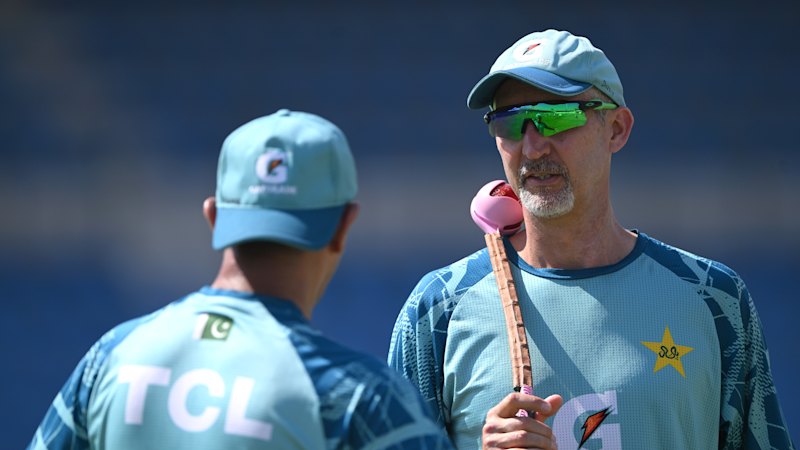
As Pakistan’s tour of England descended into chaos over the past fortnight, you could forgive Jason Gillespie having a rueful smile. After all, if anyone knows about the somewhat dysfunctional nature of Pakistan cricket, it is the Australian great.
Gillespie was appointed Pakistan’s head coach in April 2024 but resigned in December that year, and the scars of that time are still fresh. Among those in his sights are the Pakistan Cricket Board (PCB) itself, and in particular Aaqib Javed, the chairman of selectors.
It meant that he was unsurprised at recent events, namely Pakistan axing seven players and a number of coaches after back-to-back defeats at Headingley and Lord’s. A handful of those discarded players were then ordered to Clarence House last week to meet the King amid fears a low turnout would embarrass the country’s cricket board.
It all served to sum up the bizarre nature of Pakistan cricket, but Gillespie admits he went into the role with his eyes wide open.
Advertisement
“I was warned about it, absolutely,” Gillespie says regarding being made aware of the volatile nature of Pakistan cricket before joining as head coach.
“Coaching Pakistan was going to be one of the highlights of my coaching career, to coach a big international team. Pakistan is a country with a rich cricket history, with people who live and breathe the game, and I was afforded the chance to coach the country. I was honoured. I was so grateful for the opportunity.
“I was warned that it would be volatile and chaotic. But I was at a point in my career where I was looking for a little bit of a change and a new challenge. The Pakistan job came up out of nowhere, and I just felt it was an opportunity that was there to take. I felt that I could help the Pakistan Test side get better.”
Before joining Pakistan, the vision presented to Gillespie was that he was to be key in reviving their longstanding reputation for producing great fast bowlers. However, he believes the direction changed following the appointment of Javed.
Advertisement
“When I came on board, they wanted to bring back fast bowling,” he says.
“This is what was sold to me when I took on the role. They wanted to prepare surfaces that would bounce and carry and would encourage fast bowling because they felt that fast bowling was dying. I was on board and thought: ‘This is going to be really cool.’
“The appointment of Javed fundamentally altered the landscape,” he adds. “From that moment, my relationship with Pakistan cricket completely changed. Aaqib came in and took over. It appeared to me that he was in charge of absolutely everything.
“I went from looking after the Test side, managing that and looking after the players and the staff and having a role in selection to then absolutely no role in anything.”
Advertisement
Gillespie also reveals that the experience of working with the PCB left him questioning himself and doubting his future in cricket coaching.
“The whole experience just deflated me and put me off coaching. It affected me mentally, doubting myself and left me thinking whether I still wanted to be involved in the sport,” Gillespie says.
“I was totally disrespected and undermined, and I direct that towards Aaqib Javed.
“At our first meeting he came in with bravado, bluff, and bluster, wanting to show he was the man in charge. He said: ‘This is what we need to do.’ I listened and said OK. But this kept on happening, and I pushed back on a couple of his comments. I just felt from that moment on that it wasn’t going to work because he’d already decided what he was going to do. There was going to be no collaboration whatsoever.
Advertisement
“Aaqib had the support of the chairman and the board and that’s why he felt he was untouchable.
“As a coach, you feel compromised. He was not a collaborative chairman of selectors. He doesn’t take on other people’s ideas, thoughts, or opinions. He might think he does, but he doesn’t. It was his way or the highway.
“He just does what he wants because he is allowed to [because of] his close relationship with the chairman. That’s not an environment that I wanted to work in or be a part of. I don’t know many self-respecting people who would want to work in that environment.”
Gillespie, 51, also rejects criticism from Javed regarding the amount of time he and Gary Kirsten, the former white-ball head coach, spent in Pakistan.
Advertisement
“I know Aaqib came out and criticised me and Gary about our contracts and how we weren’t spending time in Pakistan,” Gillespie says. “What I will say is that it’s absolutely none of his business what our contracts with the PCB were, and it’s another example of his constant interfering.
“Gary and I were both more than willing to spend time in Pakistan. We talked about spending time for training camps, watching domestic cricket, and preparations for the series.
“When you split the coaching roles, and you have two coaches, and there’s downtime, of course you’re going to have times when the foreign coaches will want to go home for periods of time, especially if there’s no cricket being played.”
In one of his most cutting remarks, Gillespie says his admiration for Javed as a player disappeared after working alongside him.
Advertisement
“I grew up watching and admiring Pakistani fast bowlers. I loved Wasim, I loved Waqar, I loved Aaqib,” he says. “They say never meet your heroes, right, and Aaqib Javed for me is a really good example. I met Wasim, I met Waqar, I loved them. I met Aaqib and I didn’t feel it at all.”
Gillespie also has advice for Mike Hesson, the current Pakistan white-ball head coach, who has been seconded to take over the Test side from Sarfaraz Ahmed for the match at Edgbaston, warning him not to compromise his principles.
“My advice to Mike would be trust your instincts and don’t be a yes-man,” he says. “I know him, he’s a great guy and I think he’s an excellent coach. I hope he just doesn’t get caught up in all this mess just because he’s happy to accept a pay cheque.”
The Australian claims he was still owed substantial money by the PCB but refused to change his approach just to remain in the role.
Advertisement
“The PCB still owes me thousands of dollars, but I was never going to be a yes-man,” he says. “I wasn’t going to compromise on my principles; I never have throughout my career, and I certainly wasn’t going to change. I could have stayed quiet, agreed to everything and taken home my salary, but that’s not me, and part of me knew I was probably going to be sacked in a couple of months anyway.”
Gillespie further alleges that during most of his eight months in the job efforts were made to undermine and replace him.
“I knew Aaqib was sniping around behind the scenes,” he says. “That’s just who he is and the way he works. People in Pakistan cricket told me that Aaqib was sniping me behind my back.
“I’m sick of him talking negatively about me. If he continues to do it, then I’ll start looking at taking legal action about that.”
Advertisement
He believes Pakistan cricket remains trapped in a damaging cycle and lays the blame at the feet of Javed.
“It’s heartbreaking for me to see what’s going on now; it’s a mess,” Gillespie says. “I know the crux of it. It’s Aaqib Javed. He is the problem, and as long as he is there, then Pakistan cricket will continue to go backwards.
“They need strong leadership from strong cricket people. Get the right coaches in place and let them decide on what the leadership is going to be. You get chairman and people at the board sitting at desks picking the captain, it’s nonsense.
“Get the right coach in, allow him time to let the dust settle, and then allow him to pick the captain and go from there and rebuild Pakistan cricket and take it forward, because at the moment it’s going nowhere.”
Javed and the PCB have been approached for a response.
The Telegraph, London
You have reached your maximum number of saved items.
Remove items from your saved list to add more.
More:
AdvertisementAdvertisement