
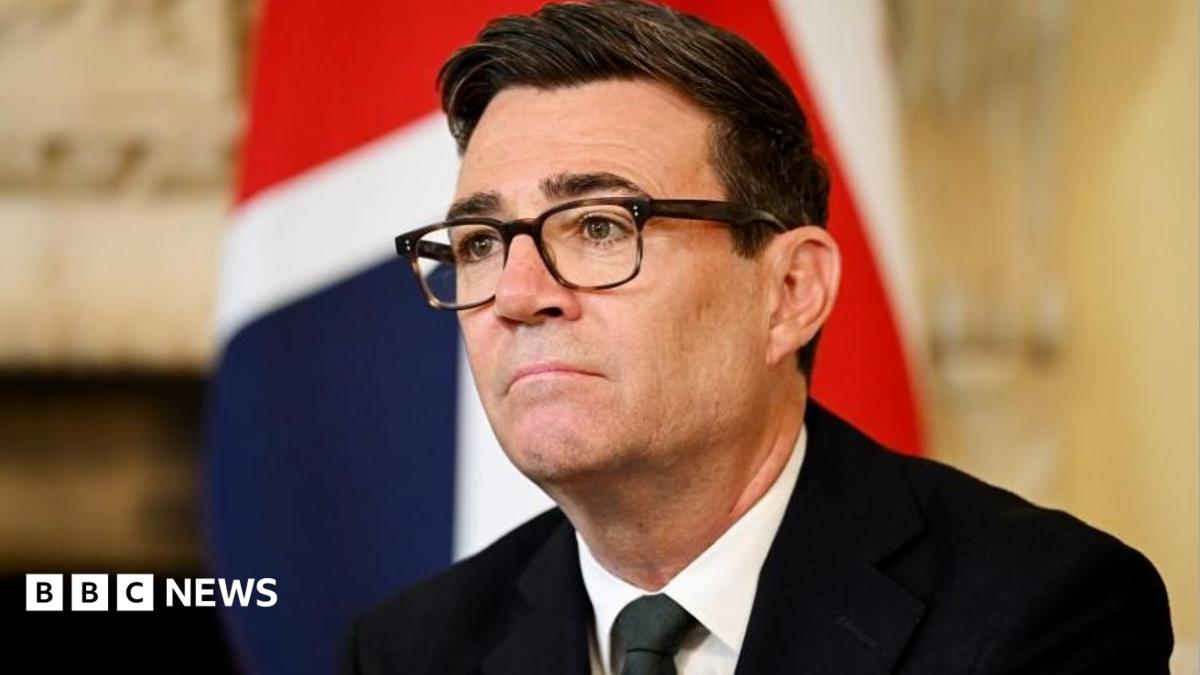
Image source, PA MediaByChris MasonPolitical editor
- Published23 minutes ago
There is little doubt that the UK’s decision to ban imports from Israeli settlements in the occupied West Bank is another significant shift in Britain’s posture in the Middle East.
The announcement from the Foreign Secretary Ed Miliband, with the Prime Minister Andy Burnham alongside him in the House of Commons, comes almost exactly a year after the UK formally recognised a Palestinian state. And it comes garnished with blunt language about Israel’s conduct.
This latest announcement is both a logical extension of that decision of 12 months ago, senior figures argue, but also, in words and actions, an expression of Burnham’s desire to go further than his predecessor Sir Keir Starmer was willing to.
It is, Miliband believes, a re-assertion of the logic of eventually arriving at a two-state solution – a viable Palestinian state alongside Israel.
The foreign secretary passionately argued that the UK did have agency and could act – and to do nothing would amount to failure. “A strategy of passivity in the face of what is happening is not a strategy,” is how Miliband put it in an interview with Jewish News, external.
There is a pride among his team that after a diplomatic effort over the summer, there is a breadth to the coordinated international action on this, with 11 other countries, including France and Canada, sharing the same approach.
“We provided a convening and coordinating role in pulling this together,” one source told me, “but we didn’t have to convince others to do this. They were coming to the same view themselves, so we agreed we should all go out and say this at the same time.”
The hope is that coordinated action increases the likelihood that the measures will have an impact and minimises the blowback to any one country from Israel or America.
UK officials had anticipated one likely reaction from Israel would be the enforced closure of the British consulate in Jerusalem, which has indeed happened.
And while there is a weary acknowledgement that no one can be certain what President Donald Trump might say next about anything ever, it is noted in Whitehall that the initial reaction of the US Secretary of State Marco Rubio was pretty understated.
Image source, House of Commons
As for the domestic political context, plenty in the Labour movement and the wider British left have long clamoured for this to happen.
Around 140 Labour MPs went public with this demand at the beginning of the summer, and Burnham was explicit in his criticism of his predecessor’s approach to the Middle East, writing in July: “Labour’s initial response to the treatment of Gaza caused huge hurt. We got it wrong and I am sorry about that.”
In recent years Labour has haemorrhaged support in many communities with a significant Muslim population, and so for a new Labour prime minister seeking to lure as many on the left – and beyond – under Labour’s umbrella, this diplomatic intervention makes sense.
But the reaction of the Conservative leader Kemi Badenoch, writing in the Jewish Chronicle, external, is a reminder of another challenge for Burnham, both political and societal.
“Once again, British Jews find themselves warning their own government that its relentless demonisation of the world’s only Jewish state risks fanning the flames of antisemitism here at home,” Badenoch said.
Later, the Chief Rabbi Sir Ephraim Mirvis said it was “truly a dark day for Britain’s Jews”.
Last October, as Mayor of Greater Manchester, Andy Burnham was the local figurehead during the grim reality of an attack at the Heaton Park Hebrew Congregation Synagogue in the city.
Miliband has sought to address concerns about what Badenoch calls “demonisation” by making his view clear that “holding British Jews responsible for the actions of the Israeli government is antisemitism, pure and simple”.
But Labour figures are keenly aware that at points in the last decade, under the leadership of Jeremy Corbyn, the Labour Party’s relationship with many British Jews was dire, a situation Starmer sought to rectify as a priority in the early years of his leadership.
In other words, the party’s recent relations with many British Jews has been fragile for some time – and many in the community already felt vulnerable after last year’s attack in Manchester, and the later arson attacks on Jewish community ambulances in north-west London in the spring.
Burnham has to manage that anxiety while making the case for the changing stance the government is announcing, in the weeks before he meets many of his international counterparts for the first time.