
Advertisement
You have reached your maximum number of saved items.
Remove items from your saved list to add more.
Washington: US Defence Secretary Pete Hegseth decided in early 2025 to spike General Christopher T. Donahue’s nomination to be the top US military officer in Europe.
Hegseth believed that President Donald Trump wanted heads to roll for the deaths of 13 US service members in a suicide bombing at the Kabul airport during the US withdrawal from Afghanistan in 2021. Donahue was not responsible for security at the bombing site. But he was a top commander at the airport, and so Hegseth decided he needed to go.
It fell to Joe Kasper, Hegseth’s chief of staff, to try to convince Hegseth that he was wrong.
Kasper asked a senior Pentagon official to prepare a card with a half-dozen bullet points laying out the facts in Donahue’s defence, current and former officials said. He took it with him in March 2025 as he and Hegseth sped through traffic to the White House for a press event.
For those few minutes in the car, Kasper knew he would have his boss’s undivided attention.
Sirens were blaring. He handed Hegseth the card.
Advertisement
These were the facts of Donahue’s three-decade career: he had seen more combat in his 20-plus deployments than just about any officer in the US military. A star in the clandestine world of special forces, he had spent years in the shadows hunting terrorist leaders. And then as the world and warfare changed, he changed with it.
He had played a central role in the US military’s efforts to help Ukraine hold off a much larger Russian force, a job that inspired his vision for a new kind of combat that married dive-bombing drones, robotics and artificial intelligence.
Now his fate lay in the hands of Hegseth, a former Fox News host who had two deployments as an army officer to Iraq and Afghanistan. Hegseth had come to the Pentagon vowing to weed out the “small” and “feeble” generals who he believed had failed in those wars.
What played out in the 16 months after the car ride was a clash between Hegseth and Donahue’s supporters, who viewed him as a generational talent.
That clash, and its outcome, was described to The New York Times by more than 40 people at the Pentagon, in Congress and around the world, nearly all of whom spoke on the condition of anonymity to avoid retribution.
It amounts to one of the most consequential chapters in Hegseth’s campaign to drive out those he sees as out of step with his priorities, a leadership purge that his critics say is driven by ideology, identity and suspicion of those with tenuous ties to former military leaders that he does not like. And it shows the intensity of the behind-the-scenes battle to save one general.
Advertisement
The more Donahue’s allies pushed, the more Hegseth’s opposition seemed to harden.
The Pentagon declined to answer questions about Donahue, saying in a statement that all senior military leaders serve at the pleasure of the president and the defence secretary.
In spring 2025, Donahue was commanding ground forces in Europe. Hegseth was new to the Pentagon. To the extent he was familiar with Donahue, it was largely through the prism of the Afghanistan withdrawal and a grainy photo that indelibly linked the general to the war’s tragic end.
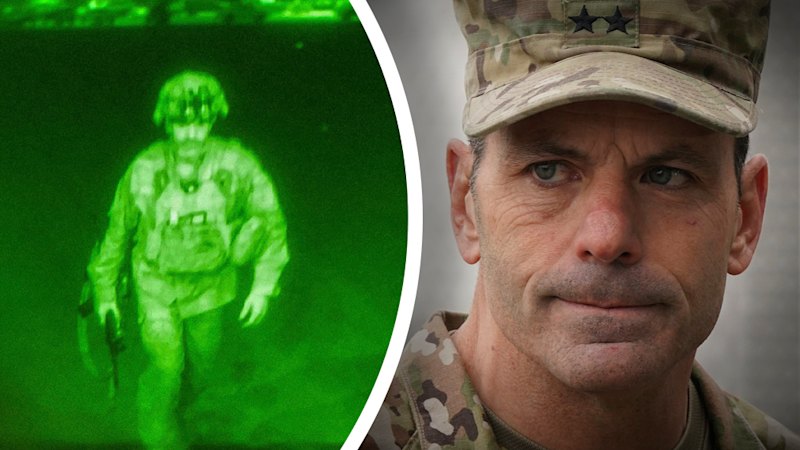
Donahue was the last US soldier to leave Afghanistan. As he stepped onto a hulking military cargo plane, an army photographer snapped his picture using his cellphone camera and night-vision device.
The green and black image rocketed around the world. Senior Pentagon officials said Hegseth seemed fixated on the photo, mistakenly referring to it as a “selfie”.
The first item on the card that Kasper handed to Hegseth in the car clarified that the photo was not a selfie and that Donahue had nothing to do with its distribution. Other bullet points noted that Marines, not Donahue’s paratroopers, were in charge of the gate where the suicide bombing occurred.
Advertisement
The defence secretary glanced at the card and passed it back to his chief of staff.
“I don’t care,” Hegseth told Kasper.
‘Brother, we need your help’
At first, Donahue wasn’t supposed to go to Afghanistan for the withdrawal. The Pentagon said it just needed about 2000 of his paratroopers from the 82nd Airborne Division to help with security at the Kabul airport.
Then, on August 16, 2021, shortly after the paratroopers started arriving, thousands of Afghans, desperate to escape Taliban insurgents, swarmed the runways, preventing planes from taking off and landing.
Donahue’s paratroopers watched in horror as Afghan special operations units, waiting to be evacuated, beat back the civilians so that flights could resume.
Advertisement
Amid the chaos, Donahue got new orders: get to Kabul as fast as possible.
Three decades had passed since Donahue graduated from West Point. He was in his mid-20s when his leadership skills and football player’s build caught the eye of a senior officer in Delta Force, the Army’s elite counter-terrorism unit.
He survived the selection process and disappeared into a world of secrecy and fake personas. Deployments to Iraq, Afghanistan, Syria and other hotspots followed as he rose to become Delta’s top commander.
The skill that often set Donahue apart from his peers on those battlefields was his ability to win the trust of local partners. It was on display in Afghanistan in May 2019 when he began leading special operations forces in the country and won over his Afghan counterpart, Brigadier General Sami Sadat.
Together, they leveraged airstrikes, special operations advisers and commandos to punish Taliban insurgents and retake territory that had been lost. “We didn’t feel like we cracked the code; we did crack the code,” Sadat said.
But their battlefield gains were fleeting. In February 2020, Trump cut a deal with the Taliban to curtail US military support to Afghan forces and begin the American withdrawal.
Advertisement
Sadat remembered sitting by Donahue’s side in their command post watching a drone feed as the Taliban rolled over an Afghan unit. “He was very angry, frustrated and ashamed,” Sadat said.
Eighteen months later, the Afghan president had fled the country and the government had collapsed. Sadat reconnected with Donahue, who was already on his way back to Afghanistan, and told him that his Afghan forces had dissolved.
“Brother, we need your help,” Sadat recalled telling him.
Donahue landed in Kabul on August 17, 2021.
About 2am, he met with Qari Hamdullah Mokhlis, a Taliban commander whom Donahue’s commandos had been trying to find and kill as recently as 2020. The general’s former target was now his partner.
“You don’t like me; I don’t like you,” Donahue’s paratroopers recalled him telling the Taliban commander. “But we’re going to have to work together.”
The biggest threat to both was the Islamic State terror group, which was determined to turn the withdrawal into a bloodbath, according to US intelligence. The US military would control the airport and its entry gates. US commanders wanted the Taliban, who had set up checkpoints outside the airport, to let American citizens and allies pass through, and keep out would-be suicide bombers.
Donahue’s paratroopers began preparing for a major attack. They cleared the roads leading to the airport’s field hospital so they would be able to rush wounded to get care.
The intelligence identified Abbey Gate, a major airport entry point controlled by the Marines, as the most likely target. The Marines were planning to leave and turn over control of the site to Donahue’s troops.
On August 24, 2021, Donahue visited the gate and saw thousands of desperate Afghans crowding the Marines who were trying to maintain order and screen them.
The chaos and proximity between the Afghans and the Marines made it an ideal target for a suicide bomber, Donahue told his paratroopers.
The plan was for Donahue’s paratroopers to take control of Abbey Gate from the Marines on August 27 and shut it down. But Donahue thought it was too risky to wait. He met with the senior US commander at the airport and recommended shutting the gate immediately.
British forces, which were using the entry to evacuate their citizens and allies, asked the Americans to keep it open. Pentagon leaders “grudgingly” agreed, a senior US official recalled.
The Marines were still in control of Abbey Gate at 5.48pm on August 26, 2021 when the suicide bomber struck. Eleven Marines, one navy medic and one army soldier, along with scores of Afghans, were killed.
Donahue could hear and feel the blast at his headquarters on the other side of the runway. “I need to know the numbers and types of casualties,” he told his staff. The situation was so dire that medics began pumping blood from healthy soldiers into the veins of the wounded.
On August 30, 2021, the United States’ longest war came to a bitter end. Donahue took a parting glimpse at the Kabul airport and then hurried onto the big, grey plane. It was the last one out and, in keeping with army tradition, he was the final soldier to board. The army photographer captured the moment at 11.46pm using his iPhone and the night-vision monocle attached to his helmet. When the plane landed in Qatar, Donahue called his wife.
His paratroopers overheard the conversation.
“We’re out,” he said.
“I know,” she said.
“How did you know?” he asked.
“Everybody knows,” she said.
She sent him the photo, which was now posted on news sites around the world. Donahue, taken aback, showed the photo to members of his team. He had spent most of his career in the shadows. Now he was everywhere.
“This is not good,” he said.
‘He wants fewer generals!’
On the 2024 campaign trail, Trump blasted the Biden administration for the withdrawal and the Abbey Gate deaths, calling the episode “the most embarrassing moment in the history of the United States”. He wondered why no generals were fired for it.
Trump did not mention the deal he had cut with the Taliban that set the collapse in motion.
The withdrawal first became a career-threatening problem for Donahue in November 2024. Markwayne Mullin, then a Republican senator from Oklahoma, put a hold on Donahue’s nomination to lead US ground forces in Europe, effectively blocking him from taking the job.
The hold set off a scramble among senior army officials, members of the special operations community and some of Donahue’s supporters in Congress. Mullin, after meeting with Donahue, relented.
For Donahue, it would prove a fleeting victory. His career and vision would soon collide with Hegseth, who resigned from the army after being singled out for tattoos that the service deemed extremist. “The military I loved, I fought for, I revered, spit me out,” Hegseth wrote in a 2024 book.
Hegseth went on to blame the army’s generals, whose ranks he believed were “bloated”. It was time, he wrote, to “clean house”.
Before he was confirmed as defence secretary, Hegseth met with Trump at his Mar-a-Lago resort and emerged from their talk believing the president-elect shared his vision.
“He wants fewer generals!” Hegseth told aides.
Donahue, in his 50s and one of the military’s youngest four-star generals, seemed to be on the ascent. Three years earlier, he created a new headquarters to funnel intelligence, technology, planning and strategy to the Ukrainians.
It worked, and the Ukrainians retook large swaths of their territory. But in the years that followed, the US military and its NATO partners couldn’t provide the Ukrainians with enough shells and missiles, so the undermanned Ukrainians improvised. They replaced scarce and costly shells and missiles with cheap drones.
Donahue and like-minded military leaders were convinced that US support to the Ukrainians was a worthwhile investment: it was bleeding the Russians and preparing the US military for future wars.
Trump and Hegseth did not see it that way. They spoke of curtailing US support and forcing Ukraine to cut a deal with Russia.
In February 2025, Hegseth travelled to Europe. The trip began with a tense conversation with General Christopher Cavoli, Donahue’s boss who, as the head of European Command, led all US and NATO forces on the continent. Cavoli, who was retiring that summer, told Hegseth that he would soon need to choose his replacement.
The frontrunner for the job was Donahue, who was standing by with his troops in Poland. It was Hegseth’s last stop. The meeting – their first and only – was brief and positive.
‘Our new model’
In Washington, Hegseth received a binder with candidates’ photos and bios. General Dan Caine, the incoming chair of the Joint Chiefs of Staff, had scribbled an effusive endorsement with a black Sharpie next to Donahue’s picture, the officials said. The two officers had worked together earlier in their careers.
Hegseth initially agreed that Donahue would take over European Command. But Hegseth later told his staff that Trump wanted punishment for the deaths at Abbey Gate.
After Kasper’s failed attempt in the car to salvage Donahue’s nomination, the chief of staff met Donahue in his office.
The top job at European Command was now off the table, Kasper explained. Donahue looked dejected. But he still had his army post and a purpose, which he described to a former colleague.
The headquarters he established in Germany in 2022 to aid the Ukrainians should serve as “the laboratory where we test new ideas and capabilities and then rapidly share them across the force”, he said.
He saw the war as a historic opportunity, the colleague recalled. In the waning days of its defeat in Vietnam, the army had sent a general to the Middle East to study how the outnumbered but innovative Israelis defeated Arab armies in the 1973 Yom Kippur War. That general’s report had transformed the army.
“This should be our new model,” Donahue told the former colleague.
He began to turn his vision into a detailed plan using a dry-erase board, officers recalled. His command would take Ukrainian advances in cheap, mass-produced drones and drone interceptors, and build on them with new tactics and high-tech systems unique to the US military, like precision-guided missiles, Patriot batteries and intelligence from satellites. All of this would be plugged into an artificial intelligence-enabled command and control system that would identify and track thousands of potential enemy targets in real time.
The system would then be shared across NATO to defend against Russia but could be replicated in the Pacific and elsewhere. The officers in the room initially called it “the Global Killing Machine”. Its proper name became the Eastern Flank Deterrence Initiative.
Donahue pitched the plan to Army Secretary Daniel Driscoll over beers at a bowling alley at his base in Germany, Pentagon officials said.
Driscoll was taken with it.
General Randy George, the army’s chief of staff, was going to retire in the summer of 2027. Now that the European Command job was off the table, George, Kasper and Driscoll cooked up a new idea. Donahue could take over for George when he stepped down.
The army chief of staff job would allow Donahue to bring the vision he had sketched out in Europe to the entire force.
But Hegseth had other plans. He wanted to nominate General Christopher LaNeve, his senior military adviser, to the chief of staff post.
Driscoll had a strained relationship with Hegseth. He tried to advance his preferred candidate by arranging a meeting between Vice President JD Vance, his close friend and Yale Law School classmate, and Donahue, officials said.
Vance might be willing to push Trump to overrule Hegseth, Driscoll reasoned.
Hegseth learnt of Driscoll’s effort and made clear his opposition. The meeting never happened.
Hegseth had set in motion a plan to reduce Donahue’s job in Europe from a four-star to a three-star position this northern summer. The move was in line with the Trump administration’s policy of shifting the military’s focus from Europe to Asia. For Hegseth, it also had the benefit of forcing Donahue to retire, if he did not get another four-star position.
In late February, the drone threat that Donahue was preparing for in Europe became a deadly reality for US forces in the Middle East.
Trump had launched an extensive attack on Iran, and Iran responded with volleys of Shaheed drones, similar to those used by the Russians. US troops were not ready.
One attack struck a US Army base in Kuwait, killing six soldiers.
Overnight, the Pentagon sent frantic messages to commanders around the world, desperate for drone interceptors.
Donahue had already distributed the command’s stock to NATO partners. But he knew someone who had more of them: General Oleksandr Syrskyi, the commander in chief of Ukrainian forces.
The Ukrainian general recalled that they had grown close over the previous four years in frequent secure video conference calls that began with the same salutation – “my friend” or “my brother” – and ended with Donahue saying, “What else can I do for Ukraine?”
“Afterwards, he would genuinely try to do something,” Syrskyi said.
Now the situation was reversed. The US military was the one needing help. Donahue asked Syrskyi for drone interceptors and Ukrainian officers with experience using them in battle. They would join their Europe-based US counterparts and teach troops in the Middle East how to defend themselves.
“I called the president of Ukraine, explained the situation, and told him that I believed providing this assistance was the right thing to do and that it would not compromise Ukraine’s defence,” Syrskyi said.
As this was happening in early March, George called Donahue to tell him to put in his retirement papers. Hegseth wanted him out.
George said he would try to convince Hegseth to extend Donahue’s command six months until December 2026. The army chief asked for 30 minutes with Hegseth to discuss Donahue and other issues, but Hegseth kept postponing the meeting.
On April 1, Hegseth fired George in a phone call that lasted 15 seconds, officials said.
George could no longer help him. There was now one last slim hope for Donahue: his supporters in the Senate. They were frustrated by Hegseth’s lack of transparency, and they valued senior officers like Donahue for their frank assessments.
One of Donahue’s supporters was Republican senator Tim Sheehy, a former Navy SEAL. Sheehy’s combat record and pro-Trump reputation gave him extra credibility with Hegseth. He had succeeded in persuading Hegseth to drop his objections to a handful of senior officers, particularly those Sheehy had served with in combat.
But his efforts to save Donahue were going nowhere.
In a meeting with Sheehy, Caine explained why: the senators’ campaign was only causing Hegseth’s opposition to grow, reinforcing his perception that Donahue was too powerful, independent and connected.
A spokesperson for the chair disputed that he used those words to describe Hegseth’s perception of Donahue.
Sheehy stopped pushing.
Republican senator Joni Ernst, who had deployed to Iraq and served 22 years in the National Guard, had been Donahue’s most insistent champion. She continued to look for a way to help him.
She believed Hegseth had promised her that he would allow George, a fellow Iowan, to finish his full term. And she felt betrayed when Hegseth fired him.
Now she was determined to block Hegseth’s choice to lead the army. Instead of LaNeve, she suggested three alternatives to the White House. Her top choice was Donahue.
But a senior White House official told her that Hegseth would never nominate Donahue for the job.
With less than a month left in Donahue’s career, Ernst asked him if he would be interested in taking over the four-star command in Austin, Texas, focused on transforming the army.
It would give him a new platform to spread the vision that he had made a reality in Europe. But he had a big concern.
“Do you honestly think Secretary Hegseth would work with me if I was there?” Donahue asked, according to a congressional official familiar with the exchange.
“Honestly, no,” Ernst replied.
Donahue retired on August 27, surrounded by people he had fought alongside.
This article originally appeared in The New York Times.
Get a note directly from our foreign correspondents on what’s making headlines around the world. Sign up for our weekly What in the World newsletter.