
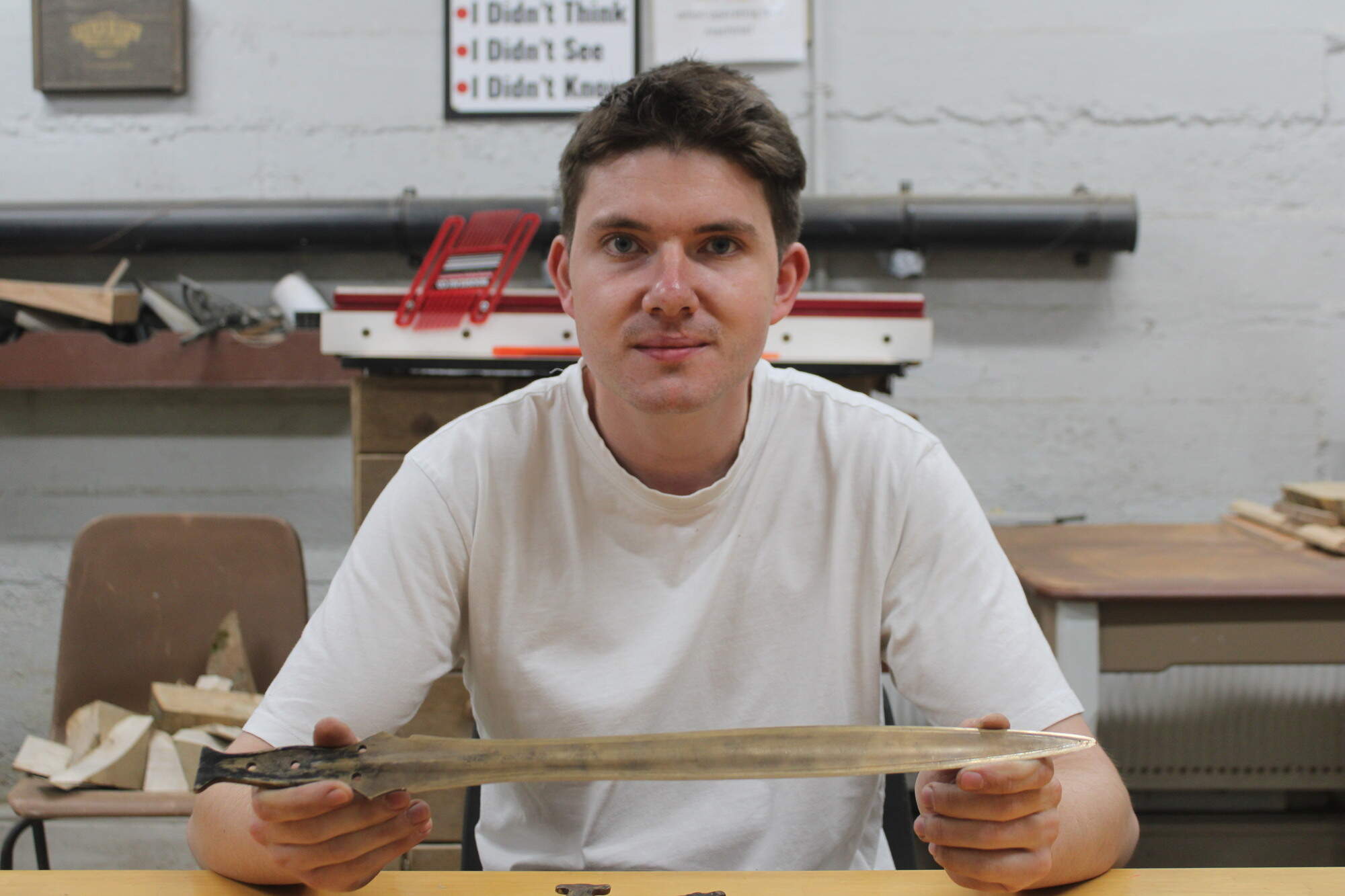
Laid out upon a table in the Ballaghaderreen Men’s Shed workshop are bronze replicas of three Late Bronze Age swords and two axe heads painstakingly recreated by 27-year-old art teacher Conor O’Connell.
They were forged with modern technology using prehistoric techniques, passed down for centuries, that had to be rediscovered in more recent times.
Just a few miles from the town, near the Sligo-Roscommon border, sits Lough Gara, one of Ireland’s most important wetland archaeological landscapes.
When the lake was drained in 1952, over 180 submerged crannog settlements emerged, along with artefacts dating back to the mid-Stone Age.
So too did many exceptionally well-preserved Late Bronze Age items, like swords, spearheads, socketed axes, gold-foil covered lead rings, tin rings, and bronze dress pins.
“I was always interested in archaeology and specifically the Bronze Age,” Conor says.
“Living beside Lough Gara, I knew people who found things like this back in the day,” he says, with one of the blades in hand.
“Even though it spent 3,000 years underground or in water in a bog, it can come up looking identical to when it went in.”
Bronze is an alloy – a mixture of copper and tin and its discovery transformed agriculture and warfare for centuries.
With the arrival of the Iron Age around 800 BC, bronze was slowly displaced as the staple metal for tools, weapons and jewellery.
Bronze smelting, though not quite made redundant, became less widespread, and the techniques and wisdom used to create such objects slowly faded.
“We still don’t actually know how they did them back in the day,” says Conor.
The workmanship on these objects, he says, is, even by today’s standards, “absolutely astounding”.
“At every stage of this, you kind of just marvel at how they – not necessarily how they did it, because I mean, we’re the same species, we were an inventive species – but just the amount of knowledge that has now kind of fell into obscurity.
“So you would have had an immense amount of knowledge passed down through generations but we’re kind of having to recreate this again and figure it out.”
Conor had a keen interest in art and archaeology from a young age. He studied at NCAD, qualified as an art teacher and has just started working in Elphin Community College.
Conor learned a few techniques from Neil Burridge, an Englishman who runs the Bronze Age Swords YouTube channel.
He gets help from former teacher, Tom Colleran, a member of Ballaghaderreen Men’s Shed who taught him metalwork up until third year.
Slowly but surely, Kilcolman native, Conor is showing more people a craft that had effectively gone extinct.
Last year, he received a Creative Ireland grant from Roscommon County Council to put on a series of heritage workshops.
In May of that year, in conjunction with Ballaghaderreen Men’s Shed, he performed a demonstration where he cast a replica Lough Gara sword by the shores of the lake.
The process of sword smelting has also inspired many of his oil paintings, some of which will be on display, along with a selection of metalworks, in Roscommon Arts Centre from September 18 to October 31.
The men who made swords by the shores of Lough Gara back in the day would have used charcoal to light a fire, which was then stoked with a bellows. Conor does something similar, albeit with a modern propane furnace.
It takes roughly the same length of time to heat the copper, which liquefies at 1,085 degrees Celsius. Solid tin is then added to the molten copper to make the metal stronger. Ideally, the finished blade will be 12pc tin and 88pc copper – adding too much tin would make the blade brittle and prone to shattering on impact.
Using wooden swords as patterns, he presses the shape into specialised sand to create a hollow cavity, removes the pattern, and pours the liquid bronze into the sand mould – the modern equivalent of the clay moulds used in the Bronze Age.
The metal solidifies within minutes. Once cooled, the rough casting is removed from the sand. The edges are then cold-hammered on an anvil to work-harden the metal.
Next, the blade is filed and polished to give it its sharp edge and distinct grooves. With modern technology, this task is much easier than it was in the Bronze Age, when craftspeople relied on natural whetstones made of sandstone, quartzite, or slate.
Penultimately, Conor tests for the centre of gravity – “which is where you can balance it” – before drilling rivet holes into the tang to fix a handle made of wood or bone.
Almost every original sword handle decomposed within years of being discarded.
But the bronze blades remained almost perfectly preserved for thousands of years.
For Conor, they are not mere trinkets or trophies, but invaluable glimpses into history.
Unlike actual archaeological artefacts which are kept behind glass, these swords, once not excessively sharpened, can be handled by both adults and children.
“That way you can actually handle them; they provide very big tangible links to history rather than always being in a book or behind a museum glass case,” Conor says.