
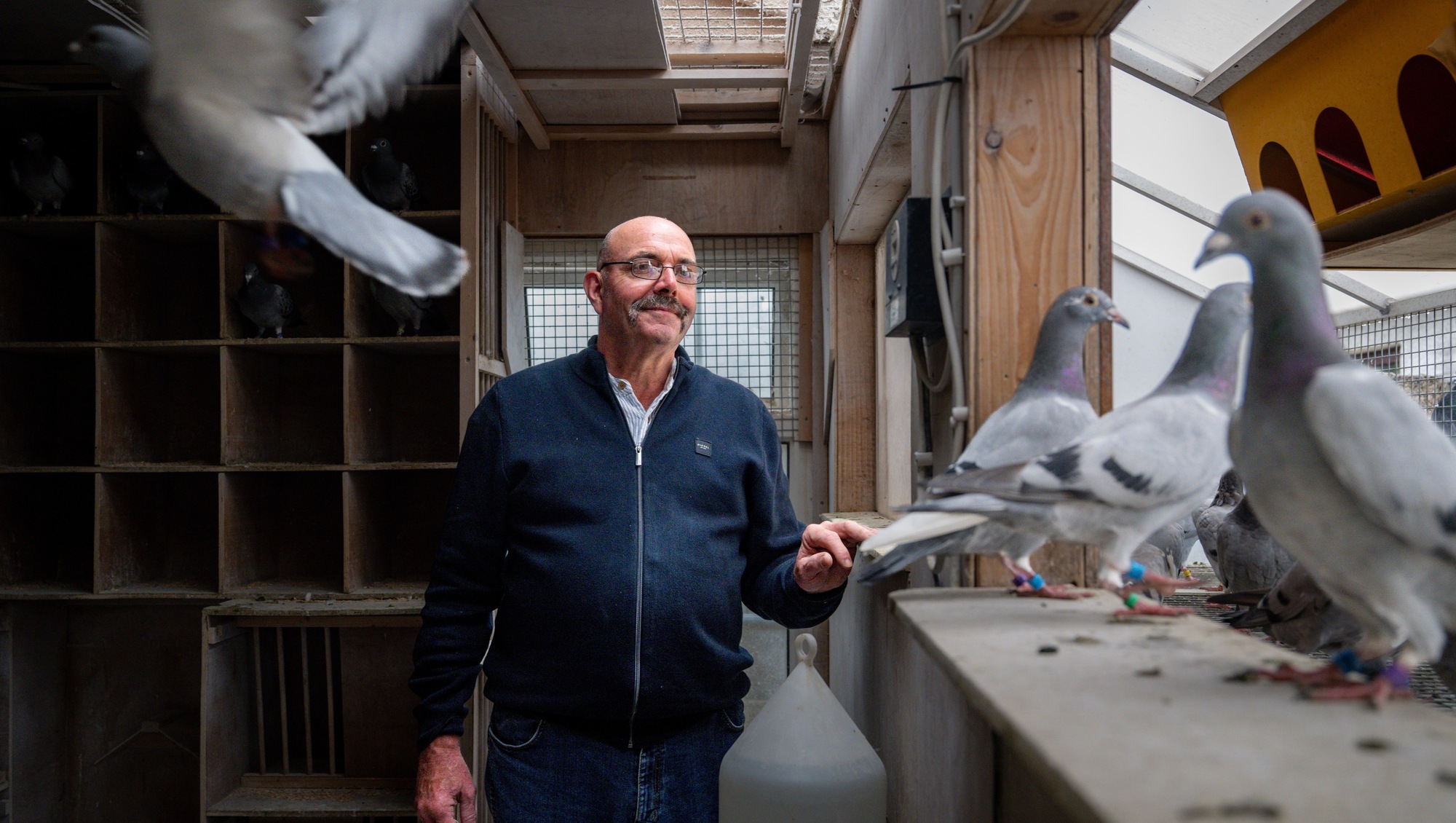
Lost racing pigeons: Cork fancier Ger O’Sullivan on rescuing birds from Taiwan and RomaniaGer O’Sullivan has spent decades breeding racing pigeons and now helps reunite lost birds with owners across Ireland and beyond Mon, 07 Sep, 2026 – 06:00Sarah Horgan
While most racing pigeons enjoy the freedom of a long flight, there are always the odd few who prefer to travel by boat.
It was a strategy that clearly backfired for one Taiwanese homebird who landed on a ship, only to find he had overstepped the finish line by thousands of miles.
Luckily, he landed on his feet in Cork where locally renowned pigeon fancier Ger O’Sullivan took the steps to send him back home.
It was an unusual, albeit not unheard of, situation for the Ballinlough granddad.
Having spent years repatriating pigeons from across the country, he was excited to rise to the challenge.
These days, he is in more demand than ever and receives an average of 10 calls a week from those seeking repatriations.
“I’ve had birds from Taiwan and Romania,” he told the Irish Examiner.
“Sometimes they might land in the fog and not really know where they are going.
“It’s often the case that they will land on a vessel that takes them a little bit further afield.
“It’s not difficult to identify a pigeon because they have individual rings on them with a unique number that is only applicable to this loft registration.”
Ger, who competes within the Cork Southern Pigeon Club and the broader Cork Racing Pigeon Federation, described the increase in pigeon losses as extremely worrying, with the peregrine falcon an always-looming predator.
“The losses are a great concern at the moment,” he said.
“This is primarily down to the peregrine falcon, which has become so predominant it’s unreal.
“They are a protected species, as are our own birds. The law of nature, however, doesn’t make provisions for that. The issue has been getting progressively worse since the 1980s.”
The nasty scars marking one of Ger’s pigeons serve as a bitter reminder of the peregrine falcon’s impact.
“When they are attacked, they keep going,” Ger said of the pigeons.
“They keep going from fright. I’ve had pigeons make it here from Scotland. I’ve had pigeons lost from Wales on routine flights.
“That’s just the way it is. It’s a common courtesy among fanciers, as well as an unwritten rule, to make sure every pigeon makes it home to its owner.
“It’s very easy to ascertain who the animal belongs to from the ring and the individual ring number.
“It’s just a case of organising the repatriation of the lost pigeon, which we do quite frequently.
“I liaise with vets in Cork because people are handing in pigeons they have no idea what to do with.”
The 67-year-old has seen the firsthand damage inflicted by the peregrine falcon.
“They are growing in numbers, so the dangers that we are exposed to now are far more substantial than before.
“They are hitting birds like there is no tomorrow. One guy from the city phoned me at 3.50pm to tell me he had one of my pigeons. It turned out that when the pigeons were liberated, the peregrine falcon went straight into them.
“They give them a horrendous death by coming down on top of them and stripping them from the nape of the neck. You might have six birds going after the pigeon at one time.”
What’s your view on this issue?
You can tell us here
The psychological damage can be enough to end a racing pigeon’s career.
“If they are attacked a second time, they might not want to go out again. This happens very regularly between April and September when the racing season is in full swing.
“I get at least 10 calls a week. I then repatriate these pigeons. The reason it’s so hard to keep pigeons in good health these days is because of the falcon and the stress it induces in pigeons.
“This brings out different manifestations of health issues.
“Pigeons are traumatised in the same way a human who is chased down the street by a guy wielding a machete might be.”
He stressed that no two pigeons are exactly the same.
“They very much have their own personalities. It’s hard to determine their unique qualities as babies, but the minute you pair these pigeons up with a cock, you start to see their personalities coming out.
“The same is true for any other young couple getting together. If they are incompatible, they won’t go together, and neither of the birds will race properly. A lot of the time, I’ll foster the eggs out, and the birds rear them like they are their own. I can get more progeny that way.”
Pigeon racing was formally introduced as a sport in Belgium in the early 1800s, when the first recorded long-distance race was held.
However, the birds had been domesticated for thousands of years before that.
Stories of pigeons being used to relay messages can be traced all the way back to ancient Egyptian times, around 3000 BCE.
The sport has an extra sentimental significance for Ger.
“It’s part of my lineage,” he explained.
“My dad was a keeper of small exotic birds, and my grandfather was a racing pigeon enthusiast.
“He influenced me from the very start. I was five years old when I got my first pigeon loft. My dad made it from an old wardrobe, which he cut down the centre and widened for me.
“It had two or three birds inside. I only had about two or three pigeons in there. It was more of a gesture from my dad to me to get me moving. I had two or three pigeons in it.
“This is a far cry from the loft I have today. You have to be sure that your pigeons are as comfortable as possible. A lot of the minor details about my loft you won’t notice.
“We are so advanced now that we even have underfloor heating. It also has double glazing for the winter.
“Pigeons don’t feel the cold, but they feel the heat intensely, so double glazing helps protect against it.
“Every cock bird is allocated a box, but sometimes they are just not happy with the house they live in.
If you are not happy in a house, you are not going to stay there. What brings any of us home is the love of our nest.
The sport has always been in Ger’s blood.
“My lifeblood is breeding and training of thoroughbred racing pigeons.
“At 11 weeks old, those birds are airborne to this loft location or any location.
“You start training them in graduations of two miles, four miles, six miles and eight miles, maybe 20 times.
“After that, the training seriously steps up because the jumps get greater. They are trained up to about 50 miles. That is considered great grounding.
“Whether they are racing from north to south or from the East back into Cork, regardless of where you are in the world, that is how it is done.”
Ger also enjoys the social element.
“It’s a lovely circle to be involved in. Just like with any animal competition involving racehorses or greyhounds, they are your hobby, and you love them. That said, you’re still always going to aim to get the good ones.”
The retired chef’s family has always been supportive of his pastime.
“My wife drives to Wexford twice a week and liberates the pigeons. She has always given me great support, which is really important to have.”
The pigeon fancier has great admiration for the birds, describing them as the heroes of their day.
“During times of war, a plane always had two pigeons. If that plane went down and the boys managed to escape, the pigeons would have the coordinates of where they roughly were. They were carried in a capsule tied to the bird’s back or leg.
“If communications were down, then these pigeons were people’s only hope of survival.
“They have been involved in so many rescues over the years, yet many people don’t realise they are heroes.”
Read More
x
185th Anniversary Offer
Six months of digital access for €18.50
Already a subscriber? Sign in
No obligation. Ts&Cs apply.
CONNECT WITH US TODAY
NEWSLETTERS
NOTIFICATIONS
Be the first to know the latest news and updates
Cork gardaí welcome new e-scooter rules as €100 fines introduced for safety breaches
Cork charity seeks homes for 80 cats and kittens as surrendered numbers spiral
Gardaí appeal for information after alleged assault in Whitegate
More in this section
Ireland’s brightest maths students are thriving. So why are experts worried about the Leaving Cert?
A selection of images chosen by the Irish Examiner picture desk
Ireland’s neutrality has a security problem — and Europe is starting to notice
#Cork – News