
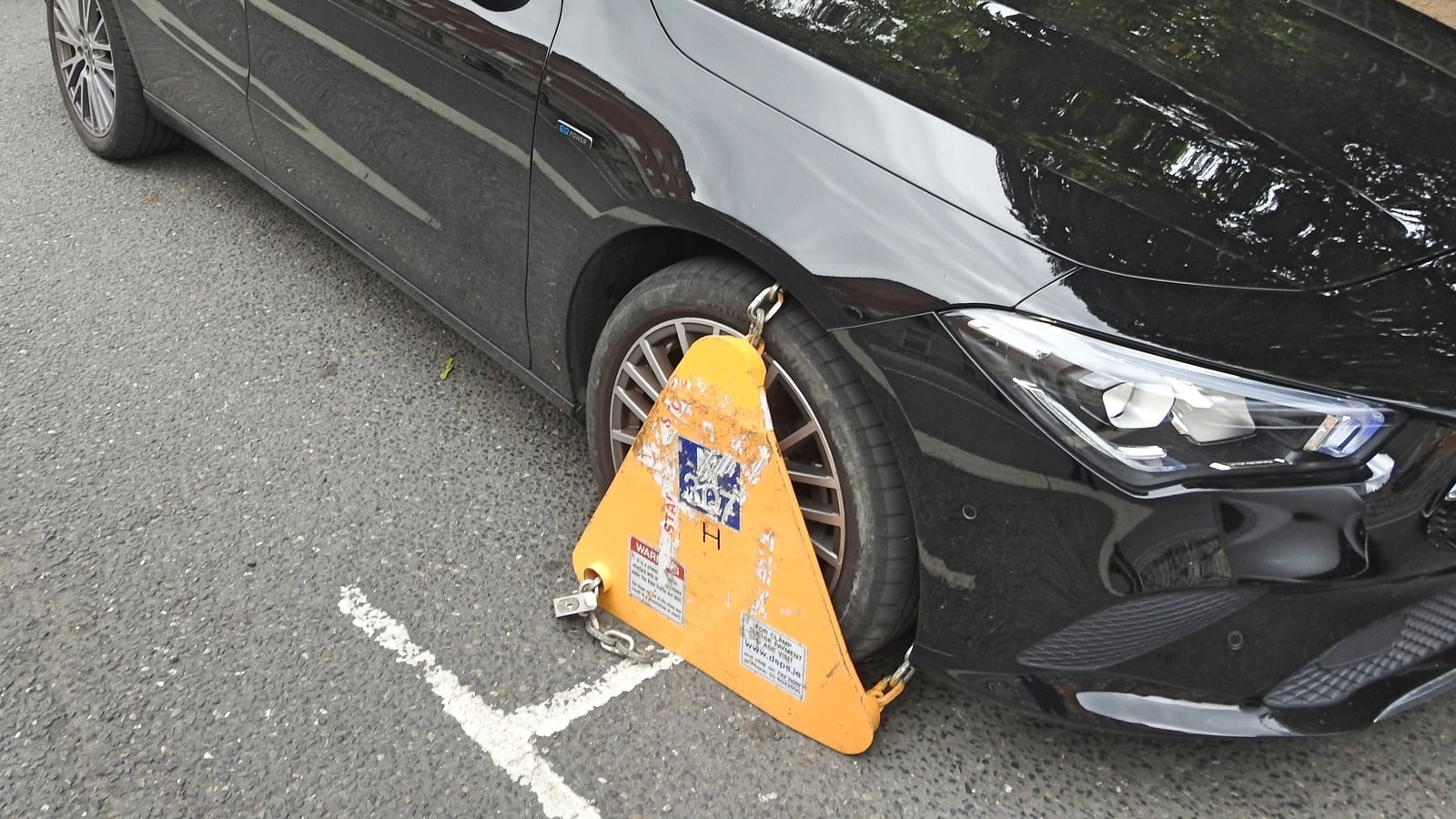
The cost of replacing clamps that are damaged or illegally removed from vehicles on Dublin streets could potentially be almost €800,000 over a three-year period, according to Dublin City Council.
The local authority has revealed that a total of 9,061 “code black” cases where clamps were either illegally removed or destroyed were reported between 2023 and 2025, with at least 100 clamps being removed illegally from each of 10 different streets in the capital in that time period.
Marlborough Place in the north inner city has been recorded as the location for 166 “code black” cases in the past three years, while 162 clamps have been listed as having been illegally removed from vehicles parked on South Circular Road.
Other areas with a high rate of “code black” incidents are Clarendon Street (129); Lad Lane (118); Peter Street (118) and Hanover Street East (112).
New figures published by Dublin City Council show the “worst-case replacement value” of replacing clamps reported as illegally removed or destroyed between 2023 and 2025 was €795,000.
However, the council said the figure should not be interpreted as the actual financial loss incurred as many clamps are subsequently recovered and repaired rather than replaced.
It estimated that the cost to Dublin Street Parking Services (DSPS), which operated parking enforcement services in the capital until recently with the role to be taken over by APCOA, of replacing a standard clamp is €130.
In reply to a series of questions on the issue from independent councillor, Nial Ring, the council’s chief executive, Richard Shakespeare said: “It is difficult to provide an exact figure, as many illegally removed clamps are subsequently recovered with only minor damage, such as a missing lock or damaged chain, both of which may be repairable.”
However, Mr Shakespeare said the estimate excluded indirect costs such as staff time, recovery attempts, administration, vehicle attendance, reporting and operational disruption.
The chief executive said DSPS did not pursue civil compensation cases in relation to illegally removed clamps.
However, he said the company had developed a policy to address the issue including the recovery of associated costs where appropriate.
Mr Shakespeare said the policy had been reviewed by the council’s law department and its implementation was under consideration.
‘Person responsible cannot be identified’
“In many instances, the person responsible cannot be identified or the cost of recovery would not be appropriate to the value of the equipment,” he added.
Removal of a clamp causing damage is an offence under the Criminal Damage Act 1991.
However, Mr Shakespeare said the matter was generally not reported to An Garda Síochána when there was no identifiable suspect or evidential basis for a criminal investigation.
An Garda Síochána does not compile figures that provide a specific breakdown on incidents of criminal damage to clamps.
Dublin City Council had previously noted that “code blacks” were often carried out near construction sites where tools to cut clamps were readily available.
It also revealed that there were approximately 2,100 where records of clamps being attached to vehicles between 2023 and 2025 were written off without a “de-clamp” or related payment.
The council said such valid write-offs could result from cancelled immobilisations which could be recorded for a number of reasons including the production of a valid disabled parking ticket, garda or council-directed releases, and other authorised exemptions such as State or diplomatic vehicles.
Just under 44,000 vehicles were clamped in the administrative area of Dublin City Council last year.
Motorists have to pay a fee of €125 to get a clamp released. However, if the release fee is not paid within 24 hours, vehicles are moved to the city pound and can only be recovered on payment of a removal fee of €250 plus a daily storage charge of €35 per day.
Read more: South Circular Road top spot for illegal parking in Dublin last year