
Legal experts say Neo-Nazis could win in High CourtBy ABC NEWS Verify’s Lucy Carter
Posted Mon 7 Sep 2026 at 4:42amMon 7 Sep 2026 at 4:42amMon 7 Sep 2026 at 4:42am
In short:
Several legal experts believe there is a significant prospect that the federal government’s ban on Neo-Nazi group White Australia may be overturned by the High Court.
The group, also known as the National Socialist Network, had been planning to launch a political party when it was outlawed in May by the government under new hate speech laws
What’s next?
The matter is set to be heard in the High Court on September 8 and 9, with judgment not expected for several weeks or months.
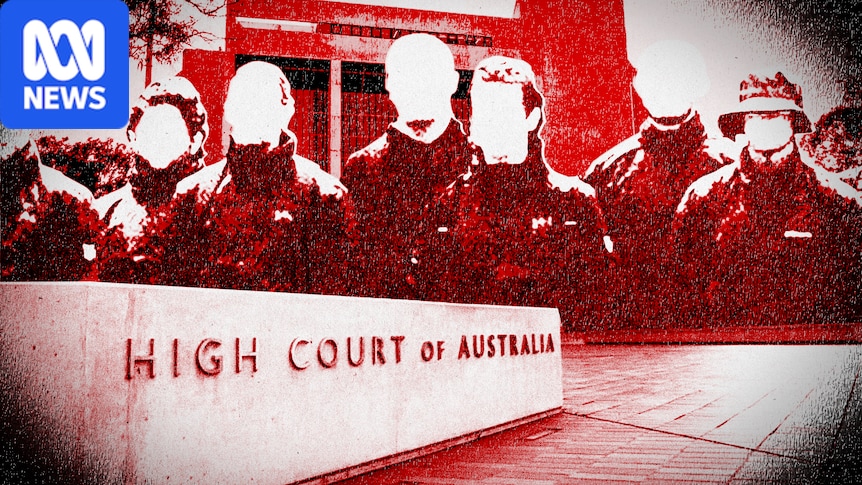
Some of Australia’s leading legal minds believe there is a significant prospect of the High Court overturning the federal government’s recent ban on the nation’s most high-profile Neo-Nazi group.
A victory in the nation’s highest court for White Australia, also known as the National Socialist Network, could embarrass Prime Minister Anthony Albanese, who in May said he was confident the new laws the government used to ban the group would withstand legal challenge.
It would also pave the way for the white supremacist group, with its sordid history of violence, criminality and racist demonstrations, to form its planned political party in a blaze of publicity.
In May, White Australia became the second group to be listed as a prohibited hate group under laws introduced in the wake of last year’s Bondi Beach terror attack.
The organisation was trying to form a political party when it was outlawed by Minister for Home Affairs Tony Burke.
It is now attempting to have the laws overturned on the grounds that they are unconstitutional.
Constitutional law expert Anne Twomey said the federal laws appeared to have been rushed through in January without sufficient scrutiny.
“There would be political issues if it was seen that the government had lost to the White Australia Party,” she told ABC NEWS Verify.
“But on the whole, the bigger issue is does this legislation survive and how might it be used in the future?
“And how consistent is it with our democratic system as imposed and required to operate by our constitution?” she said.
NSW Labor MP and former barrister Stephen Lawrence is worried White Australia leader and convicted criminal Thomas Sewell may be about to get more undeserved publicity.
“Imagine the optics. Thomas Sewell launching the White Australia Party on the steps of the High Court after having a big win there. We would be handing these people a political gift.”
Complicated legal arguments
The constitutional legal arguments Sewell and his White Australia Party are presenting to the High Court are complex.
Put simply, the first argument is that the federal government does not have the power to make this law.
The second is that this law breaches the implied freedom of political communication.
The third is that this law breaches the separation of powers between the government and the judiciary.
Constitutional law expert Anthony Gray said the federal government’s position is also multi-layered.
“They’re arguing that the harm that may be caused by a proscribed group justifies the intrusion on what otherwise would be protected political communication,” he said.
Professor Twomey said there was relevant historical legal precedent from when the federal government attempted to ban the Communist Party in the 50s.
“People were profoundly shocked when the High Court held that that legislation providing for the dissolution of the Communist Party was invalid,” she said.
“So, it is possible and it has happened before to the extent that the Menzies government did find its legislation was found to be constitutionally invalid by the High Court.“
ABC NEWS Verify sent questions to Mr Burke. A spokesman said the minister would not comment while the case was still ongoing.
Principle over ideology
Professor Twomey said that while the views of the White Australia Party might be distasteful to many Australians, it is not something the High Court can take into consideration.
She said the court would examine how these laws could hypothetically be used by a less democratic or authoritarian government.
“Do we really want on our statute books legislation that could be used in an abusive manner in a way that really undermines the democratic system? And so that’s the bigger picture that the High Court needs to address,” she said.
Professor Gray agreed that it is about legal principle rather than ideology.
“This is one of the things with freedom of speech that it’s easy to defend freedom of speech for people whose views are what we call reasonable or views with which we agree,” he said.
“It becomes challenging when we’re dealing with an organisation that — or with people who — express views with which we may disagree.“
The Director of Public Affairs at the Australia/Israel and Jewish Affairs Council, Jamie Hyams, said he believed the legislation struck the right balance.
“So on the one hand, you want to preserve our democracy, and by not giving governments too much power, but on the other hand, you need to give governments the power to deal with threats to our democracy.
“There are safeguards in there. The government is meant to act on advice from ASIO and also has to brief the leader of the opposition on it before they bring anything in.”
What happens if the government loses?
If White Australia is successful in this High Court case, it could still end up outlawed by other legal means.
Professor Gray said the federal government would likely attempt to redraft the legislation.
“That’s happened in the past where the Commonwealth has been knocked back by the High Court, they’ve then redrafted their law, and then that was deemed to be valid,” he said.
Mr Hyams said if the White Australia Party was victorious, it should not be interpreted as any kind of endorsement by the High Court.
“It will be decided very narrowly on constitutional grounds,” he said.
“If the legislation is overturned, hopefully there’ll be some guidance in there about how similar legislation can be brought forward that doesn’t, in the opinion of the court, breach their concerns about the constitution.”
The matter is set down to be heard in the High Court on September 8 and 9, with a judgment not expected for several weeks or months.