
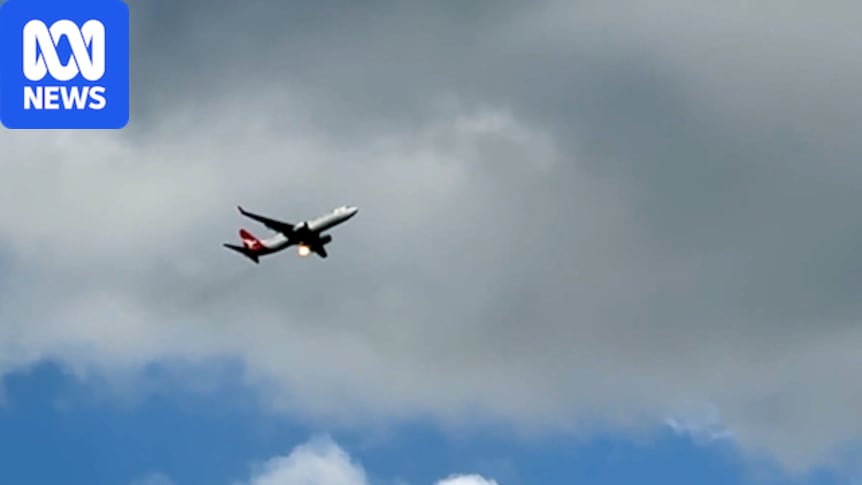
Qantas passengers on Sydney-bound flight recount panic after seeing flames spit from engineBy Gavin Coote and Paulina Vidal
Posted Sun 6 Sep 2026 at 7:38pmSun 6 Sep 2026 at 7:38pmSun 6 Sep 2026 at 7:38pmLoading…
In short:
Passengers have spoken out after their Sydney-bound Qantas flight had to be diverted due to flames shooting from the left-hand side engine.
They have recalled people’s “nervous energy”, panic and screams.
Qantas says an investigation into the incident is ongoing, and the plane has been temporarily grounded for inspection.
People screaming and widespread panic are how passengers have described the moment they heard loud bangs and saw fire spitting from an engine on a Sydney-bound Qantas flight.
On Saturday afternoon, Flight QF122 had just left Queenstown in New Zealand when it had to be diverted to Christchurch in what the airline said was a “suspected engine issue”.
Kriti Sethi was on her way home after her holidays, and was sitting towards the back of the plane where she “could see the fire” coming from the left-hand side.
“It happened around five times, so we hear bang, bang, bang and there was five times fire coming out,” she told the ABC from Sydney Airport after spending the night in Christchurch.
“And then the people were screaming; people were like, ‘Oh my God.’ It was quite scary.”
Despite the cabin crew initially blaming the landing gear, Ms Sethi said that, because of her seat’s location, she could see everything.
“So we were like, ‘No, it’s actually fire coming out of the engine, it’s not landing gear’.”
Adding to the panic and fear was the turbulence.
“So the plane was shaking as well. So it was fire and then went straight into shaking; it was just so scary,” she said.
Announcements from captain
Sari-Elle Kraemer, who was sitting on the right-hand side of the plane, said there was a lot of nervous energy on board, especially after the lights went off.
While she could not see the fire, she could hear other passengers talking about it and did not know what to think.
“I’ve never experienced something like that,” Ms Kraemer said.
“Just the noise and the fact that people could see fire on the plane was scary, but obviously the pilots are trained to deal with that, and I felt it was under control after a few minutes.”
Throughout the ordeal, passengers were kept informed of what was happening.
Ms Sethi said the flight’s captain told passengers in one announcement that the plane had experienced a chemical failure with the engines, forcing the aircraft to make an emergency landing in Christchurch.
Fire engines and emergency services were on hand at the tarmac.
Both women have commended the professionalism of the cabin crew, praising their handling of the incident, and were grateful for the safe landing.
“The cabin crew were amazing, and the captain was amazing,’ Ms Sethi said.
“Once we landed, everyone was clapping.”
She was still nervous on her trip home, but again the captain “made an announcement, saying ‘That we understand what happened yesterday. It was a traumatic experience for you guys’.”
Incident under investigation
A spokesperson for Qantas said the plane had been grounded in Christchurch as engineers carry out an inspection and examination.
It will remain there until it is cleared to resume flying, with an investigation underway into what caused the fire.
In a second incident in two days, another Qantas plane has been grounded temporarily and is under inspection after it was forced to return to Sydney Airport this morning.
Flight QF121 was en route to Queenstown when an incident took place halfway into the trip.
“A flight deck alert indicated a potential issue with the aircraft’s anti-skid system,” the airline told the ABC.
A recovery flight is being organised for Monday, with passengers forced to stay in Sydney overnight.
‘Aircraft is designed for these sorts of things’
International aviation consultant Neil Hansford said that while it remained unclear what caused the issue, an engine blade might have detached.
“And obviously when it’s a piece of metal going at that many revs, it’s hit a fuel line and the fuel’s ignited,” he said.
“So the captain’s able to shut the engine down, use the fire suppression system and put the fire out.
“The aircraft is designed for these sorts of things, so if an engine loses power on take-off, it’s designed to fly on safely and continue to climb.
“These are all controllable circumstances, and you don’t necessarily want them, but at least with the training of Qantas pilots, they totally know how to handle it; they’re tested in the simulator.”