
“I cannot be bought.”
Nigel Farage’s voice boomed around the National Exhibition Centre in Birmingham. They were the opening words – literally – of a video played to the delegates at the Reform UK conference, to get them energized for the main event, the leader’s speech.
No doubt it seemed like a good idea, right up to 22 hours previously, when Channel Four News unloaded a half-hour-long report, mostly made up of covert filming, that offered a contrary view.
Over the decades I have reported on many political events in many countries; I can’t think of a comparable case where a party’s big set piece was so thoroughly torpedoed by a single media report in the way that Reform UK’s annual conference was.
After the toughest 48 hours in Reform UK’s short history, Mr Farage closed the parties second annual conference with the following words: “I tell you what we learnt yesterday and today. There will be times in this journey when there are good days, and times when there are difficult days.
“More often than not, things will be put upon us that are unfair. But sometimes we will make mistakes. Sometimes we will get things wrong, and get a bit of a kicking for it.
“But what this conference has shown is, whatever you throw at the leadership, whatever you throw at you, the People’s Army, we immediately pick ourselves up, dust ourselves down, and start all over again.”
But this is the third time this summer that Reform UK has had to pick itself up and start all over again – and the reason has been the same one each time – serious allegations of dodgy political financing involving either offshore money, offshore donors, cryptocurrencies or foreigners.
The trail runs through the undeclared £5 million personal donation to Mr Farage by Thailand-based cryptocurrency billionaire Christopher Harborne, broken by the Guardian; the deeply investigated Sunday Times story on George Cottrell, a very close aide and supporter of Mr Farage for the past decade, and his alleged role in supplying covert finance and other support to Reform.
The Times’ radio podcast series “Posh George” followed, about the same Mr Cottrell, who was convicted of wire fraud in the US and arrested by the FBI in Mr Farage’s company on their way back from the Republican convention that selected Donald Trump as the 2016 Presidential candidate.
Then Thursday night’s Channel Four expose.
Police are now examining four different party funding issues surrounding Reform UK. The Parliamentary Standards Commissioner is examining the £5m gift, and on Friday confirmed it had received a complaint from the Liberal Democrat party about the events shown by Channel Four and the British-based investigative journalists Group “Verbatim”, which had staged the elaborate and costly sting operation. The Electoral Commission may also get involved.
It is the cumulative effect of these financial issues that is now endangering the most interesting political movement in Britain, just as it tries to step on the electoral gas to accelerate to what it hopes will be a victory in a general election its leader believes will happen next spring.
This party conference in Birmingham’s National Exhibition Centre was supposed to be the launchpad for that election countdown. The theme of the event, “The First Hundred Says”, accompanied a raft of policy announcements of what Reform UK plans to do in the first quarter of its first year in power.
Notably, it plans to declare a national emergency and ram through legislation to change the way the UK is run, and do it in ways that cannot be stopped by the judiciary or the civil service or the house of Lords.
If that sounds familiarly Trumpian, it is. Deliberately so.
‘Bigger and better to come’
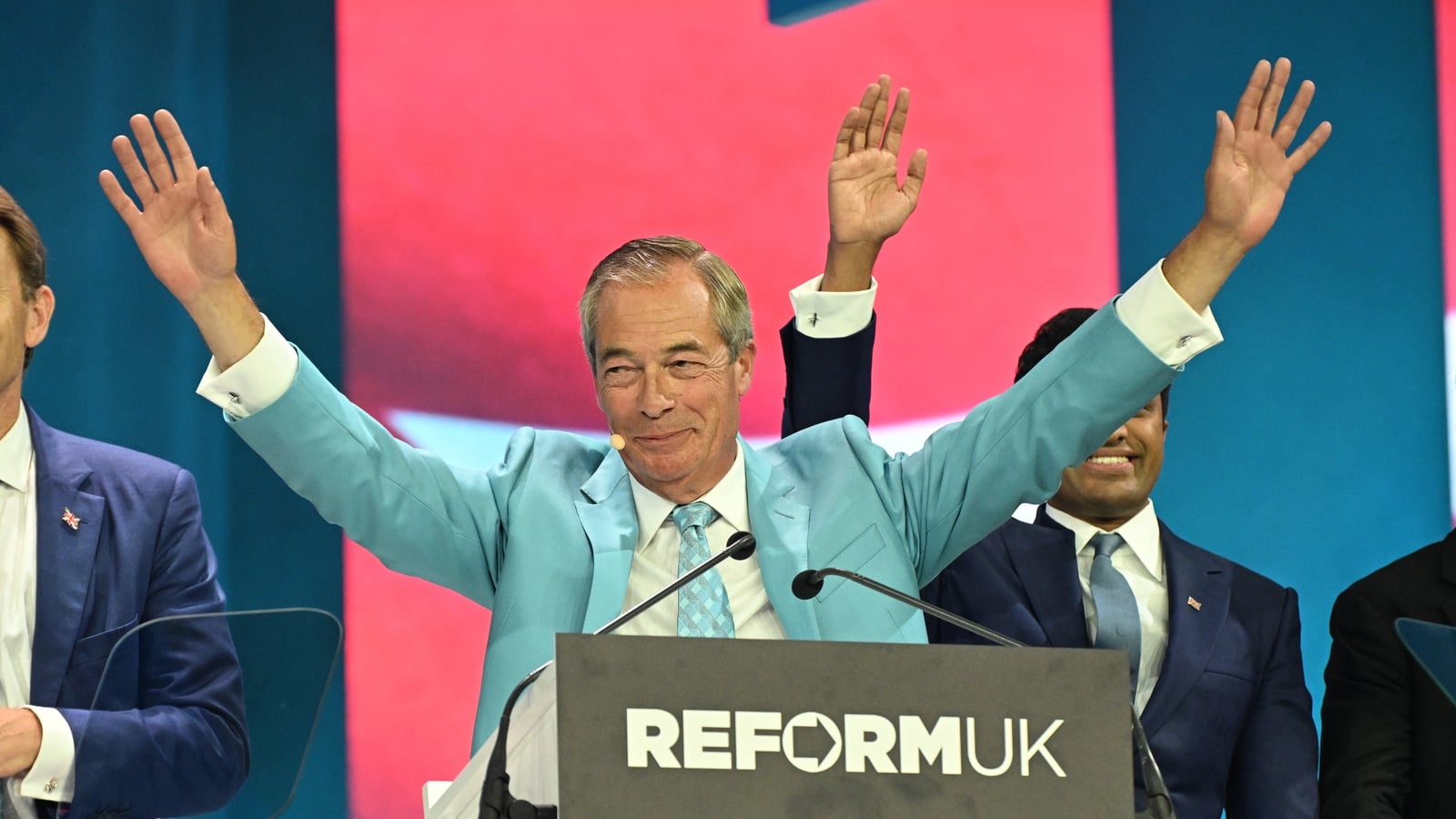
Clad in a pale teal suit and tie, and looking curiously like a US televangelist, Mr Farage closed the 2026 conference yesterday afternoon with the promise of bigger and better to come.
“Over the course of the next few weeks, you will see the other party conferences. They will look dismal and tiny in comparison to what we have been able to do here in Birmingham, and we’ll make sure next year is even bigger and greater and even more fun than this one has been,” he said.
The conference was indeed an impressively organised affair – apart from a brutally bad accreditation check-in arrangement that resulted in massive lines of unbadged delegates and a delayed start.
The main stage set was almost worthy of hosting a Eurovison Song Contest, while the multiple smaller venues around the vast NEC exhibition halls were a constant hive of earnest discussion on how to organise a party and the kind of policy ideas its supporters are interested in.
People we spoke to – a lot of them saying it was their first time at a political conference – were all impressed by the event, if a little shellshocked by the external events that surrounded it. Digesting what happened will take them some time.
For me, the overwhelming feeling was of deja-vu. It felt like a smaller version of the Republican National Convention in Milwaukee in the summer of 2024: similar slick visuals and broadcast quality AV systems, similar language in the breakout sessions (“Woke universities”, “Liberal establishment”, “Left-wing media”, “The blob”).
Similar way of structuring and leading debate by speakers. Similar data gathering on attendees. Similar targets – and tactics for taking them. Similar emphasis on immigration as the key mobilizing force.
This is not really surprising, given Mr Farage’s one-time closeness to President Trump (the relationship has cooled in recent years, as has his relationship with MAGA guru Steve Bannon).
I had last seen Mr Farage in the flesh at the annual CPAC conference for conservatives in Washington DC last year, where he made a speech of the “phoned it in” variety. The event was more memorable for Argentinian President Javier Milei presenting a chainsaw to Elon Musk, to slash bureaucracy in his new job as DOGE head.
The same President Milei, who on Friday, started rattling sabres over the Falkland/Malvinas Islands, which made it easier for some of the right-wing papers in Britain to not feature the Reform UK scandal prominently.
Jordan Bardella, the number two, and rising star, of Marine LePen’s party, the National Rally, was also supposed to speak at that CPAC event, but pulled out on the spot after Elon Musk made a gesture some interpreted as a Hitler salute.
Mr Bardella did turn up and spoke at the Reform UK conference on Friday. Indeed, he was supposed to be the star turn.
Both he and Mr Farage signed a joint pledge for a French government under President LePen and Prime Minster Bardella to co-operate with future Prime Minster Farage by accepting the return to France of migrants attempting to cross the English Channel, something all French governments have resisted doing.
The Reform UK party delegates loved it.
Mr Bardella told them: “Together we must take back control of our borders. If we win the election, our government’s immigration policy will be simple: You do not enter France simply because you have decided to. You enter France because France has allowed you to.
“We will restore control and protection at our borders, and we will send foreign criminals back to their countries of origin”.
While it played well in the hall, it provoked a ferocious attack from the National Rally’s political opponents in France, who accused Mr Bardella of selling out France to the English.
A small taster of what is to come in next spring’s French Presidential election. It is why Marine LePen has been careful not to position the party too close to Donald Trump’s Republicans.
But for Reform UK, there has been a new relationship with MAGA world via the vice President, JD Vance.
He is reportedly very close to James Orr, the man who, until Friday morning, was Reform UK’s head of policy.
He had to step down because he was one of the two officials filmed by the investigative journalists suggesting ways to bend the electoral financing laws.
A most fortuitously timed profile of Mr Orr – an assistant professor of theology at Cambridge University – was published by the Financial Times Magazine this weekend.
Although mostly concentrating on his work as a conservative academic in Cambridge, the lengthy article also detailed his links with vice President Vance, who has visited him at his Cambridge home and who invited Mr Orr to visit him while on vacation in the Cotswolds last year.
According to the article, Mr Vance has described Mr Orr as his “British Sherpa”.
In his Friday speech, Mr Farage attacked the organisation behind the covert filming of Mr Orr and his closest political aide Dan Jukes, saying the “Centre for Climate Reporting”, the forerunner of “Verbatim” had been criticized in the US Congress for its methods, adding: “They have, for over a year and at huge financial cost, targeted figures in Reform UK.
“Make no mistake, this was an exercise in entrapment. I want to be clear: the party has done nothing wrong.”
The Congressional criticism related to a previous sting operation carried out by the undercover reporters against Russel Voght, often described as the intellectual driving force of the MAGA movement.
He is regarded as the principle author of Project 2025, the 900-page plan of action for the second Trump administration.
Unlike Reform UK, his plan was implemented in 180 days – but then again, the USA is a much bigger country.
The method was to be executive orders, justified by a declaration of states of emergency. Which is also similar to the Reform UK plan for the first 100 days: a state of national emergency to force change on the UK.
Mr Vought was secretly filmed by two reporters posing as potential donors, a supposed brother and son in law of a reclusive New Mexico millionaire.
They talked of a potential seven figure donation to Mr Voght’s then-think tank, the Centre for Renewing America. He told them he was busy drafting executive orders for Mr Trump to rule by decree in the first few months of his administration.
The meeting was filmed a week after that Republican convention in Milwaukee, in July 2024 – the one that nominated Donald Trump as the Republican Presidential Candidate, the convention that I recalled strolling through the Reform UK Conference on Friday.
Mr Vought is now the Director of the Office of Management and Budget in the Trump administration – a key job in running the US Bureaucracy the way Mr Trump wants it.
The similarities in the sting operations by this journalist group are quite striking: the weakness in the party defences were the intellectual powerhouses shaping policy on behalf of their campaigning and showbiz oriented political masters, both of whom are content to outsource the detailed grind of actually governing to others.
When it came to the Presidential election, of course, the sting operation against Mr Vought made no difference: it was soon swept away in the bloodshed at Butler, PA and the attempt on Mr Trump’s life at a campaign rally.
But what of Reform UK?
These allegations of improper financing are not a one-off, and are unlikely to go away soon.
But Mr Farage may be inspired by the US example – the public may not care when it comes to election time, such is their eagerness for change. Indeed, Mr Farage’s most often-used phrase when the £5m gift was disclosed was “nobody cares”.
The question for the coming months is will the British public care, or will Mr Farage be proved right? Certainly, the battle for Britain has intensified over the last few days, and the time for decision may be short.
At Conference, Mr Farage repeated his view that Andy Burnham will call an early election in the spring (others have suggested November, in the manner of Boris Johnson when he took control of the Conservatives after ousting Theresa May).
Either way, the logic is that the new Prime Minster wants a mandate from the people, and a new mandate gives them a longer time in office. This government is already at the halfway point in the normal electoral cycle.
That gives Mr Burnham about two years – a short enough time to be at the mercy of events as we head into what looks like increasingly turbulent waters ahead.
But Mr Burnham has spoken about a ten year programme to transform Britain, requiring a Tony Blair-like two or three electoral victories. That logic impels him to go to the country sooner rather than later.
Mr Farage obviously wants Reform UK to supplant the Labour party as the biggest in Parliament, and for him to become Prime Minster. But to achieve that he has to first supplant the Conservative Party by getting Tory voters, particularly in Southern England, to desert the party.
Such a dramatic re-alignment has happened before, 100 years ago, when Labour supplanted the Liberals.
Obviously the Tories, the oldest and most electorally successful political party of the all, want to avoid the fate of the Liberals, and are fighting an existential fight against Reform UK.
The latest financial shenanigans is a gift for its leader Kemi Badenoch, who said: “I thought those revelations were extraordinary. I watched that expose twice. The second time I needed a stiff drink because I could not believe what they were doing.
“Reform UK clearly believed that the rules don’t apply to them. There’s absolutely no way that I would have that sort of behaviour in the Conservative Party. What I saw on camera looked like illegal activity. I understand that they have been referred to the police. It’s definitely time for a police investigation.
“This is just yet another thing on top of Nigel Farage’s £5m which he can’t really explain. The investigations into George Cottrell … This is a party that says it wants to run the country, but if it doesn’t believe in the rule of law, then why should they be allowed to make our laws?”
I would love to say let’s watch the opinion polls for the impact “Oystergate” has had on British politics, but that whole business had been badly tarnished by this affair too. As have the newspapers that published Page One stories based on the unattributed polling that was supposed to be paid for by undercover reporters on a sting operation – the Times and the Daily Telegraph.
The fact that two of the UK’s leading newspapers were, they say, duped, and the polling firm that carried out the research has been reprimanded by the Opinion Pollsters professional organisation adds to the impact the Channel Four News film.
It has exposed a cosy arrangement between some polling companies and right-leaning newspapers which, at the very least, didn’t ask enough questions about where this interesting, Page One-worthy polling information had come from. Both papers had to issue statements on the polling affair on Friday.
There ought to be some deep soul searching about the nature of political polling and its use by media organizations to generate stories that fuel the electoral fire. But don’t hold your breath. The business of politics and the media runs on polling information, so it’s going to keep on coming. We may be addicted to it.
Opinion polling is now indicating that Reform UK has been on a gently downward slope over the past eight months or so.
From the start of the year, when the unattributed poll in the Daily Telegraph that the investigative journalists agreed to pay for was suggesting a Labour Party wipeout in the local elections, with Reform UK in first place, to this weekend, the average “poll of polls” data shows Reform UK slipping from first place on abut 30% to scrapping with the Tories for third place, netting just under 25%.
But the spread between the three parties is pretty close to the margin of error for polling. As autumn returns to London, the nature of the three-way fight in the upcoming Battle for Britain is becoming clearer.
And it is going to be vicious.