
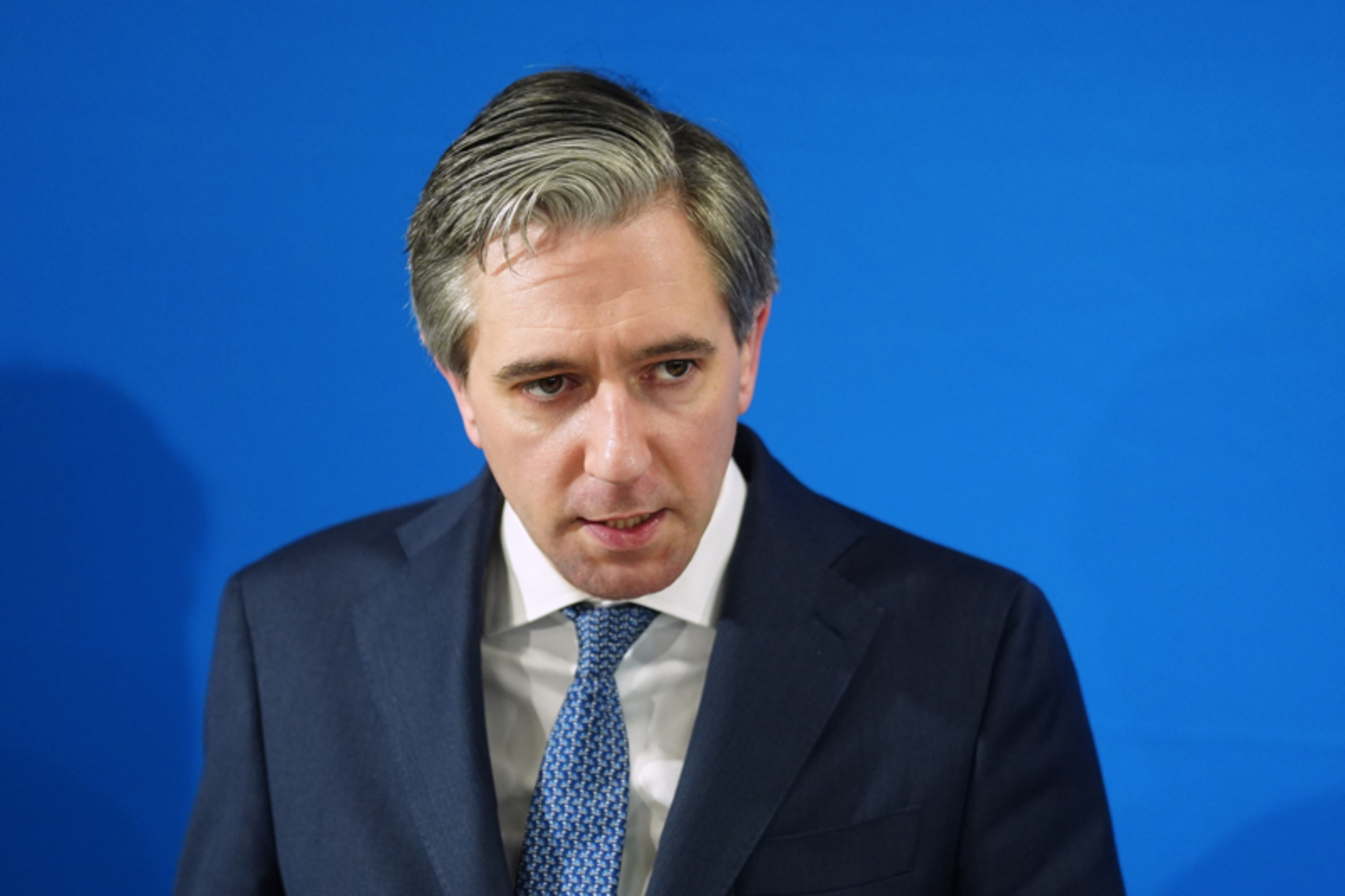
Under the rule, investors in exchange-traded funds (ETFs) pay a 38pc exit tax every eight years on gains on the investment, even if the gains have not been realised
Finance Minister Simon Harris’s failure to reform archaic “deemed disposal” tax rules risks Ireland’s credibility as an international funds centre and threatens to undermine the success of his proposed new investment scheme, a senior figure in the Irish funds industry has warned.
“There’s a risk around our credibility as an international funds centre,” said Andrea Kelly, chair of the Irish Funds Industry Association.
Kelly said it was “disappointing” that Minister Harris did not announce an expected reform of what she described as an archaic measure when he published his investment scheme roadmap last Monday morning.
Under deemed disposal, investors in exchange-traded funds (ETFs) pay a 38pc exit tax every eight years on gains on the investment, even if the gains have not been realised.
“So these are paper gains and someone may not have cash to pay the tax. So in practice people end up having to redeem some of the investment to generate cash to pay the tax. And that breaks the compounding effect, which is the real benefit of investing in those types of funds.
“Everyone accepts it’s a problem and it doesn’t make sense that they are not doing anything on a problem that you’ve already diagnosed,” said Kelly. “Officials accept it’s a problem. Government accepts it’s a problem. They’ve recommended in their own reports, as far back as October 2024, that they need to abolish deemed disposal.
“Our view very firmly is that the Government should be taking the opportunity to abolish deemed disposal in the Finance Bill 2026,” she said.
Not doing so, she said, would “affect our credibility as a jurisdiction on delivering effective change and as a leader in international financial services”, she said.
Kelly welcomed last week’s publication of Minister Harris‘s Roadmap on Taxation of Retail Investment, the centrepiece of which was his proposed new tax-efficient Personal Investment Account (PIA) for Irish retail investors.
She welcomed the acknowledgement that “the current tax treatment of investment funds, ETFs and other investment products as overly complex, creates distortions and discourages long-term investing.”
But, she said, there was a risk that Minister Harris’s new PIA scheme would be brought in without the proper building blocks to make it a success.
The deemed disposal debate was “symptomatic of the incremental and piecemeal approach” that was taken in Ireland to “fixing structural issues in terms of regulation, legislation, the tax code”.
“We have that very incremental, piecemeal approach and I think we need to be more strategic,” she said.
Kelly said the failure to include the much-needed reform until Budget 2028 and beyond was disappointing and had taken away from the announcement of the new investment accounts.
“We really welcome that they are bringing in the PIA,” she said. “But there’s a huge amount of negative commentary across the sector now. Instead of a really positive focus being on how PIAs can be a success, people are talking about the failure to address deemed disposable.”
She said the funds industry was willing to work with the Government to help it reform the system more quickly.
“Doing so would provide certainty for investors, address the most widely recognised flaw in the current regime and show that 2028 is the completion point for broader reform, not the starting point for action.”
Ireland is the third-largest domicile for investment funds globally but Irish people were not benefiting as much as they could from this success, she said.
“As an industry based in Ireland we are very, very successful globally. But we want our citizens, our neighbours, our friends, to be able to participate in what we are facilitating for international investors.”