
Advertisement
THEATRE
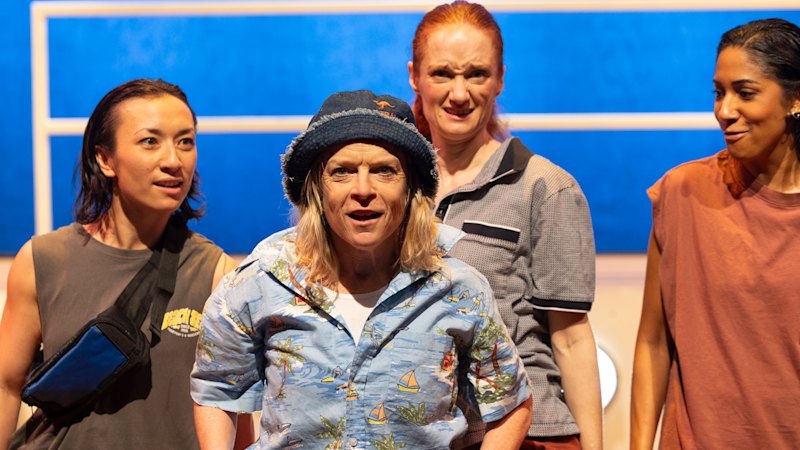
Savages ★★★★★
Theatre Works, until September 12
I first saw Patricia Cornelius’ Savages at fortyfivedownstairs in 2013. Set among four middle-aged blokes on a cruise ship, this funny, pathetic, deeply disturbing exploration of misogyny and masculinity is one of her finest plays, though I didn’t think the all-male cast did it justice at the time. What’s it like with a female-identifying and nonbinary cast? Well, it’s funnier, sadder, and even more disturbing, crafting a paradoxical authenticity from the artifice of cross-gendered performance.
It must be said that such performance has long had a complex relationship with misogyny and patriarchal culture. The boys who played women on the Elizabethan stage owed their careers to women’s oppression, for instance, even as the roles they originated could subvert it.
In 21st-century theatre, no close observer could miss the fact that the whirligig of time has brought in her revenges. From the drag kings in Emmanuelle Mattana’s hit play Trophy Boys to Kate Mulvany’s extraordinary performance as Richard III for Bell Shakespeare, our sharpest and most theatrical critiques of masculinity have largely come from bending or upending the gender binary.
Advertisement
Kitan Petkovski’s production wrong-foots the audience from the start. The actors arrive onstage as female-presenting characters in summery feminine attire. They make zero effort to pretend to be men, and it isn’t until they unload their troubles and board the ship that their transformation into blokes occurs.
It’s a winding-up that will be unwound to piercing effect in the play’s final moments, well after all the banter and bullying, the competitiveness and camaraderie of these larrikin figures have been stripped bare. Hardcore misogyny, and the bodies it victimises, are revealed simultaneously – a potent moment of truth that left the opening night audience in stunned silence.
In between, the tragedy of blaming women for a patriarchal system (that’s always been a Faustian bargain for men) arrives through performances that are just as astute in the realm of comedy.
Zoe Boesen, AYA, Laila Thaker, and Nicci Wilks avoid stereotype and refuse the soft option of bare caricature. The psychology underlying performative masculinity – what it lets men get away with, and the wounds it inflicts – is intricately realised. And the exquisite choric structure of Cornelius’ play is handled with an empathic command of the disjunction between how these men privately think and feel, and how they behave when their mates are the intended audience.
Advertisement
It’s brilliant theatre at every level and, given how theatrically heightened its framing of gendered inequality can be, I wouldn’t be surprised if cross-gendered performance becomes the norm for future productions of Savages.
Reviewed by Cameron Woodhead
DANCE
Two Blood ★★
Monash Performing Arts Centre, season finished
Co-choreographed by Daniel Riley, Jasmin Sheppard and Brianna Kell with Australian Dance Theatre’s dancers, Two Blood is a decidedly wobbly piece of dance drama. It’s so wobbly, in fact, that during its many lulls, I worried the whole thing might just fall apart.
The starting point is the discovery of bodies in a creek: a Tagalaka woman and a Cantonese man, their bones locked in an embrace. It is an unsettling symbol of entangled communities but, alas, the lovers and their fate soon disappear among the production’s splintered parts.
Advertisement
There are memorable fragments. Carly Sheppard brings her unique physicality to multiple scenes, while Yilin Kong has created a strong solo for the middle section. But there is also a lot of material that feels inconsequential and underdeveloped. It’s all very disappointing, given the talent involved and the resources at their disposal.
There is extensive text provided by playwright S. Shakthidharan, who is also a co-director, but it proves surprisingly flat: mutterings and impressionistic monologues circling themes of belonging with nothing that resonates strongly with the movement.
The show’s highlight is James Howard and Andy Qilong Chia’s score: hypnotic grooves, crispy synth loops and interesting rhythmic change-ups. It’s a shame the choreography is so determinedly unmusical because this stuff is wonderfully danceable.
The musicians appear on two video screens wheeled around the stage—one of the show’s more effective devices. Matthew Adey’s superb lighting design supplies the otherwise missing drama, especially when intense reds blaze outward at the audience.
These sorts of collaborations do not need to produce a seamless whole. Difference should remain active. There should be an encounter in which forms rub against one another, and spectators remain conscious of their own position.
Advertisement
Certainly, Two Blood presents us with differences but it fails to activate them. Its drab fragments merely coexist – without anything happening between them.
Reviewed by Andrew Fuhrmann
MUSIC
Grand Organ Festival ★★★
Melbourne Symphony Orchestra, Melbourne Town Hall, September 3-5
Celebrating 120 years since its first concert under founding conductor Alberto Zelman, the Melbourne Symphony Orchestra returned to the Melbourne Town Hall, site of its first appearance. This also provided the opportunity to experience the hall’s grand organ over a series of three concerts.
Saint-Saëns’ Symphony No. 3 (“Organ”) seemed an inevitable finale to the festival opening. Firstly, young Finnish conductor Emilia Hoving gave ebullient accounts of Latin-flavoured items: four dances from Ginastera’s Estancia, Bizet’s Carmen Suite No. 1 and Danzón No. 2 by contemporary Mexican composer Arturo Márquez. A historical nod came with the Nocturne from Mendelssohn’s A Midsummer Night’s Dream, played at the orchestra’s second-ever concert.
Advertisement
Containing far more than the theme from the Australian movie Babe, the symphony is a masterly woven musical tapestry, displaying Saint-Saëns’ superb skill in form and orchestration.
Hoving was at her best spinning the luxuriantly ardent melody in the slow section. Negotiating the work’s rhythmic and contrapuntal complexities led at times to some slightly unsteady ensemble and a few of the tempos in the symphony’s faster sections could have been reined in, most notably that containing the familiar march.
Those expecting an apocalyptic outburst from the organ would have been disappointed; organist Joseph Nolan was at pains not to overpower the orchestra, even to the point of arguably creating some small sense of anti-climax.
Featuring the combined choruses of the MSO and Tasmanian Symphony Orchestra, the second program centred around the Requiem by Maurice Duruflé. Fauré’s Cantique de Jean Racine and Duruflé’s four motets on Gregorian themes set a suitably Gallic mood beforehand.
It was a missed opportunity that the Requiem, a choral gem similar in mystic mood to that of Fauré’s setting, was not presented in its original orchestrated version, but rather in the version for organ alone, leaving Nolan to mitigate a dry acoustic.
Advertisement
Even so, seasoned chorus master Warren Trevelyan-Jones ensured the well-prepared singers presented an attractive tone, attentive to the meaning of the text. Mezzo-soprano Sally-Anne Russell seemed at times overpowered by the accompaniment in the Pie Jesu, while baritone Simon Meadows trod a fine line between operatic drama and religious fervour.
To round off the festival, Nolan gave a solo recital featuring two of the instrument’s most popular works: Alexandre Guilmant’s Sonata No.1 and Widor’s Organ Symphony No.5. After some flashy displays of prodigious technique and the organ’s brute strength, the festival culminated in a well-controlled account of Widor’s celebrated Toccata, enthusiastically received.
Admirable though the idea of this organ festival was, it does raise the question as to what sort of relationship the MSO intends to have with the so-called “king of instruments”.
Lamentably, Arts Centre Melbourne clearly has no intention of installing a pipe organ in Hamer Hall and the orchestra has abandoned its once-popular Town Hall series, with the 2027 season brochure listing no concerts there. So, despite strong audience support for hearing the organ with the orchestra, is the instrument destined to become a Cinderella with no Prince Charming in sight?
Reviewed by Tony Way
Advertisement
THEATRE
GRIMM ★★★
Arts Centre Melbourne, until September 12
Brisbane-based Shake & Stir celebrates its 20th anniversary with a vaudevillian mash-up of Brothers Grimm fairytales. It’s a diverting, if lightweight, entertainment that ricochets with frenzied comedic momentum between the darkness and doom of the original folk stories, and the happily-ever-after whitewash of their Disneyfied progeny.
Audiences around the country might be familiar with the company’s popular adaptations across children’s and adult theatre. They’ve toured everything from Roald Dahl’s The Twits to George Orwell’s 1984, and this show lands in some twisted panto-zone in between.
The plot is a precisely constructed chaos labyrinth of fairytale mayhem. Passages fork through story beats from Red Riding Hood, The Robber Bridegroom, Beauty and the Beast, and so on, though the central tale is Aschenputtel – the super-grim German folk version of Cinderella in which the “ugly stepsisters” hack off their toes to fit into the slipper and … get their eyes pecked out by doves at the wedding afterwards.
Advertisement
You can see why Disney didn’t go there, yet this flamboyant panto fears only the dull moment. It heaves with droll invention: splashes of comedy horror, silly sideswipes at some of the obnoxious politics underlying fairytales, and the meticulously choreographed slapstick and japery of commercial farce.
True, GRIMM is a bit light on music. In any event, the smattering of pop cabaret and musical theatre homage is performed with great dynamism and charisma by the four-strong ensemble (Aljin Abella, Helen Cassidy, Henry Rollo, Nelle Lee), and you wish there were more Big Bad Wolves and Red Riding Hoods singing it out.
As a satirical subversion of fairytales, however, GRIMM can’t match the highest level of musical theatre. It pales in comparison to the sardonic sophistications of Sondheim’s Into the Woods, say, or even Meow Meow’s apocalyptic cabaret reworkings of Hans Christian Andersen stories. What GRIMM does give us is much more lowbrow, but no less skilled. If Dracula’s theatre restaurant had ever put on a fairytale-themed show, it might have looked something like this cartoonish crowd-pleaser.
Sadly, the Melbourne Dracula’s was staked for good, after 37 years of operation, in 2017. This show may well find a niche among its former clientele, with an energetic mix of undemanding, unpretentious performance styles – theatre restaurant cabaret, pantomime, and inane commercial comedy – geared to ensure popular appeal.
Reviewed by Cameron Woodhead
Advertisement
JAZZ
Stephen Byth Quartet ★★★★★
The JazzLab, August 30
Stephen Byth last performed in Australia in 2024, when he competed in – and won – the National Jazz Awards at the Wangaratta Jazz Festival. Two years later, he has returned to record a studio session offered as part of the prestigious award.
Byth (a Melbourne-born saxophonist and composer) has been living in the US for the past eight years, but has maintained his connection to the local jazz scene. He’d never worked with two of the three musicians he selected for this new recording – bassist Yunior Terry and drummer Ebs Daramola – but knew they’d make the perfect rhythm section for the music he had in mind.
He was right. The day after the studio session, Byth’s quartet performed the freshly recorded repertoire in front of an eager crowd at JazzLab, sounding more like a seasoned ensemble than a group assembled for a one-off project.
Advertisement
This was partly due to the kinetic rapport between Terry and Daramola, whose rhythmic beds were wonderfully dynamic and alive. Milton Nascimento’s Paula e Bebeto was buoyed by exuberant Afro-Latin rhythms that sashayed beneath Byth’s animated tenor sax; Keith Jarrett’s De Drums was underpinned by an irresistibly groovy bassline and backbeat.
On guitar, Theo Carbo was equally responsive and flexible, whether he was doubling Byth’s melody lines in deft unison or creating warm, resonant waves flecked with tinges of distortion and grit.
While Byth is a master at making other artists’ tunes sound like his own (Egberto Gismonti’s Agua e Vinho was especially memorable, the sax gliding across the melancholic theme with exquisite tenderness), he’s also a supremely gifted composer.
Pain to Progress felt like a suite in miniature, its narrative arc containing angular, twisting melodies, alluring chord progressions, propulsive rhythms and marvellously expressive solos from Byth and Carbo.
Here’s hoping this superb one-off encounter – brimming with energy and potential – can develop into an enduring collaboration.
Reviewed by Jessica Nicholas
Advertisement
MUSIC
Vera Blue | Modern Rituals Tour ★★★★
Northcote Theatre, August 26
We’re in a forest in the middle of inner-city Melbourne. White gauze curtains form a mysterious cubicle on the stage, imprinted with the ominous shadow of bare trees. A figure steps out from the curtains, large black angel wings cutting a striking silhouette. She opens her mouth and sings.
The woman is Celia Pavey, better known as Vera Blue. She rose to fame in 2013 as a traditional folk singer competing on The Voice and has since become an electro-pop star, but her startlingly controlled voice remains the centrepiece of it all.
This show – on her first headline tour of Australia since 2022 – marks the release of her third album, Modern Rituals. There’s something ritualistic indeed about the way that Pavey performs, moving like an otherworldly spirit as she leads the spellbound crowd.
Advertisement
The live Vera Blue experience does a lot with a little. Pavey is accompanied by two band members on drums and guitar/keys, occasionally jumping on the keys and a wind synthesiser herself. That curtain becomes a portal to different worlds, as new images appear and the journey continues; Pavey disappears behind it twice to emerge in new costumes, as the colours on stage transform from dark to light.
Pavey’s vocal purity stands in stark contrast to the shuddering industrial textures that colour her new record, but she has range. On Private, her vocals transform into a shouted staccato, and elsewhere, they are doubled to create a self-contained harmony. In The Corner shows off her higher register, and on Rituals, bathed in the spotlight, her voice is the sole focus.
The energy ramps up as the two band members create a club-like atmosphere with heavy electronic beats, leading into the ecstatic Go Lucky and older hit Regular Touch. Here, there are glimpses of Pavey as a potential arena superstar – one can only imagine what she could do on a bigger stage, whipping the room into a euphoric dance party.
But it’s the voice that is the heartbeat of all of this. With just a guitar, Pavey encores with Dolly Parton’s Jolene, paying tribute to the country superstar who passed away just that morning. She encourages the audience to sing along, leading an impromptu choir through a rousing rendition, before closing with her recent cover of Radiohead’s Creep for Triple J, rising to shivering heights on the bridge. Whether she’s singing her own songs or other people’s, Pavey’s voice is a gift.
Reviewed by Giselle Au-Nhien Nguyen
Advertisement
DANCE
GG ★★★
Now or Never Festival, Arts House Melbourne, until August 30
Technology is part of the originary grammar of the street dance imagination. Think of popping, strobing, animation and the robot – and of the electronic music that so often accompanies these forms, with its insistent, machinic beat.
And think also of the illusions: slow motion and stop-motion, fast-forward and rewind, pulsation, motorised articulation and signals travelling through a system. The fascination of street dance is the way it gives a body to these inorganic rhythms of everyday life.
GG – a collaboration between street-dance partnership CONJAH and new-media collective PSEUDO, presented as part of the tech-focused Now or Never festival – continues this tradition of strange embodiments by restaging the constrained movements of video-game characters.
Advertisement
The opening is disarming and exceptionally beautiful. A wagon rolls onstage like a medieval puppet booth. Reaching into its tiny theatre from above, Ooshcon uses one hand to create a happy homunculus. It’s an extreme – albeit comic – demonstration of control and illusion-making.
The curtain then rises on Ooshcon, Jahra Wasasala, Harrison Hall and Byrin Mita, wreathed in smoke. Here they resemble non-player characters in video games: stiff figures with tiny repertoires of precisely repeated gestures, shuffling around, waving, dying.
It’s very droll: not hyperreality but hyporeality. GG reproduces the glitches and laborious spatial calculations of older games – turn this way, then that, just to approach another character at the correct angle. Embodied onstage, these familiar limitations become wonderfully strange.
The game character is then linked to its prototype, the puppet, in Wasasala’s very fine floor-bound solo. They seem tangled in invisible strings, unable to plant their feet. A sheet engulfs the collapsed body; when it lifts, the puppet seems to float, unencumbered, like Petrushka’s ghost.
Advertisement
As a finale, the audience is brought on stage as rough cypher. Movements are translated to avatars in a game projected at the back of the stage – a digital playground created by PSEUDO, whose lead artists here include Hall, Sam McGilp and Henry Lai-Pyne.
The conceptual progression is suggestive. Puppets and game characters imitate humans; humans then imitate those figures; finally, avatars imitate the humans. There is some opportunity for audience participation here, but as a spectacle, it’s a bit flat.
GG contains several virtuoso vignettes. Overall, however, I think less would be more: less clamorous sound, less video, less sensory clutter.
Its best ideas deserve a quieter theatrical frame – the maximal attention that only a less maximal production can give them.
Reviewed by Andrew Fuhrmann
Advertisement
DANCE
Networked Flesh ★★★
Now or Never Festival, Victorian College of the Arts, until August 28
Directed and choreographed by Megan Beckwith, Networked Flesh features a huge ensemble of second-year students dancing on small platforms around Studio 221 while audiences roam freely, viewing an augmented version of the performance through their phones.
Point your device at a stage and soft, pink, flesh-like forms suddenly appear. You might get dozens of small organisms hovering around the dancers or a single globe pulsating or a pair of them seeming to orbit the moving body, as though caught in its gravitational field.
The audience thus provides part of the stage machinery. They also help shape the event. Over the course of the 45-minute work, spectators choose their own journey through the space, while the dancers continually migrate between platforms and an off-stage area.
Advertisement
Depending on your setup, Networked Flesh can require some initial mucking about before the augmentation works smoothly. But that friction is also true to contemporary life. So few activities now – even going to the theatre – can be enjoyed without a smartphone.
And there is a pleasingly lo-fi underside to the apparatus. The app is activated by QR codes pasted onto signs that are manually exhibited by the performers. Craft glue and cardboard thus become load-bearing components in this gaudy mesh of flesh and code.
The dancers perform vigorous, but relatively simple, contemporary phrases that appear to respond to the changing digital patterns. But, of course, in the moment, they are effectively blind to the images of quivering flesh that crowd around them.
This production comes out of a dance school rather than a laboratory, so it’s not surprising that the dancing is more advanced than the augmentation. And what I find most interesting here is the opportunity to consider how this mediation alters the experiences of the dancers.
Advertisement
What feedback do they receive from an audience watching partly through screens? Has something in the reciprocal relationship been disrupted? Or has that relationship, like the visible space, only been augmented into a more ambiguous form?
At times, it all feels a little sinister: a lone dancer surrounded by a silent crowd pointing phones while an unseen network transforms their image. Loose shifts, socklets and the athleticism of the bouncing bodies set up an unmistakable atmosphere of voyeurism.
But perhaps the phones introduce a different sort of thrill. Is it a new kind of intimacy for the dancers? A sense of excitement that is heightened by doubts and anxieties about what the audience can see? A kind of double exposure?
Reviewed by Andrew Fuhrmann
The Booklist is a weekly newsletter for book lovers from Jason Steger. Get it delivered every Friday.
You have reached your maximum number of saved items.
Remove items from your saved list to add more.
More:
- Melbourne live reviews
- Arts
- For subscribers
- Performing arts
- See & Do
- What’s on
- Victoria
- Review
- Live music
- Live music
- Review
Andrew Fuhrmann is a dance critic for The Age.Jessica Nicholas is an arts and music writer, specialising in contemporary jazz and world music.Giselle Au-Nhien Nguyen is a writer.Connect via X.AdvertisementAdvertisement