
Fifty years of census reveals shift in southern right whales breeding off AustraliaBy Jenae Madden and Emma Pedler
Posted Sun 6 Sep 2026 at 12:00pmSun 6 Sep 2026 at 12:00pmSun 6 Sep 2026 at 12:00pm
In short:
Half a century of aerial tracking off the Great Australian Bight has revealed insight into the breeding patterns of the endangered southern right whale.
This year’s data show nearly twice as many whales are travelling solo rather than in cow-calf pairs, compared to 2023.
What’s next?
Long-term data reveals the calving cohort cycle is extending from every three years to every five.
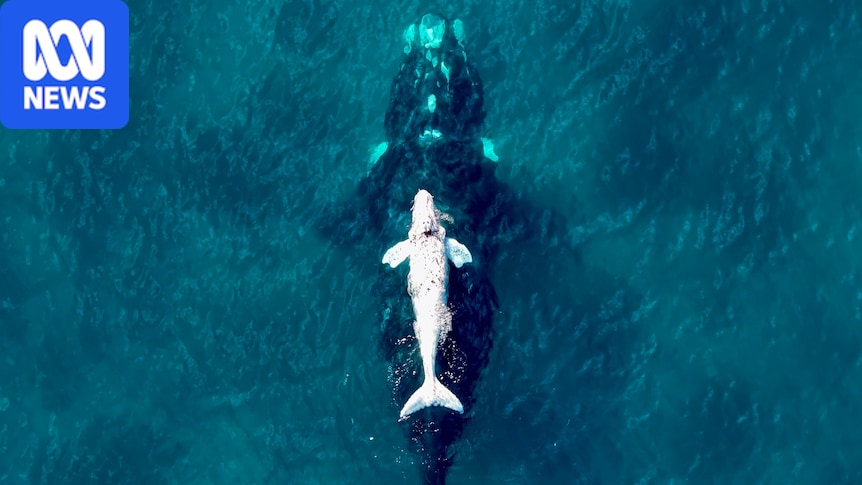
Each winter, southern right whales move north from the Antarctic to the southern Australian coastline to breed in warmer waters.
For 50 years, researchers have been tracking the great whale’s migratory patterns between Fremantle in Western Australia to Ceduna on South Australia’s far west coast, revealing a key change in their birthing cycles.
Murdoch University senior researcher Joshua Smith, who led this year’s census, recorded 520 whales across the south-west, including 235 cow-calf pairs.
The figures show a decline from last year’s count of 646 individual whales and 304 calves, and a 20 per cent drop in individual sightings compared to a decade ago.
“Since 2011, there has been a stalling in the population,”
Dr Smith said.
Australian Right Whale Research Program chief scientist Claire Charlton has conducted land-based monitoring from the head of the Great Australian Bight Commonwealth Marine Park on the Yalata Indigenous Protected Area.
She said that while total whale sightings were down this year, the Bight still saw a gathering of 61 mother-calf pairs, making up more than 30 per cent of the south-west total.
“It’s a conservation success story for the marine park,” Dr Charlton said.
Alongside breeding pairs, the whale census tracked about 50 unaccompanied whales without calves.
Dr Smith said while traditional calving sanctuaries, including the Head of Bight and Israelite Bay in Western Australia, remained active, overall activity was unusually quiet.
Increased intervals between whale calving
Dr Smith said the long-term data revealed southern right whale populations were stagnating.
“The population isn’t really increasing to any extent,” he said.
“There’s actually indication that calving rates are dropping.“
A decade ago, it was thought whale breeding cycles restarted every three to four years.
Dr Smith said one of the major findings in the long-term data was that those intervals were now pushing every five years.
“The three-year cycle that we used to always pride ourselves on is extending,” he said.
Dr Smith said it was evident through strong highs and lows from year to year.
“It takes 10 years and maybe two or three cycles of a reproductive female coming back to the coast before you can really see what’s going on in the population,” he said.
“That’s why it’s so important to have this long-term data.”
Why the change in whale behaviour
Dr Charlton said changes in water temperatures were impacting marine food webs and breeding patterns.
“Their breeding cycle is directly linked to their body condition and their body condition is linked to their feeding success,” she said.
She said as the ocean warmed, there were fewer sea lice, which leads to fewer krill to feed the great whales.
“[Whales] are also under pressure from krill fisheries and have less prey available. That’s causing stresses to them and their long-term recovery.“
She said they may hold off breeding due to food scarcity, explaining why breeding cycles were pushing to the five-year mark.
While the whale survey was conducted off the Great Australian Bight, Dr Charlton said attention should also be paid to whale populations in Victoria and New South Wales.
“South-eastern populations of southern right whales have experienced low sightings and no female calf pairs,” Dr Charlton said.
Hotspots for southern rights
Dr Smith said hotspots for populations were in Israelite Bay, Point Ann and Point Charles along the south coast of WA and in SA at the head of the Bight.
Whaling in the 20th century reduced the population, but increased sightings in Western Australia in the 1970s led scientist John Bannister to begin an aerial survey to observe their recovery in 1976.
The Western Australian Museum’s annual southern right whale aerial survey continues to paint a picture of changing whale behaviours off the continent’s south coast.