
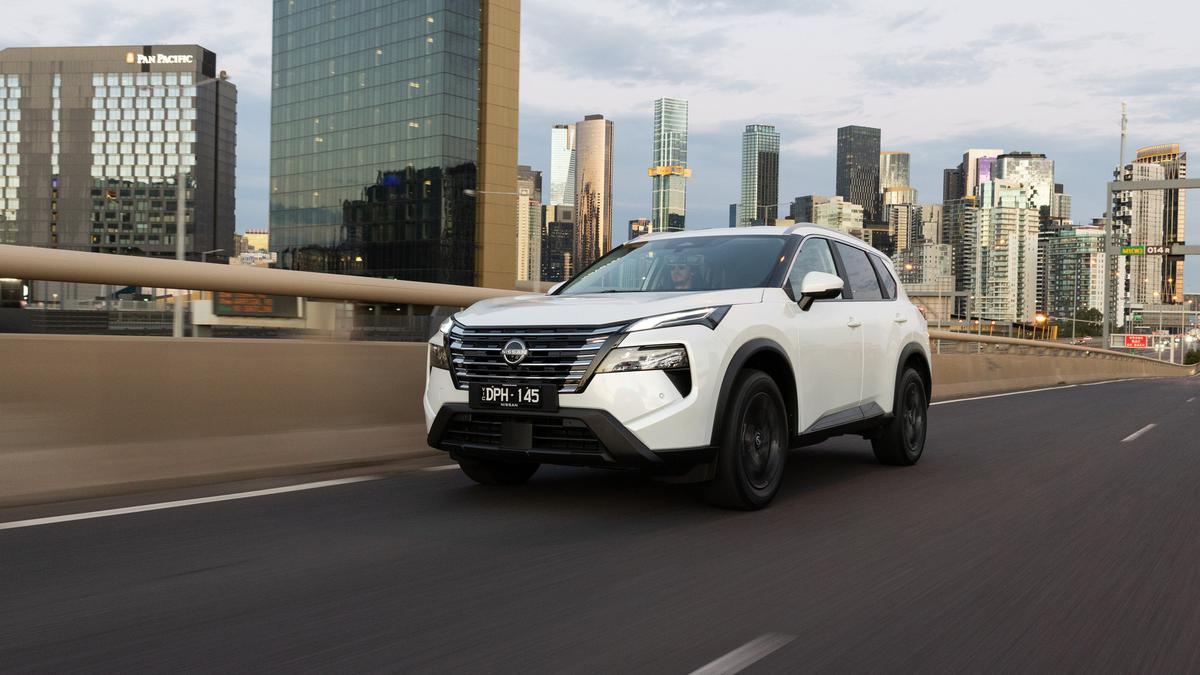
Finally, the fourth-generation (T33) Nissan X-Trail, launched in America as the Rogue in 2020, and in Australia and Japan in 2022, has been updated with a refreshed exterior, extra tech and new cabin materials.
There are petrol and hybrid variants in the range with two-wheel drive and AWD options — and I’ve got the 2.5-litre petrol engine 2WD ST-L spec here, which is $42,780, plus on road costs.
What’s new?
The grille, front and rear bumpers and LEDs have been updated. Some grades get new 18-inch and 19-inch wheels.
There are also two new exterior colour options — Deep Ocean Blue and Everest White — plus a couple of interior colour changes. I’m loving Chestnut quilted Nappa leather, which is available only on the flagship Ti-L. Otherwise, it’s black.
It’s a big step up, with MY 26 grades now including, as standard, wireless Apple CarPlay and Android Auto, a 12.3-inch infotainment screen and a three-year subscription to Nissan’s connected car services, which gives you access to various functions, including security tracking, remote operations (like locking and unlocking doors) and geofencing though a smartphone app.
Specifically on the ST-L, there’s now leather “accented” upholstery (previously synthetic), a leather-wrapped steering wheel and the front passenger gets 10-way power seat adjustment, including two-way lumbar support, matching the driver’s seat and replacing the previous manual adjustment.
Oh, front seats are heated.
And from the ST-L grade and above, there’s also an “intelligent” 3D around-view monitor (otherwise a 360-degree camera) with eight camera angles — which is handy if you’re stuck in between a tree and a fence in a narrow alleyway — and lets you “rotate” a three-dimensional image of the vehicle and its surroundings.
I had to use it — once.
It also includes T-junction view for better visibility when turning and “skeleton hood” view — which is similar to Mercedes-Benz’s “transparent hood” and Mazda’s “see-through view” — essentially allowing a driver to look through the car body, making it easier to navigate car wash tracks, avoid curbs and see hazards on the road that are normally out of sight.
Is it safe?
All X-Trails with a build date from August 2022 have a five-star ANCAP safety rating based on testing of its partner model, the Qashqai, with 91 per cent for adult-occupant protection, 90 per cent for child-occupant protection, 74 per cent for vulnerable road-user protection and 97 per cent for safety assist.
Note, the rating is for six years (like all ANCAP ratings) and expires in December 2027.
Dual frontal, side chest-protecting and side head-protecting airbags are standard, as is a centre airbag which provides added protection to front seat occupants in side-impact crashes.
All variants have comprehensive ADAS features, including autonomous emergency braking (car-to-car, vulnerable road user, junction assist and back-over) as well as a lane-support system with lane-keep assist, lane-departure warning, intelligent forward-collision warning, emergency lane keeping and an advanced speed assistance system.
Nissan’s ProPilot, effectively semi-autonomous drive technology, is included on ST-L and above grades. It’s easy to flick on and off — and is impressively accurate in keeping set speed, distance and position, even driving downhill. You still have to keep your hands on the steering wheel, obviously.
Then and now
Initially unveiled at the 2000 Paris Motor Show, the X-Trail arrived in Australia in late 2001, with the current fourth generation debuting at Auto Shanghai in April 2021.
Current models are available in a choice of two and all-wheel drive with a 2.5-litre four-cylinder petrol engine and CVT automatic transmission — or with an electrified (series hybrid) 1.5-litre three-cylinder petrol engine powertrain Nissan calls e-Power.
There’s also a new, more “rugged” 2.5-litre AWD Rock Creek grade with distinctive styling built on the ST-L grade.
Pricing, excluding on-road costs
2WD X-Trail
+ 2.5-litre ST: (5 seat): $38,305
+ 2.5-litre ST-L (5 seat): $42,780
+ 1.5-litre ST-L e-Power: $45,990
+ 1.5-litre Ti e-Power: $50,915
+ 1.5-litre Ti-L e-Power: $54,715
4WD X-Trail
+ 2.5-litre ST: (7 seat): $41,305
+ 2.5-litre ST-L (7 seat): $45,880
+ 2.5-litre Rock Creek: (7 seat): $48,315
+ 2.5-litre Ti (5 seat): $51,580
+ 2.5-litre Ti-L (5 seat): $54,580
+ 1.5-litre ST-L e-Power (5 seat): $49,080
+ 1.5-litre Ti e-Power (5 seat): $54,580
+ 1.5-litre Ti-L e-POWER (5 seat): $58,380
What’s it like?
It’s a medium SUV, so competing against the Toyota RAV4, BYD Sealion 7, Hyundai Tucson, Mazda CX-5 and Kia Sportage — in that order — in its segment (under $65,000).
The cabin is family-friendly, with wide-opening doors at the back that make it easy getting kids in and out of car seats, plenty of head and legroom, dual-zone AC controls, wireless charging, four USB-Cs (there’s both data and charging up front) and wireless phone connectivity that pretty much sets itself up — and doesn’t drop out.
The finish is mid-spec — but the air-flow control panel feels irritatingly plasticky every time I touch it. Otherwise, most things, including volume, can be adjusted from the steering wheel.
Six-speaker sound system is OK; only the Ti-L gets 10-speaker Bose.
Maximum braked towing capacity is 2000kg, you get a temporary spare wheel and boot space is 585 litres (expanding to 1396L with rear seats folded), with configurable floor space and four tie-down hooks — but the ST-L gets only a manual tailgate.
The drive
It’s 2WD, with power sent to front wheels. Quoted outputs are 135kW at 6000 revs /244Nm at 3600 revs, which is plenty for regular driving.
The ride is comfortable on R18 Dunlop 235/60s — the thicker sidewalls doing a decent job of absorbing road bumps and uneven surfaces.
But the first thing I notice is that the accelerator pedal is sensitive. Likewise, the steering.
Small inputs make for sudden outputs.
You get used to it — and adjust accordingly, so it’s no big deal — but after a week, I still find the steering light which, to be fair, is calibrated for city driving, so parking and manoeuvrability is easy.
The turning circle is 11.1 metres and visibility is good.
There are three drive modes — Eco, Normal and Sport.
Sport adds a bit of weight to the steering, but makes acceleration feel on edge, so I’m happy to leave it in Normal.
Either way, acceleration is decent and there’s minimal wind noise over side mirrors.
Recommended fuel is 91 RON and Nissan claims 7.4 litres/100km combined consumption. I do better, averaging 6.9L/100km over a week of city, suburban and highway driving.
Warranty and servicing
The 2026 X-Trail comes with Nissan’s 10-year/300,000km warranty, which includes up to 10 years/300,000km of roadside assistance, when serviced at an authorised Nissan dealer. Service intervals are every 15,000km/12 months (previously 10,000km/12 months), with capped-price servicing of $399 each time for the first five years.
Get the latest news from thewest.com.au in your inbox.
Sign up for our emails