
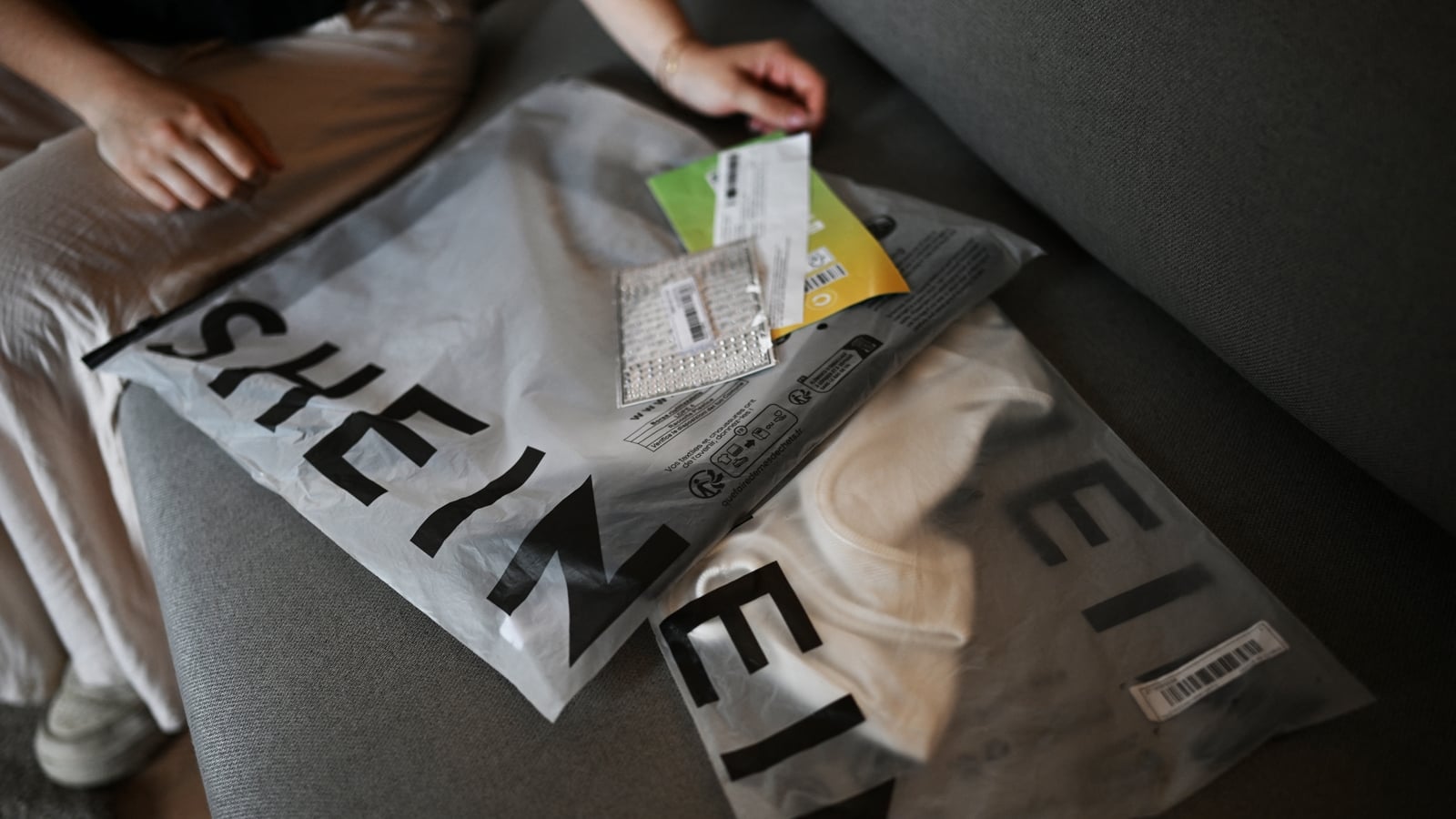
When Shein raised funds privately in 2022, few would have predicted it to be a high-water mark for the Chinese fast-fashion giant.
Back then the company’s blistering growth made it seem like the inevitable future market leader in global fashion – with its $100 billion valuation that year perhaps even seeming modest to some.
But after aborted attempts to float shares in both New York and London, the company this week debuted in Hong Kong – securing a price-tag of less than $27 billion.
That’s despite the fact that it is now a much bigger company than it was back in 2022.
That year, it’s thought to have had sales of around $27 billion globally. In terms of profit, it was likely making somewhere in the region of $700m.
Compare that to last year, when the company had revenues of more than $41.8 billion, and a profit of more than $2 billion – and that far-lower valuation may not make much sense.
But the thing to remember with company valuations is that there are always numerous factors at play – often how a company is performing at that particular time is just one small part of the puzzle.
For example, there can be good and bad times to float a company on the stock exchange – and getting the timing right can have little to do with the firm itself and a lot to do with the mood within markets.
At the moment a huge amount of investor attention is fixed on anything AI, for example, and that’s come at the expense of pretty much every other type of business.
But even beyond that, a company’s stock market valuation should be seen as a bet on how the company will do in the future as opposed to how it’s doing now.
That’s why we see the likes of SpaceX floating at a record-breaking valuation, despite the fact that it’s losing billions of dollars each year.
It’s also why we’re likely to see Anthropic and OpenAI float at valuations of well over $1 trillion – possible even coming close to $2 trillion – despite both firms currently haemorrhaging money, with little prospect of them turning a profit in the near future, and even less hope of them recovering the massive investments made to date.
But in those cases, and to a certain extent with all stocks, traders are betting that – at some point in the future – those companies will make lots more money than they’re making now. Or, at the very least, they’re betting they’ll have a reasonable chance of selling their shares to someone else who believes they’ll make lots more money.
And with Shein, investors are less confident about the company’s growth now than they were back in 2022.
Rise and Shein
Shein is continuing to grow year-on-year – but the pace of that growth has slowed considerably in the past 18 months.
Between 2022 and 2023, its sales revenue rose by around 19%.
Between 2023 and 2024, it rose by nearly 21%.
But between 2024 and 2025, sales were only up by 8%. And that slowdown in sales growth has continued into 2026.
It means that a company that had been a retail juggernaut – which was massively increasing sales month after month – has suddenly started to look relatively average in terms of its growth.
And many traders fear that this is the new normal for Shein which, if you plot it out over the next few years, means it won’t be nearly as big of a company by 2030 as it would have expected to be back in 2022.
Call of Duties
One of the biggest factors behind this is how the mood music around cheap imports from China has changed.
That souring started in the US – not just because of its ever-increasing trade tensions with China, but specifically with the end of what was called the de minimis exemption.
That exemption effectively allowed for lower goods from other countries – like China – to come into the US without any duties attached. So when a customer bought a $5 dress on Shein, they knew they weren’t going to have to worry about paying sales taxes or customs charges on top of that.
But that exemption was removed around a year ago – and it had an immediate effect on sales at Shein – as well as other China-based companies.
In results for the first three months of this year, Shein said its US sales were worth just over $2 billion, compared to nearly $2.4 billion a year before. That’s a more than 14% decline.
With that relatively simple change, US authorities had made Shein goods less of a bargain to customers there – making them less inclined to buy as much or as often.
And that’s hugely important because, until that point, the US was Shein’s biggest global market. It accounted for close to 30% of its sales in 2023 but – by the start of this year – US sales made up just over 22% of its global total.
Europe, which is Shein’s next biggest market, has of course followed the US in ending its de minimis exemption. As online shoppers will likely be well aware, there is now a flat, €3 charge levied on each item coming into the EU from China. And that may soon go up to €5.
That levy is an attempt to curtain the massive influx of cheap, often low-quality items coming into the region each year – and it seems to be having some success on that front.
And given that customers don’t get it refunded on anything other than faulty returns, it also undermines a major piece of the fast-fashion business model where shoppers buy multiple items at once with the intention of sending the things they don’t like back.
The UK is also looking at introducing an import charge of its own – and Shein has said all of that may have an impact on its sales in the coming years.
Shop “local”
Shein is making moves to try to work around these new charges.
That includes establishing warehouses and distribution centres within Europe. In June, for example, it announced it was taking over a logistics centre in Rathcoole in southwest Dublin.
The idea here is that the company will import goods into the region or the country that a customer’s purchase technically counts as inter-European. That will mean the €3 (or €5) charge will not apply.
And even though importing the goods will mean it has to pay other kinds of levies – like import duties or VAT – the company reckons it will still work out as being cheaper for the customer than the EU’s added charge.
And that may be the case – but the problem with model is that even the most efficient logistical set-up that’s based in the EU, US or UK will cost more to run than if it could continue to manage the same logistics from China.
That ultimately means that, one way or another, its products will cost more to European and US shoppers than they might have done a year or two ago. Last month Shein said that it’s having to raise prices in the EU as part of its response to these new charges and duties.
And if it’s prices are going to be higher, that obviously has an impact on the appeal of what it’s selling, and potentially on the profit it’s able to make on the sales it continues to register.
Penneys for your thoughts
This is obviously good news for Shein’s main competitors.
Not all of them, though.
Some – like Temu and Aliexpress – will be grappling with the same duties and charges that have complicated the flow of cheap Chinese goods into the EU and the US.
But others will expect to benefit from Shein’s difficulties.
Penneys – or Primark as it’s known everywhere else – has stubbornly resisted calls for it to become an online retailer, sticking to bricks and mortar as its sole sales channel.
In a lot of ways, that makes it a very different business to Shein. But at the end of the day they’re both fast-fashion-focused – and are both targeting the same kind of customer.
In July Penneys announced it was cutting prices across a huge number of its core products – in what was seen as an attempt to Shein success in out-budgeting the budget retailer.
The timing of those price cuts are unlikely to have been a coincidence. They were announced just weeks after the EU’s three euro charge kicked in, just as consumers were starting to feel its impact.
Penneys knows many customers will suddenly have felt like Shein wasn’t the value proposition it once was – and if the shop in their local supermarket or town was cutting prices, maybe it was worth returning to for the fashion haul.
The added bonus of going to a shop is that a buyer can get the product now rather than wait for a delivery – customers would also have a better idea of the quality or fit of what they’re buying. And if there is an issue, returns tend to be a lot easier too (and no duties or delivery fees down the tubes either).
So when all of that is put together with a less glaring price differential, suddenly physical fast fashion brands like Penneys have an edge against Shein that they’ve not really had up until this point.
The fact that Penneys/Primark has continued to expand in the face of stiff competition from Shein suggests it’s doing something right with its approach.
Earlier this week it announced a new store opening in Italy – its 500th outlet worldwide. It now has shops across Europe, it’s rapidly expanding in the US, and has even started opening stores in the likes of Dubai and Kuwait.
But it’s not alone in seeing an opportunity in Shein’s stumble.
Spain’s Inditex Group – the biggest fashion retailer in the world, best known as the owner of Zara – has recently been expanding its low-cost, fast-fashion brand Lefties.
It already has 225 shops – most in mainland Europe – but last month opened its first in the UK. The presumption being that, if that goes well, a wider expansion in that market will follow.
The Retail Environment
Needless to say, ethical questions around Shein’s supply chain have also hindered the brand.
The now well-known environmental impact of fast fashion is also putting many shoppers off.
It’s no coincidence that, as growth at the likes of Shein has stalled, more eco-aware platforms like Vinted have been growing dramatically.
Last year its sales rose by 47% to nearly €11 billion – and a lot of that is being driven by people who are trying to shop more sustainably.
(Though many users complain that Vinted is full of people re-selling Shein, Penneys and Temu products – which is not exactly ideal, though probably better than those products being dumped outright.)
But despite growing concern about its environmental cost, fast fashion is continuing to grow.
Shein may now be growing at a slower pace than it was in 2023, but it’s still growing. Penneys and Inditex are only opening new stores in Europe and the US because there’s consumer demand for their low-cost goods.
So it’s not as though consumers are now abandoning fast-fashion en mass.
Instead what seems to be motivating attitudes around the likes of Shein is the same thing that made it so popular in the first place – price, convenience and affordability.
Those various tax and duty charges – and rising costs for Shein – are making its products that bit less attractive than they were before, while at the same time competitors are getting more aggressive in trying to protect and expand their turf.
That’s taking some sales away from Shein – but not necessarily from fast fashion.
Rather than environment, one thing to watch in terms of the future of fast fashion is consumer sentiment.
The consumer mood been struggling lately due to rising inflation, as well as geopolitical concerns – and that is now bleeding through to sluggish and even falling retail sales in the US, UK and Europe.
In the past, when people became more price sensitive and started to curtail their spending, it was to the benefit of budget retailers. Penneys was one of the companies that actually did well during the financial crisis, for example.
But at the same time, there’s a difference between people buying things because they’re cheap, and because they’re seen as good value.
If people become more considered in their purchasing in the coming months and years – because they’re trying to stretch their budgets – they’re probably going to be reluctant to spend money on items they aren’t sure they want or need, especially if they’re from brands that are inconsistent in terms of quality.
At the very least they might start to reign in the size and frequency of their shopping hauls.
And that’s a risk to online retailers like Shein – which is yet another factor that’s concerning markets at the moment.