
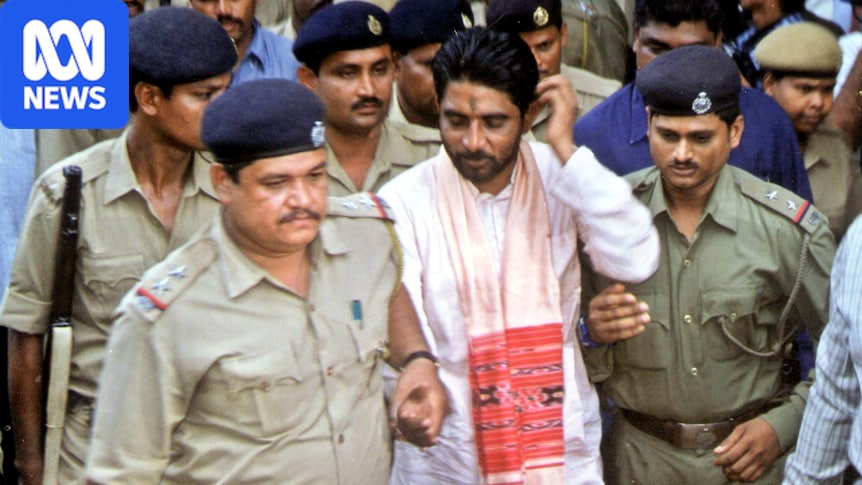
Indian court to decide if man who led mob to burn Australians alive should be freed
Posted Sat 5 Sep 2026 at 12:29pmSat 5 Sep 2026 at 12:29pmSat 5 Sep 2026 at 12:29pm
Warning: This story contains graphic details of violence. Reader discretion is advised.
The man who led an angry mob of Hindu zealots as they burned an Australian man and his two sons alive in their car may soon walk free from an Indian jail.
Dara Singh — also known as Rabindra Kumar Pal — was jailed for life in 2000 after burning Christian missionary Graham Staines and his two young sons, aged six and 10, in their station wagon in Manoharpur village in Odisha, India, in 1999.
The armed mob of about 50 people doused the station wagon with kerosene, set it alight and prevented Mr Staines and his boys from getting out.
They believed the missionary was converting poor Hindus to Christianity.
In 2003, Singh was sentenced to death, which the High Court reduced to life imprisonment two years later.
In July 2024, Singh filed a plea for release, claiming good behaviour and saying he had spent more than 25 years in prison.
The Indian Supreme Court is in the latter stages of considering his petition for release, which could be as early as a few days away. Of the 13 convicted over the murder, Singh is the only one who remains in prison.
Three decades working with lepers
Mr Staines, originally from Beaudesert in Queensland, had spent 34 years in India prior to his murder, working with people affected by leprosy and with Indigenous tribes.
ABC India correspondent Jonathan Harley covered his funeral in 1999.
“The starkest images was scores and scores of lepers, dressed in little more than loin cloths, walking along talking of how Graham Staines had helped them, his compassion for them, his care for them,”
he reported.
A message of forgiveness
Graham Staines’s widow Gladys publicly forgave the mob of murderers in the days following the attack.
From Townsville where she now lives, Ms Staines said in a statement that her feeling towards the killers had not changed more than two decades later.
“I continue to forgive,” she said.
“I have forgiven the killers and have no bitterness because forgiveness brings healing and our land needs healing.“
Ms Staines said forgiveness was following Jesus’s teaching and example.
“God in Christ has forgiven me and expects his followers to do the same,” she said.
“I have no comments regarding the law taking its own course.”
Continuing the work
After the murders, Ms Staines decided to stay in India with her daughter and continue ministry work among people affected by leprosy.
She told the ABC in 2005: “I stayed on because I wanted to care for the people.”
Ms Staines worked in India for more than two decades, before returning to Australia and settling in north Queensland.
International magazine Christianity Today described her as “the best-known Christian in India after Mother Teresa”.
In 2005, she was awarded the Padma Shri — India’s fourth-highest civilian honour — in recognition of her dedicated service to people affected by leprosy.
In 2015, she received the Mother Teresa Memorial Award for Social Justice.
Dangerous place for Christians
Open Doors, a charity supporting persecuted Christians around the world, says more than 72 million Christians live in India.
The charity’s 2026 annual report ranked India the 12th most dangerous country on Earth to be a Christian.
That is up from 28th in 2014 — the year Narendra Modi was elected prime minister.
Open Doors executive Anna Hutchins said it was “very difficult” to do charity work like the Staines’s in India now because of growing negativity towards external organisations entering India, with many charities being kicked out of the country.
Ms Hutchins said that was in part because of anti-conversion laws and the rise of Hindu nationalism.
She said horrific violence still occurred.
“There’s a story of a woman who shared about Jesus with her friends and she was killed by members of her village the very next day,” Ms Hutchins said.
She said the story of the Staines family — which was made into a movie in 2019 — had captured the world’s attention at the time and was still a powerful story.
“One of the reasons it attracted so much attention was because of Gladys’s almost immediate posture of forgiveness,”
she said.
“People can’t understand that response of hers. That’s why it’s so powerful. That’s actually the one defining thing of Christianity.”