
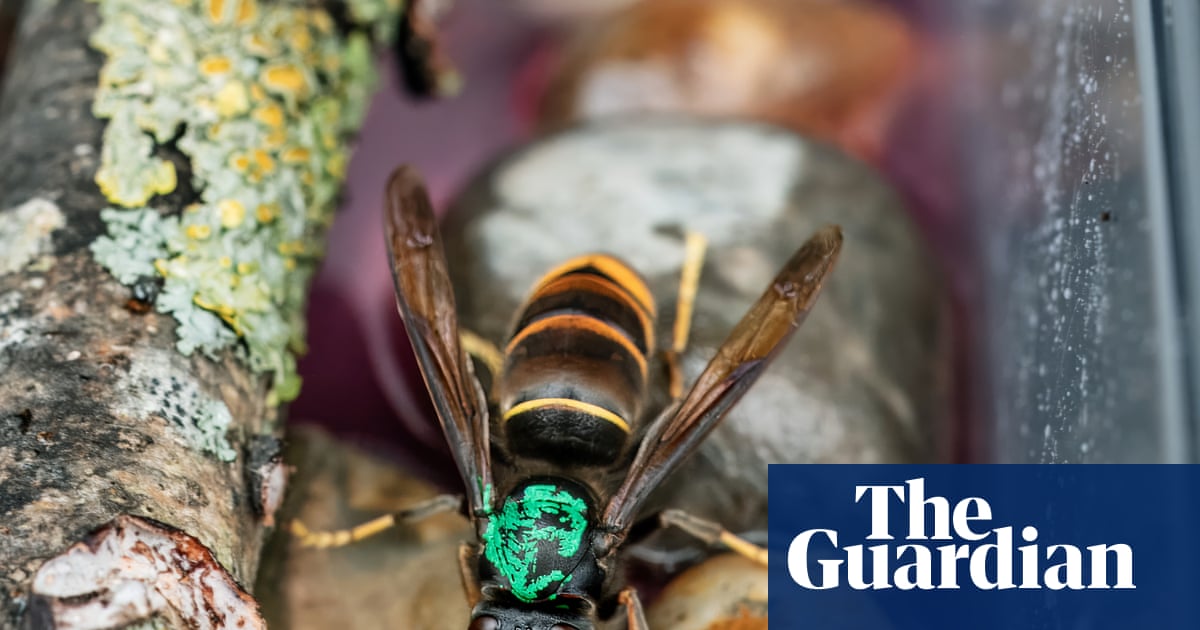
Beekeepers warn of Asian hornet threat and call for UK awareness campaign
Experts say invasive species are creating ‘pollinator deserts’ and could have serious impact on food security
British beekeepers have called for a national awareness campaign about the impact of Asian hornets as they warned the invasive species was creating “pollinator deserts” and threatening food security.
Native to south-east Asia, the yellow-legged hornet is thought to have arrived in Europe in 2004 and has continued to spread ever since, its numbers probably boosted by increasingly warm springs and summers.
The end of summer is a crucial time in Britain’s fight against the species. As colonies mature and nests reach maximum size, the hornets produce fertile new queens that will leave, mate and seek places to survive winter. The following spring, they establish new colonies, resulting in more nests across a wider geographical area.
Asian hornets are an invasive species that prey on other insects. “Yellow-legged hornets cause significant damage to native pollinators, including our much-loved honeybees,” said Kate Wilson, the head of the National Bee Unit (NBU), which is responsible for bee health in England and Wales and sits within the government’s Animal and Plant Health Agency (Apha).
Graphic showing comparative size of Asian hornet and common wasp
But as well as threatening bees and making honey production difficult for beekeepers, the “real cost” of Asian hornets also concerned human safety, pollination and biodiversity, said Lucie Chaumeton, a trustee of the British Beekeepers Association (BBKA) and the vice-chair of its committee on the yellow-legged Asian hornet.
“Asian hornets leave behind pollinator deserts, with a serious impact on food security and agricultural economy,” said Chaumeton, who is also a beekeeper.
The government has been aware of this threat to biodiversity since it completed a risk assessment in 2011, which prompted the Department for Environment, Food and Rural Affairs and the Welsh government to develop a contingency plan for dealing with the species.
Britain’s strategy is based on destroying nests to prevent the hornets from becoming established. Missing a single nest sustains an already established colony and risks the establishment of new colonies. One indication of the strategy’s effectiveness is the number of nests that are found. In 2025, the NBU destroyed a record 161 nests.
But there is still some evidence of establishment. Genetic analysis of nests found in 2024 confirmed that queens had successfully mated, survived winter and established new nests the next year. This means the period when queens emerge from hibernation is an important intervention point.
Apha said the public and beekeepers played a key role. Public sightings and reports are used to identify suspected hornets, while volunteer teams from the BBKA help confirm sightings, track nests and undertake spring queen-trapping. Once a nest is confirmed, the NBU is responsible for its destruction.
Chaumeton said: “The National Bee Unit’s response is extremely effective. But this relies entirely on members of the public reporting sightings.”
Post-it notes and tiny trackers: behind the race to stop Asian hornets thriving in the UKRead more
The scale of public participation is significant. In 2024, nearly 30,000 reports were submitted, resulting in the identification of 24 nests. Modelling of the British invasion suggests that public reporting is essential to controlling the species; eradication depends on how quickly new incursions are detected and dealt with.
Despite this, Chaumeton said Asian hornets were still seen as a “beekeeping issue” as opposed to a threat to national biodiversity involving the whole country. “Beekeepers cannot do this on their own. We urgently need more government-led national awareness campaigns so everyone in the country understands the threat,” she said.
Apha has been testing technology to make capacity go further. In 2025, it trialled radio transmitters attached to hornets to help locate nests. Researchers are also testing VespAI, an artificial intelligence system to identify Asian hornets visually.
So far, the approach has resulted in the destruction of identified nests, but the number found last year raises a question about whether a system involving volunteers can continue to scale up. “We need a clear multi-year commitment from successive governments that eradication will continue,” said Chaumeton.
Wilson added: “We encourage the public to remain vigilant and continue to report any potential sightings using the Asian Hornet Watch app and online.”
Explore more on these topics