
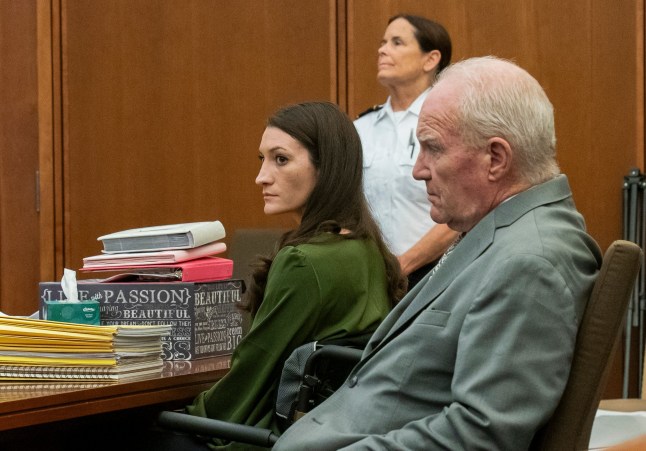
After six days of deliberations — and still no verdict — in the Lindsay Clancy trial, her defence team has now asked for a juror to be removed from the process.
The Massachusetts mother, 36, is on trial for the murders of her three children: Cora, five, Dawson, three, and Callan, eight, in January 2023.
Clancy does not deny killing her children by strangling them with an exercise band in the basement of their home, but her defence claims she was in a state of postpartum psychosis when the crimes took place, and therefore was not criminally responsible for her actions.
The prosecution says that, while there was no doubt Clancy was suffering from depression, she still made a calculated decision to kill her children.
However, after almost six weeks, over 80 witnesses, and 35 hours of deliberation, the deadlocked jury of nine women and three men still cannot reach a unanimous decision on how to convict Clancy.
They have sent Judge William Sullivan — who is presiding over the Clancy case — two previous notes to state they cannot reach a verdict.
In the latest development, the jury forewoman sent the judge a note saying one juror would not follow the judge’s instructions on reasonable doubt.
Reasonable doubt is a legal term that refers to the lack of evidence proving the guilt of a criminal defendant.
This led to Clancy’s defence attorney, Kevin Reddington, requesting that the juror who reportedly cannot agree with the other 11 be removed, reportedly leading to audible gasps in the courtroom.
However, the judge promptly denied the removal request.
The defence attorney told reporters that the one holdout on the jury ‘refuses to listen to the law on reasonable doubt.’
However, Judge Sullivan told Reddington in the courtroom: ‘I don’t feel it is proper for me to side with one side or the other of the deliberations.’
Later, Reddington and prosecutor Jennifer Sprague had a tense exchange with the judge at the sidebar. This is a private discussion between the judge and the attorneys that takes place out of earshot of the jury.
The BBC reported that journalists could not hear the conversation between the judge, prosecution and defence, but stated that Reddington looked visibly distressed.
The outlet stated that he then brought Clancy over to the judge in her wheelchair to update her on the proceedings.
Clancy is paralysed from the waist down after she attempted suicide following her children’s killings.
It is reported she self-harmed before jumping out of a two-storey window at the Duxbury, Massachusetts home she shared with her ex-husband, Patrick Clancy and their three kids.
The judge sent the jury home again yesterday following the failure to reach a verdict. He instructed them to resume deliberations the next day (today) at 9am EST (2pm BST).
Should the jury not reach a unanimous verdict for the third time, Judge Sullivan could declare a mistrial.
Prosecutors would then decide whether to retry Clancy. Reddington previously told reporters to ‘bring it on’ should a mistrial happen.
However, he has also said that he does not think Clancy could emotionally handle a second trial.
During the trial, Reddington — who has become somewhat of an internet celebrity over the past few weeks — has consistently told reporters that his client has found the experience harrowing.
Former labour and delivery nurse Clancy has broken down in court multiple times, including wailing, ‘I can’t do this’ during testimony about the injuries her children suffered in their deaths.
What are the possible outcomes of Lindsay Clancy’s trial?
The jury has five ways to decide Lindsay Clancy’s fate, as deliberations continue.
These are:
- not guilty
- not guilty by reason of insanity
- first-degree murder
- second-degree murder
- manslaughter
Although Clancy was charged with three counts of first-degree murder, the jury is being allowed to consider alternative charges of second-degree murder and manslaughter.
If they find Clancy guilty of first-degree murder, which requires ‘premeditation’ or ‘extreme atrocity or cruelty,’ according to Massachusetts state law, she would face life in prison without parole.
If convicted of second-degree murder, she would be eligible for parole.
For lesser manslaughter charges, Clancy could still face up to 20 years in prison for each count.
There is also the option of not guilty by reason of lack of criminal responsibility, which is a complex outcome in itself.
This would mean a judge could confine her to a mental health facility.
Then there’s the not guilty verdict, in which Clancy would walk free. However, that is considered highly unlikely.
Comment now
Comments
Add Metro as a Preferred Source on Google
Add as preferred source