
Advertisement
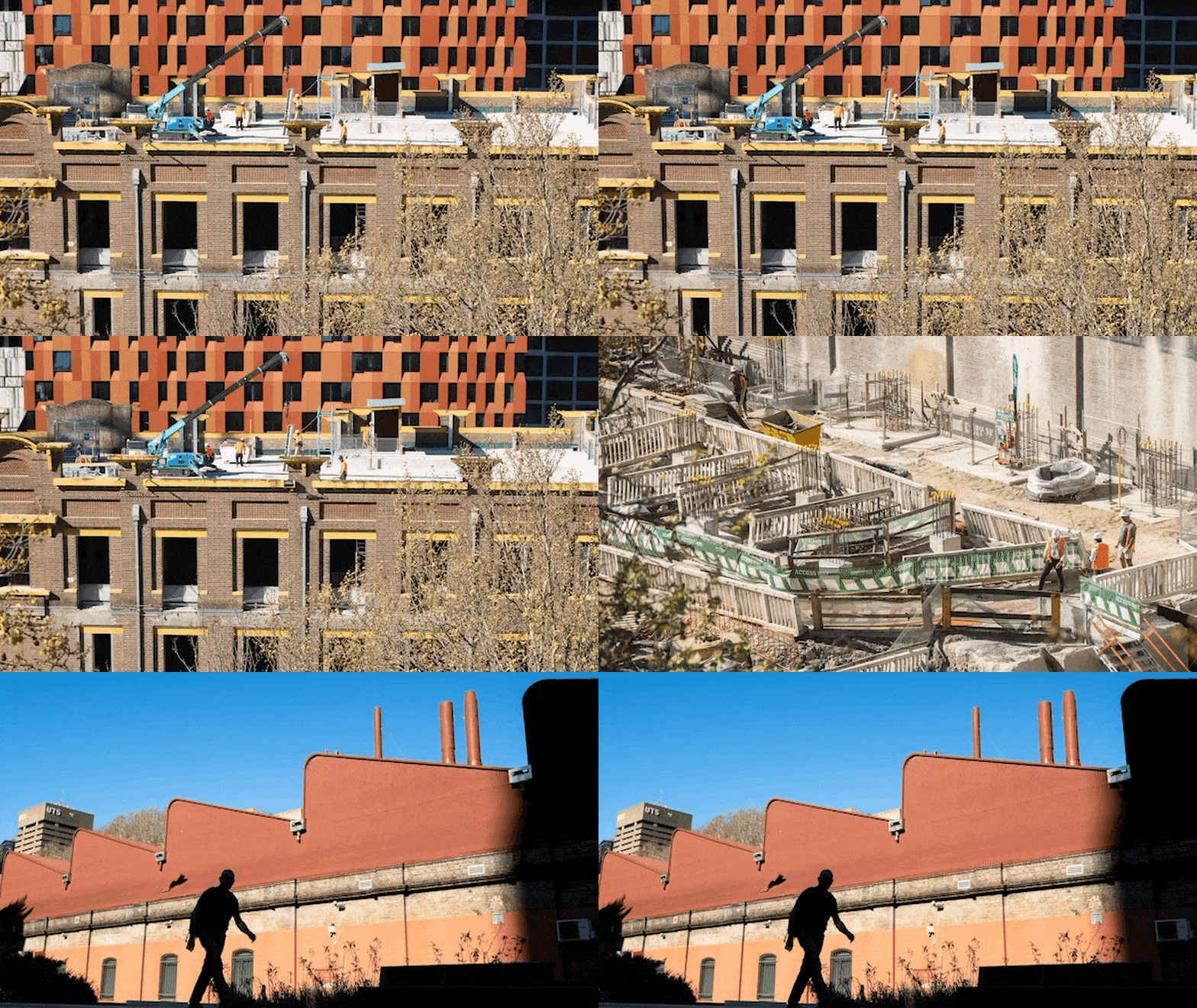
The Minns government is investigating options to sell the Harwood Building – the saw-tooth-roofed former tram shed housing Powerhouse Museum offices and workshops next door to its Ultimo site – in the latest blow to its flagship billion-dollar museum project.
The potential sale of the 125-year-old building has been raised at the highest levels of government as a $300 million rebuild of the Ultimo museum faces an $80 million budget overrun and an unfunded fit-out.
It is the latest challenge to confront the newly installed museum leadership team of Abbie Galvin and Louise Herron as they race to open the museum’s $1 billion Parramatta headquarters, western Sydney’s first state-significant cultural institution, on November 7.
The budget pressure comes after the abrupt departure of its chief executive, Lisa Havilah, who was stood aside one week ago to answer “fresh allegations” regarding procurement and potential conflicts of interest triggered by a protected whistleblower complaint in 2025. Staff have been told that she intends to defend herself from those allegations and that she hopes to return to her role.
Advertisement
Construction began in March to build new commercial creative studios along Harris Street, a “cloister garden” on the forecourt, and to reorient the Ultimo museum’s primary entrance towards the Goods Line facing Haymarket. The build schedule started behind schedule and is running up to two years late. Doors are now not expected to open until early 2029.
The discovery of extensive friable asbestos and lead paint contamination inside the heritage buildings, not detected in standard testing by Powerhouse in 2014, 2019 and 2021, has added $20 million to $30 million to the cost of the rebuild. NSW Treasury is now scrutinising the operating budgets of both Powerhouse Parramatta and Ultimo.
The Herald understands that as part of that review, there is to be a wholesale reconsideration of the $300 million Ultimo rebuild, and even the retention of the site itself, including options to reduce the scope of the redevelopment and its use of materials. However, taking a red pen to the project risks delivering a suboptimal outcome of lower construction quality than the facility it was intended to replace.
The core Ultimo construction contract with Richard Crookes was signed in June 2025, completely exhausting the project’s contingency budget, according to several sources not authorised to speak publicly. A further $23 million had been notionally set aside for fit-outs.
Advertisement
Treasurer Daniel Mookhey was said to be furious when advised earlier this year that additional funding would be required to replenish contingencies, to help with clean-up costs and to meet fit-out expectations to ensure the project’s completion.
Public Works is now undertaking a preliminary commercial assessment of the Harwood site’s market value as part of the overarching Treasury review.
The government is required to report on the state of the budget in December, and the Treasury review marks its final opportunity to adjust funding or allocate extra money to the project before entering the pre-election caretaker period ahead of the March state election.
Alternative options could include mothballing the site – incurring significant contractual penalties – or selling the building after bringing it up to current building codes. Arts Minister John Graham is on the public record as promising to “save” the Wran building, named for Labor premier Neville Wran, and which is to be rebuilt. It served as the original entrance to the museum before it was converted into the touring hall.
Advertisement
The Treasury review is also closely examining operational requirements at both museum campuses with an eye to cutting funding for the Parramatta Powerhouse, potentially undermining the original concept championed by Havilah for immersive museum experiences and around-the-clock activations.
This raises questions about whether western Sydney will receive the kind of innovative world-class museum originally promised by successive Coalition and Labor governments or whether it will revert to a more classic, stripped-down museum model, which risks lower commercial revenues and less repeat visitation.
Infrastructure NSW chief executive Tom Gellibrand told parliament that one-third of the $300 million allocated for Ultimo has already been spent. “We have encountered contamination, which is sadly commonplace,” Gellibrand said. “We were predicting that we’d find things like lead paint, but not to the scale and volume that we ultimately encountered.
“In terms of the friable asbestos, we were unable to fully investigate some parts of the museum prior to construction because they were enclosed with plasterboard and other barriers. What we’re doing is working closely with the Museum of Applied Arts and Sciences to look at the scope of the project and determine whether modifications to scope or materials can offset those additional costs.”
Advertisement
Graham told budget estimates that while officials are attempting to absorb decontamination costs within the existing budget envelope, completion timeline projections have slipped from 2027 to 2028, and now to early 2029.
The Ultimo rebuild dates to Labor’s 2023 decision to scrap a previous $500 million rebuild proposed by the former Coalition government in favour of a modest “heritage revitalisation” intended to preserve the 1988 Wran Building’s curved roof. The museum has remained closed to the public since February 4, 2024.
Scaffolding crews have stripped out internal walls, staircases and mezzanines inside the heritage-listed Boiler House, Engine House, Power House, and Turbine Hall. A sub-basement space for a theatrette has been excavated.
Also gone is the steel-ribbed galleria that previously housed industrial-age relics, such as Locomotive No. 1 and the Boulton & Watt steam engine – both of which are slated to return to Ultimo.
Advertisement
Former curators and trustees have long feared the government would backtrack on its election promise to reopen Ultimo as a fully functioning museum. While Graham remains publicly committed to keeping Ultimo dedicated to museum spaces, he may face severe pushback from cabinet colleagues seeking commercial returns or a balanced budget. In 2020, the Heritage Council refused to consider a new heritage nomination for the complete Powerhouse site, leaving the Harwood Building vulnerable to commercial development.
A NSW government spokesperson said Labor was committed to the Powerhouse Museum, including the Wran building’s reopening in Ultimo. “The approved Powerhouse Museum Ultimo budget is $300 million. The NSW Treasury review is considering the future operating model for the Powerhouse in its entirety, and options to deliver a museum in Ultimo that meets community needs and expectations.”
Heritage experts say the Harwood Building remains an indivisible part of the Powerhouse Museum complex in terms of historical significance and site context and its ongoing museum functions.
Built in 1899 as Sydney’s first electric tram depot, it was co-located with the power house specifically to power the city’s expanding tram network. Under former Coalition arts minister Don Harwin, senior bureaucrats had previously considered plans to redevelop the Harwood site into a commercial lyric theatre.
Start the day with a summary of the day’s most important and interesting stories, analysis and insights. Sign up for our Morning Edition newsletter.
You have reached your maximum number of saved items.
Remove items from your saved list to add more.
More:
Linda Morris is an arts writer at The Sydney Morning HeraldConnect via X, Facebook or email.AdvertisementAdvertisement