
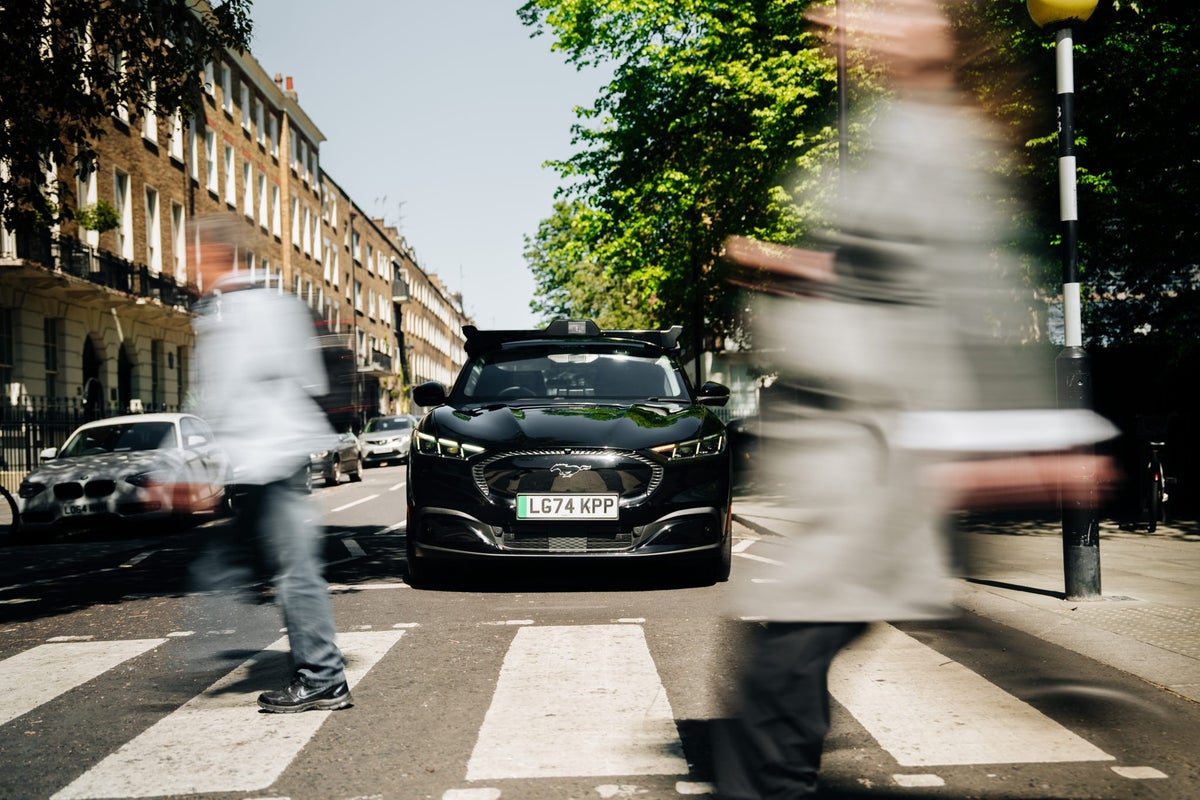
Uber’s taxis are now driving themselves around London’s streets.
Travellers hailing one of the company’s taxis may find themselves met by a self-driving version that uses sensors and AI to get around the streets. The announcement came shortly after Uber said it would cut 3,000 jobs, or 10 per cent of its workforce, partly so that it could free up money to invest in future expansion including robotaxis.
Only 15 of the cars are available at launch, in a limited trial. While robotaxis are relatively common in the US – from rival companies including Waymo, as well as Uber – the smaller and more complicated nature of European streets pose a particular challenge for self-driving cars and regulators have taken a more cautious approach as a result.
For now, there are so few robotaxis that Londoners will not be able to specifically choose for their journey to be in one. But they can increase their chances by opting-in to self-driving cars in the Uber app’s settings, and if they are allotted a self-driving car they will have the option to accept it or choose to instead have a human driver.
If an Uber customer does get a self-driving car, they will be met by an electric Ford Mustang that uses technology built by British company Wayve to drive itself. At launch, they will still have a human driver behind the wheel, who is ready to take over when the car poses a danger.
Those Ford Mustangs have already been spotted driving around British streets as the two companies tested the technology ahead of a full roll-out. But they have only been occupied by the companies’ test drivers, until now.
Wayve and Uber said that “fully driverless operations” will begin at “some point in the future”, but gave no specific date. Other companies such as Waymo are also hoping to launch their self-driving taxis on London streets, but are awaiting approval from regulators including the Department for Transport and Transport for London, which is now not expected until next year at the earliest.
Wayve said that it is “starting with a small number of vehicles in this initial phase and will grow thoughtfully over time in-line with rider demand, readiness, and regulation”. Uber’s global head of autonomous mobility Sarfraz Maredia said the initial launch is a way to “build credibility with consumers as well as with the government”.
London is only the second city in Europe after Zagreb to have the self-driving Uber vehicles. Officials have been supportive of the rollout in the UK but it has occasionally been held up by safety concerns and a focus on ensuring a properly regulated introduction.
“This is a major milestone for the future of transport in London, as British innovation brings this technology onto our roads and gives passengers more choice,” said Heide Alexander, the UK’s transport secretary. “Today’s announcement further cements Wayve’s status as a technology trailblazer here in the UK, and highlights how British innovation is helping drive investment and growth in transport.”
Wayve itself is based in London, and chief executive and co-founder Alex Kendall said the company was proud to launch its tech to the public for the first time in its “home city and one of the most complex driving environments in the world”.
Uber partnered with and invested in Wayve in 2024, with the aim of using its technology to introduce self-driving vehicles in 12 countries. The self-driving taxis use the Uber app and an in-car experience designed by the company, alongside Wayve’s “AI Driver”.
Join our commenting forum
Join thought-provoking conversations, follow other Independent readers and see their replies