
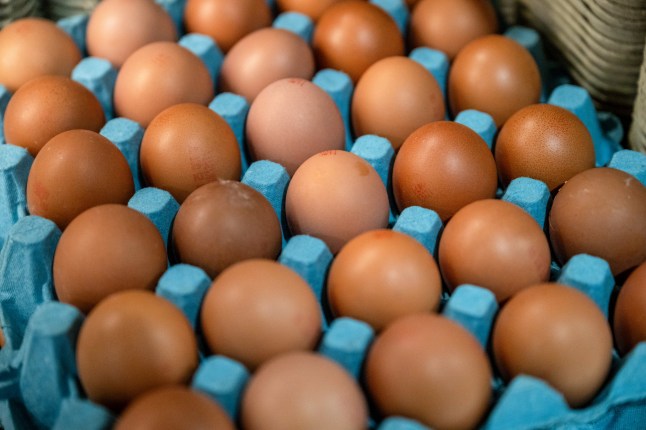
A Salmonella infection linked to imported eggs in England has now caused hundreds to fall ill and one person to die.
Cases of Salmonella linked to the affected eggs have topped 500, new figures show.
The outbreak has been linked to small cafes, restaurants and takeaways, according to the UK Health Security Agency.
The risk to the general public still remains low, UKHSA said, but as of September 1, 528 cases had been reported.
It’s a large increase from the 474 cases reported at the end of August.
Sign up for all of the latest stories
Start your day informed with Metro’s News Updates newsletter or get Breaking News alerts the moment it happens.
The cases are spread over three different clusters which are genetically different but part of a wider family of Salmonella enteritidis, UKHSA said.
The majority of cases, 305, and one death, are linked to one strain of the illness in England. There have been 182 cases linked to another strain and 41 linked to a third.
Hannah Charles, lead epidemiologist at UKHSA, said: ‘Our investigation to date indicates a link to imported eggs; however, this investigation remains ongoing.
‘We will continue to follow up cases and investigate any further common sources if they come to light.’
All the Salmonella samples from patients seen in hospitals are analysed through genome sequencing, which allows authorities to identify the outbreak’s starting point.
Symptoms of Salmonella are mild in most cases, causing diarrhoea, stomach cramps, vomiting and fever.
But infections can sometimes be serious, particularly in young children, pregnant women, older people and people with weakened immune systems.
Professor Ian Young, chief scientific adviser at the FSA, said: ‘Our food safety advice remains the same: eggs that are thoroughly cooked and handled hygienically should not present a food safety risk.
‘Infants, young children, pregnant people and older adults should only eat raw or lightly cooked eggs if they carry the British Lion mark or are produced under the Laid In Britain scheme.
‘This advice does not apply to those who are severely immunocompromised and require medically supervised diets, who should continue to follow individual medical advice. If you’re eating out or buying food that contains eggs, you may not know if these carry the British Lion mark or are Laid In Britain assured.’
If someone has purchased eggs or eaten eggs without the British Lion mark, they should ensure they are thoroughly cooked and avoid any dishes containing raw or lightly cooked egg, such as mousses, fresh mayonnaise or hollandaise sauce.
‘As with any foodborne illness, good hygiene remains your best protection: store and cook food according to the packet instructions, wash your hands thoroughly before handling food and always after handling raw meat, poultry and eggs,’ he added.
Get in touch with our news team by emailing us at [email protected].
For more stories like this, check our news page.
Comment now
Comments
Add Metro as a Preferred Source on Google
Add as preferred source