
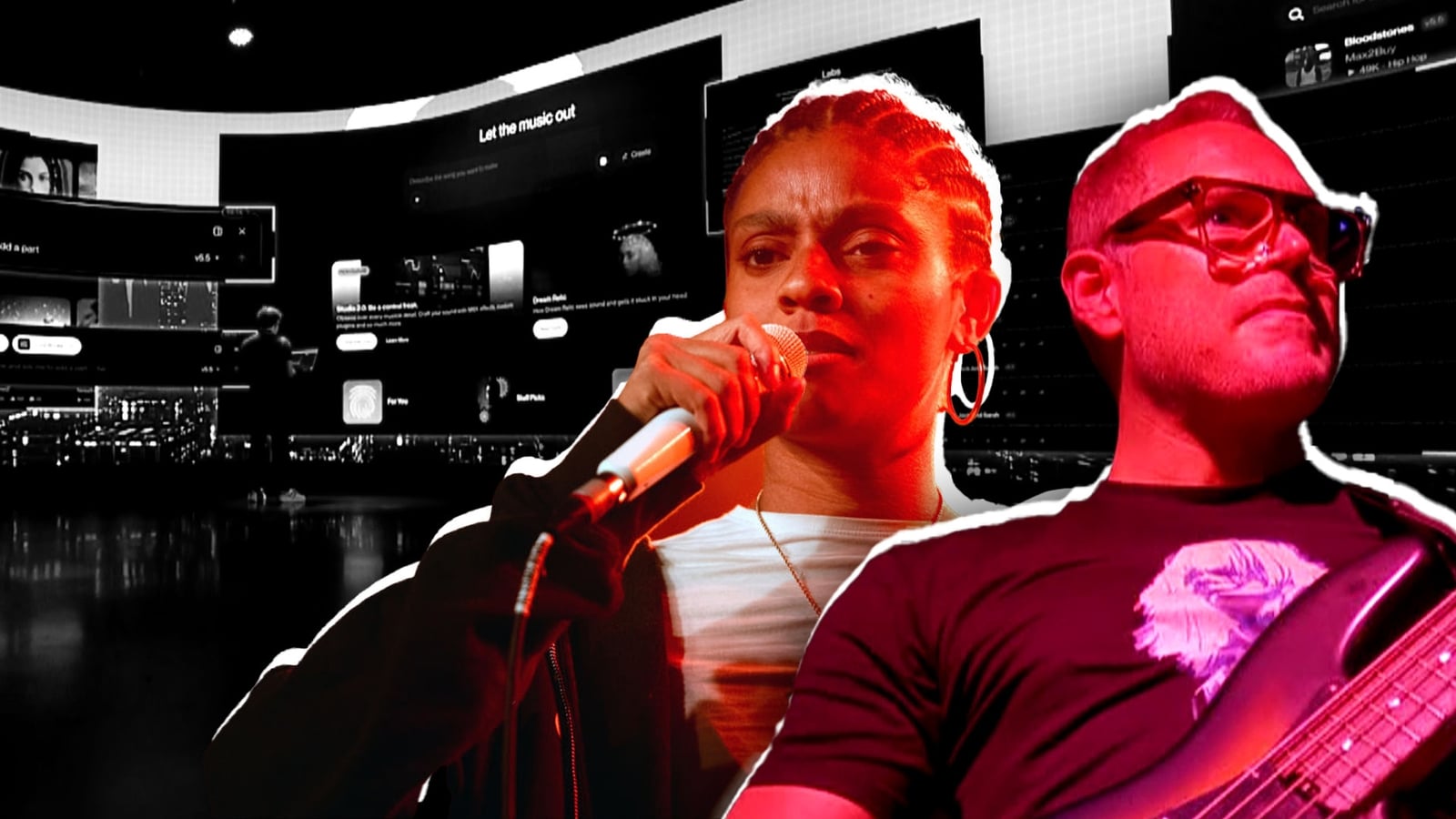
As AI-generated music becomes increasingly difficult to ignore, the music industry is beginning to grapple with how it should be treated. Spotify is introducing labels to identify AI-generated artists, while Australia’s official charts have moved to exclude songs made wholly by AI.
Its rise has prompted debate around copyright and artists’ livelihoods, but also a more fundamental question: as AI becomes capable of doing more of the things humans do, where do we want to draw the line between humanity and machine?
From synthesisers and sampling to auto-tune and digital production, new technology has constantly changed how music is made.
Artificial Intelligence (AI) is the latest development to raise questions about how much of the creative process we are willing to hand over to machines.
Yet, as some artists and technology companies have pointed out, simply saying a piece of music was made ‘using AI’ tells us little about how much of that process was actually handed over.
“Lots of musicians use AI in different ways, for example, for mastering,” said Oxford Professor of Composition Jennifer Walshe, “that’s very different to saying, ‘can you just pump out a song for me?’ Or can you make the initial sketches for a drawing for me?”
Professor Walshe, who is originally from Dublin, has experimented with AI and written extensively about what the technology means for music.
The distinction she makes is between using AI to assist with parts of the creative process and using generative AI tools capable of creating the music itself.
It is this generative end of the spectrum that has driven much of the recent debate.
Generative music tools work in a similar way to Large Language Models (LLMs) like ChatGPT or Google Gemini.
Rather than generating text, they generate audio, having been trained on large amounts of existing music to learn patterns and relationships in melody, rhythm, harmony, and vocals.
They can produce ‘fully formed’ tracks based on a text prompt and while some see them as a threat to the human creative process involved in making music, others see them as a tool for it.
Either way, AI-generated tracks are increasingly finding audiences beyond the platforms used to create them.
In one case, an AI-generated song about Puerto Rico went viral, appearing in tens of thousands of social videos, and lip-synced by celebrities including Luke Combs and Jennifer Love-Hewitt.
The Puerto Rico tourism board has even promoted the song, and made a music video with the ‘creator’ of the track, who accepts it was generated by Suno, an AI platform.
Suno says it has more than two million paying subscribers, and advertises heavily online.
With the Puerto Rico case in mind, I decided to sign up and see what it would output from my own text inputs.
I live in Dublin 12, so I started somewhere familiar.
My prompt was packed with similarly relevant local references for places like Ashleaf Shopping Centre and Tymon Park, and activities like cycling around estates, to drinking cans with friends in the evening sun.
The instructions were aimed at producing a nostalgic, feel-good song, that might work on radio or social media. I asked for “mellow summer vibes,” “warm jazzy chords,” and an “authentic” Irish accent while specifically asking it to avoid “parody, novelty lyrics or stereotypical Irish references.”
Suno responded by writing about buying a chicken fillet roll, apparently deciding this did not fall foul of the no-stereotypes rule. Its idea of an “authentic” Irish accent also sounded distinctly American.
When I played the resulting song, which Suno titled ‘Ashleaf Summers’, to Professor Walshe, she immediately identified some of the characteristics she associates with AI-generated tracks.
There was a “tinniness” and “gloss” to its sound, she said, while its obvious rhyming scheme produced the kind of “slightly cringe lyrics” she regarded as another telltale sign.
Among them was the chorus line “golden cans in golden weather,” and an attempt at teenage existentialism with the lyrics: “all of us immortal, or at least we felt close”.
Nevertheless, Professor Walshe also thought it was just plausible enough to pass largely unnoticed within the typical playlist of mainstream music radio.
“It could be something that, I’m listening to the radio in the car, and that’s playing,” she said.
We need your consent to load this flourish contentWe use flourish to manage extra content that can set cookies on your device and collect data about your activity. Please review their details and accept them to load the content.Manage Preferences
The speed with which something passable could be produced by tools like Suno highlighted why there is so much unease around AI music.
And music offers an interesting test of what happens when that logic is applied to an activity where efficiency isn’t necessarily always the point.
For the companies building generative AI tools, removing some of the work involved in is part of their appeal.
Suno CEO Mikey Shulman has argued that “the majority of people don’t enjoy the majority of the time they spend making music.”
For award-winning Dublin electronica producer Rory Sweeney, whose latest album Old Earth was released this year, Mr Shulman’s view risks misunderstanding what gives music its value in the first place.
“When you’re talking to someone about music or someone recommending you music, they often don’t really describe how it sounds. They describe these things about the person who wrote it,” Rory said.
For Rory, human toil is part of the creative process rather than a problem to be eliminated.
“Your own mistakes, your own shortcomings, and also your own quirks as a person, your own interests are what makes it interesting,” he added.
Dublin R&B singer-songwriter Aby Coulibaly, who has built a growing following with releases including Taurus and Long Nights, similarly believes that the person behind a song remains central to its appeal.
“When I’m listening to a song, what connects me is when I hear a little voice crack or I hear the emotion behind someone’s words and their voice,” Aby said.
“If I’m writing a song about grief and, like, losing my dad, I could never give that to AI and be like, ‘this is gonna give me the perfect song’. It’s not gonna be able to feel what I felt,” she added.
But not everyone sees generative AI as fundamentally different from the technologies that came before it.
Hector Castillo runs the Blues’ Jam at Arthur’s Jazz and Blues Club on Thomas Street in Dublin 8, where musicians are selected at random to perform together. He is less concerned about what the arrival of AI might mean for music.
“It’s like the internet. The first days everyone was a little reluctant, but I think it’s like any other tool. You can have good usage and bad usage,” Hector said.
While acknowledging the diverging points of view amongst fellow musicians, Hector said he has previously paid for Suno himself and was impressed by its capabilities.
“Maybe I need an idea for a violin, and I’ll try three or four ideas. None of them are good to me. And then, okay, I’m going to give Suno, for instance, the chance. AI is proposing and I’m deciding. That way, I’m the one creative in the process,” Hector said.
For Hector, then, the important distinction is not whether generative-AI is involved, but whether the musician remains in control of the creative process.
But that raises an obvious question: how far can you truly push that distinction? Extending our earlier experiments with Suno, we decided to push it further. How much of the creative process could we hand over to AI and still feel like the music was ours?
To explore that, we conducted an utterly non-scientific experiment about human preferences around AI and music.
I asked my colleague Sarah Burke, who is not a musician, to make a song using Suno. She was given no advice beyond the basic instructions needed to use the platform.
Sarah handed over almost the entire creative process. She uploaded a list of her most-listened-to tracks to ChatGPT, asked it to turn her musical tastes into a prompt, and gave that prompt to Suno. It outputted what it titled ‘Basement Boogie’.
We need your consent to load this flourish contentWe use flourish to manage extra content that can set cookies on your device and collect data about your activity. Please review their details and accept them to load the content.Manage Preferences
I, also not a [good] musician, took a different approach and tried to apply what I had learned from Rory and Aby by putting more of myself into the process.
I came up with an idea for the song, sang a hook, played chord progressions on a guitar and uploaded those recordings to Suno, before allowing the platform to build the finished track around them.
It called the song ‘What Stays,’ which was the hook I had given it.
We need your consent to load this flourish contentWe use flourish to manage extra content that can set cookies on your device and collect data about your activity. Please review their details and accept them to load the content.Manage Preferences
In both cases, the technology turned those inputs into what sounds like a finished recording, something neither of us could have done in that time.
Then we took both songs to the public, without initially telling people how they had been made.
The result was surprisingly one-sided. Almost everyone we spoke to preferred Sarah’s track.
There was an irony in the result. While I had tried to communicate with Suno through my own voice, chords and ideas, Sarah had effectively used one AI system to speak to another. Her song was the clear favourite.
But the more revealing reactions came when we told them both songs had been made using AI.
Several were surprised, while some said knowing how the tracks had been made changed how they felt about music they had liked only moments earlier.
One listener, who preferred Sarah’s song, said she had not suspected either track was AI-generated. After the reveal, however, she said she liked both less.
Another had also preferred Sarah’s track, but said learning it was AI-generated made her uncomfortable because she believed the technology was taking from human artists.
Three people who listened together all enjoyed Sarah’s song and were surprised to discover it had been generated using AI.
But the lower barrier to making music held little appeal for them. They had not made music before, they said, so being able to make it more easily did not make them want to start.
The reactions exposed an interesting tension. People could enjoy AI-generated music without knowing how it was made, while becoming much more resistant to it once they did.
That reaction echoes a point Rory Sweeney had made when we spoke about Suno’s approach to music-making.
“People aren’t as drawn to the actual finished product as the likes of people like Suno’s CEO would like to think,” he said. “There’s all this other stuff that goes along with it.”
For Prof Walshe, the reaction speaks to an important distinction between producing an end result and taking part in the process of making it. She compares generative AI in music to another creative activity, namely cooking.
“When I’m composing, we’re like a chef. We’re actually in the kitchen, and we’re pulling the onions out and we’re chopping them. Somebody working with a platform is like somebody who’s hired a private chef. They might be designing the menu, but they’re not chopping the onions,” she said.
But Prof Walshe does not see that as a reason to be pessimistic about where music goes next.
“I definitely think there’s going to be loads of great music made. I definitely think there’s going to be new things that we can’t predict,” she said.
What remains uncertain though is how much of that future music will be made with AI, how much will be made by it, and whether that distinction will continue to matter to the people listening.
Additional reporting Sarah Burke.
A report from Jack McCarron, Sarah Burke and producer/director Aaron Heffernan on AI music is broadcast on the 3 September edition of Prime Time at 9.35pm on RTÉ One and RTÉ Player.