
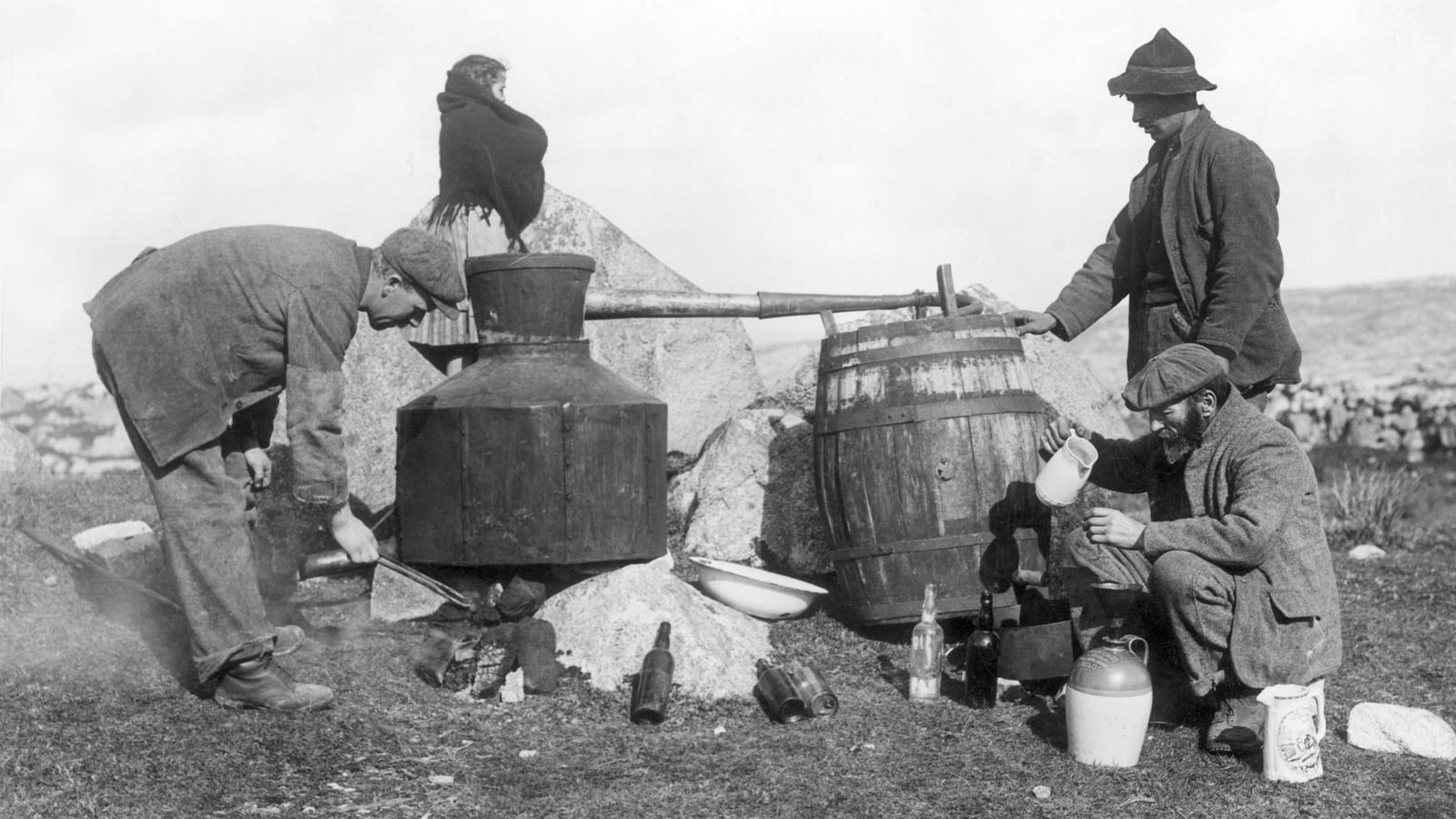
Analysis: The IRA’s anti-poitín campaign was an early example of the group presenting themselves as figures of law and order to win popular support
By Caoimhín De Barra, Gonzaga University
Poitín has been legal in Ireland for almost 40 years and distillers these days market the spirit as quintessentially Irish. But did you know that during the War of Independence, the Irish Republican Army went to great lengths to stamp it out entirely?
For centuries, poitín was firstly a legal definition. Spirits produced by a licensed distiller were called whiskey, but those distilled illegally, even if identical to whiskey, were called poitín. The spirit was made only in the northern half of the country in remote locales, where the ban was difficult to enforce and legal liquor expensive to transport there. The heyday of poitín was in the early 19th century, but it had gone into steep decline by around 1900.
We need your consent to load this rte-player contentWe use rte-player to manage extra content that can set cookies on your device and collect data about your activity. Please review their details and accept them to load the content.Manage Preferences
From RTÉ Archives, reporter Cathal O’Shannon hears from Newmarket Poteen Festival organiser Michael Flanagan on how to make the drink for an episode of Newsbeat in 1970
But the First World War saw the British government raise the duties on whiskey, and poitín flourished once more. Its rise caught the attention of Irish Volunteers, who were trying to usurp British authority and present themselves as figures of law and order.
Many of these men found their nationalist spirits awakened by societies like the GAA, the Gaelic League, or the Pioneer Total Abstinence Society. Membership frequently overlapped between the three organisations. Fr James Cullen, founder of the Pioneers, said in a speech at Vinegar Hill in 1911 that “Ireland lost all her fights through drink.” When the War of Independence broke out, the country was flush with poitín, but also young men who believed its consumption was harmful to the cause of Irish independence.
The Irish Volunteers could make use of poitín for their own purposes. In June 1920, the IRA in Cork planned to get the garrison of the RIC barracks in Inchigeela intoxicated on poitín, and then raid the building. A sympathiser took a bottle inside, but the first officer who drank from it became violently sick. Not surprisingly, no-one else touched it and the planned attack had to be called off.
We need your consent to load this rte-player contentWe use rte-player to manage extra content that can set cookies on your device and collect data about your activity. Please review their details and accept them to load the content.Manage Preferences
From RTÉ Archives, RTÉ News report on a Garda raid on poteen makers in Cappamore, Co Limerick in 1962
But mostly, the IRA were opponents of poitín. In the second half of 1920, the organisation carried out about 100 raids on illicit stills across Ireland. Rather than this being planned, it appears that a chance encounter set off the flurry of activity. At a dance in Clones in June, some members of the Monaghan Irish Volunteers observed a man selling poitín. They learned that it had been manufactured outside of the town, and the men, led by Eoin O’Duffy, cycled through the night to the location and smashed the still.
A few days later, O’Duffy made a speech in St. Joseph’s Hall in Clones. He said that Irish independence movements in the past had been “conquered through the means of drink,” but he promised his men “would take in hand the wiping out of the poteen evil, the prevention of drunkenness and Sunday traffic in alcoholic liquor.”
Soon, newspapers were filled with accounts of poitín searches across Monaghan. Not only were distillers stopped, but they were usually immediately court-martialed as well, and ordered to pay a fine to the local parish priest. By the end of the month, Captain P.V. Hoey believed that the “degrading traffic” in the county had been “practically eliminated.”
We need your consent to load this rte-player contentWe use rte-player to manage extra content that can set cookies on your device and collect data about your activity. Please review their details and accept them to load the content.Manage Preferences
From RTÉ Come To Your Census podcast, Liz Gillis and Greg Walls look at where Ireland’s revolutionary leaders were living in 1926 when the first census of the Irish Free State took place
In the months after this, there were reports of IRA raids in Antrim, Armagh, Tyrone, Sligo, Mayo, Galway, and Donegal. One important effort to curb the distillation of illegal whiskey was monitoring the use of treacle, a vital ingredient at the time. There are several newspaper reports of treacle being seized and destroyed by IRA units.
Given that the IRA was fighting a war with the British government, why did they go to such effort to suppress poitín? Primarily, it was a public relations exercise. At a time when there was a global movement against alcohol, the IRA knew that many Catholic clerics detested poitín. In 1921, the Bishop of Achonry Patrick Morrisroe declared “this abominable evil is the source of fetid corruption in every district where it existed.”
Clearly, information was being fed by Irish Volunteers to newspapers as part of a campaign to show that the IRA were doing a better job enforcing the law than the RIC. Even their opponents were impressed. One anonymous correspondent in the Londonderry Sentinel, stated “I am a Unionist, but I have no hesitation in declaring that Sinn Fein has done more in the past three months to stop the deadly industry than the police have been able to do in the last twenty years.”
READ: A short history of Irish Poitín
Newspapers were not the only way to amplify the message. In autumn 1920, the IRA frequently displayed captured stills outside of churches after Sunday mass. This again reinforced the link between the work of the Irish Volunteers and the Catholic Church.
These raids stopped as suddenly as they started. At one poitín search just before Christmas of 1920 in Tyrone, a farmer was shot dead. The local parish priest denounced the raiders from the pulpit. In response, the IRA stepped back from carrying out these searches. Other factors that explain the sudden stoppage include an escalating conflict with crown forces, and poitín makers becoming more careful about their operations.
The anti-poitín campaign of 1920 is important because it shows us the socially conservative nature of Irish republicans at the time. It was also an early example of the IRA policing a behaviour to win popular support, something that would occur again in later republican campaigns against drugs and joyriding.
Follow RTÉ Brainstorm on WhatsApp and Instagram for more stories and updates
Dr Caoimhín De Barra is an associate professor of history at Gonzaga University.
The views expressed here are those of the author and do not represent or reflect the views of RTÉ