
Advertisement
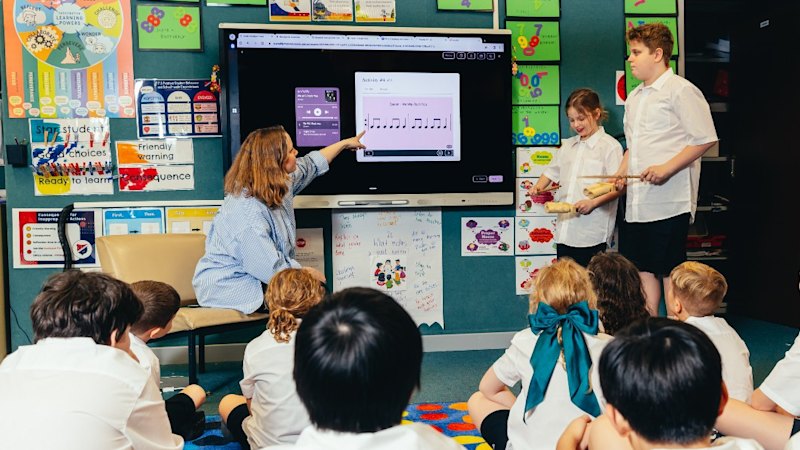
Music educator Ricky Kradolfer recalls ending a primary school lesson and strumming his guitar while the next class of students filed into the room. A young boy from the new group looked like he wanted to sing along, so Kradolfer gave him the microphone and kept playing.
“He started kind of rapping, but I could tell the words weren’t fully formed, but he was trying to find melody and flow. And then the principal came in and started crying and then she was getting out her iPhone and filming,” Kradolfer said.
“And then we finished and all the kids were super excited and I was like, ‘what was all that about?’ And the principal said, ‘that student’s non-verbal.’”
Kradolfer’s story illustrates some of the less quantifiable but invaluable impacts of music in classrooms.
Advertisement
He is the co-founder of Amplify Music Education, a provider of arts education software currently used in more than 1000 Australian schools that helps non-music teachers deliver quality music lessons.
Amplify is one of the sponsorship partners of Brisbane’s annual music industry conference Bigsound, helping launch its education stream.
Sessions bring together researchers, consultants and curriculum experts as well as Australian music stars such as Sam Cromack (Ball Park Music), Ian Haug (Powderfinger) and Sasha McLeod (Sycco).
The main topic of conversation was the same as Amplify’s reason for existing: the shortage of classroom music teachers.
Advertisement
Sydney-based Kradolfer and his wife Natalie started the business when he was facing burnout while teaching at five different schools a week. Making the hard decision to drop one, he asked the school what it would do to replace him, and was told: “Nothing. We won’t be able to find another teacher”.
University of Melbourne professor of education futures, Glenn Savage, says he sees this happening at schools across the country.
“At a school I visited very recently in Western Australia, they had a fantastic music program, a fantastic music teacher, a fantastic choir. And 18 months ago, that teacher left. They have no music program now, it’s just stopped.”
Jane Polley, who heads the arts curriculums at the Australian Curriculum, Assessment and Reporting Authority (ACARA), said the Australian curriculum explicitly states students need to be experiencing the arts, but it can be difficult to deliver in practice.
“Where it breaks down is in systems: rural and regional areas find it very difficult to run arts programs. One person might leave, it takes a lot of expertise and training to be done really well, or it can happen that arts education is done poorly and that has real ramifications down the line.”
Advertisement
The conversation is taking place as Queensland’s system for scaling subjects comes under scrutiny, with educators warning the current system is accelerating a decline in enrolments for creative arts subjects.
Savage said the lack of value placed on music is at odds with a world rapidly being reshaped by AI.
“The OECD traditionally has said schools are primarily for making young people job-ready, and it’s why we have things like NAPLAN,” he said.
“They are now admitting their own logic is flawed, and they’ve come up with a very bold idea: we need to refocus the purpose of schooling around the idea of ‘human flourishing’.”
Advertisement
The OECD’s Education for Human Flourishing plan emphasises teaching ethical competence, adaptive problem-solving, understanding the world, appreciating the world, and social and emotional skills.
“What can we create in schools that can build this, that can deliver on this vision? I would say build music, build the arts,” Savage said.
Education consultant Kathleen Jenkins, who has both primary school teaching and music industry experience, said schools are good at measuring numeracy and literacy but are less good at measuring ‘soft’ skills like collaboration, creativity and expression.
“If we take away an arts curriculum, we’re not taking away things that [just] look pretty in the world,” she said. “For the child, we’re taking away developing those core muscles.”
Advertisement
Bigsound, which has been running for 25 years, is a showcase for the music industry, with more than 100 performers across three nights in Fortitude Valley.
Kat Gibbs, head of people and culture at Unified Music Group, said school music education had a role to play in preparing young people for that industry.
“Building those capabilities through music education … is so, so important, because it can put them on a path. If we don’t provide that opportunity at a young age, we’re taking away the voices that will ultimately shape our culture of music.
“It’s not just about musicians, there’s a whole ecosystem of roles that create the industry. I think there’s so much opportunity.”
Former Powderfinger guitarist Ian Haug, who now plays with The Church, spoke affectionately of his early primary school teacher, Mr Fildes, as one of the people who put him on that path.
Advertisement
“We’d go into the classroom and he’d be sitting in the front with a guitar, and the song I remember him playing a lot was Walk Right In, by Dr Hook. He made everyone join in,” he said.
“He wasn’t specifically a music teacher, but the way he got everyone to participate set a mood of joy through the day.
“It’s just so good for your soul and for mental health to do music.”
Bigsound runs from September 1-3. See the full program, including the schedule of live music.
Start the day with a summary of the day’s most important and interesting stories, analysis and insights. Sign up for our Morning Edition newsletter.
You have reached your maximum number of saved items.
Remove items from your saved list to add more.
More:
- Australian music
- Music festivals
- City life
- Primary school
- For subscribers
- OECD
- Brisbane
- NAPLAN
- Fortitude Valley
Nick Dent is a Culture Reporter at Brisbane Times, covering arts, entertainment and things to do in the city.Connect via email.AdvertisementAdvertisement