
When it came to facilitating his mother’s final journey Michael* was adamant she was not going to leave in the same fashion as those who went before.
A resident of SignaCare Nursing Home in Bunclody, Co Wexford for four years, Michael’s mother, who was in her nineties, passed away two months ago.
Naturally, during those four years, Michael and his family were privy to many solemn departures as residents bid goodbye to their loved ones one last time. However, he also witnessed how ongoing accessibility issues at SignaCare impacted upon those grieving families.
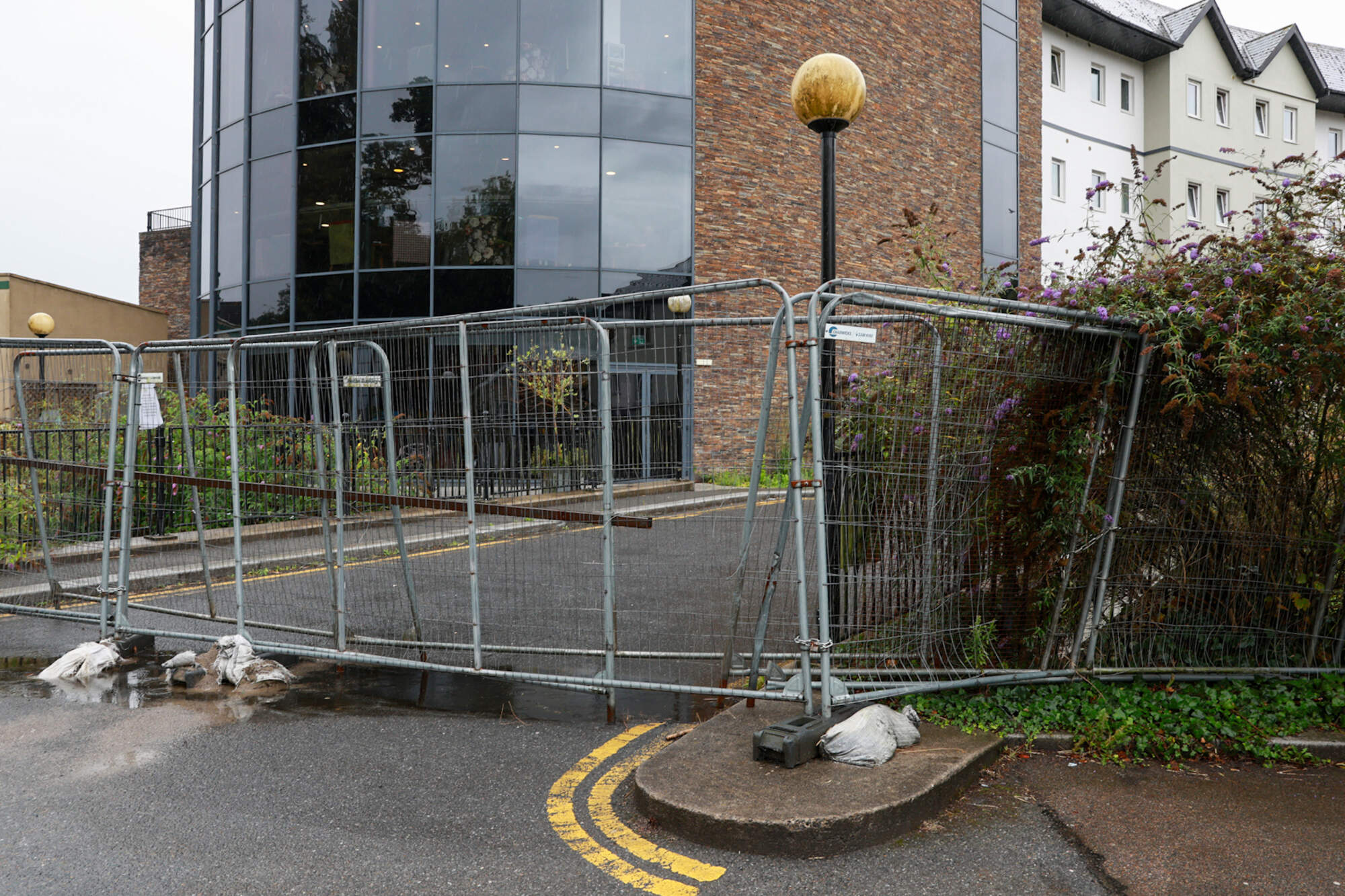
Since 2019 the bridge connecting the front of the building to the street outside has been closed off due to structural issues. A separate bridge at the back of the building has been temporarily open for visitors during that time, but is primarily an emergency access point.
And so, residents and their loved ones exit and enter SignaCare either via a side entrance or the garage used for deliveries.
This includes those who pass away in the nursing home.
Speaking on condition of anonymity, Michael says he and his family saw a lot in their four years visiting the nursing home.
“People who pass away there, they were brought out the front door and down through the service area to the back where all the deliveries and everything are,” he recalls.
“Then they were brought out onto the back alley where the local restaurant is and loaded into a hearse there. It seemed just totally degrading.”
As his mother reached her final hours, Michael made a promise to her.
“I said to her, in front of the undertaker, if that front exit was closed off I was going to bring an angle grinder and cut down the fence so she could get out that way.”
Thankfully, Michael did not need to resort to such drastic measures; the bridge at the back of the nursing home was open for his mother so that she could leave SignaCare in the kind of dignified manner she deserved.
In December 2023, Carlow County Council approved a planning application from SignaCare for “the carrying out of remedial/repair works” to the bridge so that it could eventually be reopened.
However, that decision was subsequently appealed by a Mr Pat Finnerty of Shillelagh, Co Wicklow, who, in his submission, said he found “it unbelievable that a competent planning authority would grant planning permission” for these remedial works and advised that “the correct procedure” would be for An Bord Pleanála (now An Coimisiún Pleanála) to review the application.
An inspection was subsequently carried out by An Bord Pleanála and a report was issued thereafter. Included in the report was a statement from SCA Planning of 17A Bridgecourt Office park, Walkinstown Avenue, Dublin 12, which noted that “every aspect of the development was assessed for potential impacts on the environment, expert consultants were engaged, and their robust assessments are evident.
“The proposed works are important to the viability of the town, local community, the nursing home and general public health and safety.”
On Mr Finnerty, SCA Planning said, “(he) lives 14km away and raises issues of no relevance to the proposal, which could significantly delay the remedial works and reopening of the bridge.”
Having reviewed the case, An Bord Pleanála upheld Mr Finnerty’s appeal and refused planning permission on the grounds that the bridge included in the plans was “materially different” to the actual structure and would therefore represent an “unauthorised structure”.
The board also said it could not be satisfied that “the proposed development individually, or in combination with other plans or projects would not be likely to have a significant effect on the Slaney River Valley special area of conservation (SAC)”.
Since that decision from An Bord Pleanála on January 20, 2025, no further applications to repair the bridge have been submitted, leaving families like Michael’s continuing to use a side entrance to access the nursing home.
And they explained that, upon entering the building from the side entrance, visitors must negotiate tunnel-like corridors before entering the nursing home proper through the kitchen area. This has led them to question the safety of the building and how the residents would be evacuated in the case of emergency.
Despite their concerns, despite any complaints they may have about the layout of the building, Micheal and his family are adamant about one thing.
“Let’s be clear on this,” he said, “the staff in there are excellent. They were very good to my mother, and she was always grateful to them and always thankful to them.”
While Michael is at the far end of his experience with SignaCare Bunclody, other families in the village are only beginning theirs. Emily’s* brother, who is in his sixties and confined to a wheelchair, has been in the nursing home since December of last year.
And, for the majority of that time, his family have been unable to bring him out for the visits which were once a mainstay of his life.
“If you want to take him out you have to go out through the kitchen, we’re not physically able to push the wheelchair that far,” she says, referencing the pebbled lane used by delivery drivers to access the side of the building. “So we can’t collect him. He’s an invalid, he can’t walk. He has special needs. He used to attend a nearby Reach Hub, but they’re finding it difficult to get him in and out because they can’t bring the van around to get him into it.”
Having walked the lane in question, it’s clear that it’s not suitable for wheelchairs; something which Emily reiterates.
“It’s not suitable for any purpose. It’s even hard on the staff to bring them out. Trying to wheel someone on that rough terrain is very difficult.
“And my brother loves to get out and go around the town. If we were to go up at lunchtime to take him out we wouldn’t physically be able to roll him out that way, we’re afraid the wheelchair would turn over on that surface.
“He constantly asks if he can go visit family members of friends, but we just can’t do it, we tell him; ‘oh we’ll be getting that bridge fixed’, and he asks, ‘are they coming soon to do it?’”
While regular visitors to the nursing home have become used to this unorthodox mode of access, those new to the area are often left confused by the barricade at the front of the building.
“There was an ambulance a while back,” Emily says. “It had to go around the back, it should be straightforward; ‘there’s the nursing home, you go straight in’.
“People are asking, ‘how do I get in there? I can’t find any entrance.’ You have to explain to them, you go down a lane, and you’ve to ring a buzzer and someone will let you in.
Having taken the difficult decision to admit her brother to a nursing home, Emily says that not being able to bring him out has left her feeling guilty, left her feeling like she is depriving her loved one of the small joys in life.
“If you were stuck at home, and you couldn’t go out your front door, how would you feel?” she asks. “We’ve had to keep fobbing him off, it’s not really fair. We had such a beautiful summer, and we couldn’t bring him out.
“Psychologically it’s having an effect on him, he’s restricted in what he can do. He loves meeting people, he misses it. You feel guilty about not being able to bring him out, even if it was only for a cup of tea. He was born and reared here, everyone knows him.”
However, like Michael she is full of praise for staff who are dealing with what is an awkward situation for all concerned.
“It’s so well-run, it’s a beautiful nursing home, you couldn’t fault it. They are exceptionally kind to the residents, it’s immaculate inside, it’s spotless.”
While technically SignaCare Nursing Home is located in Co Carlow (as it is situated on the far side of the River Clody), Wexford county councillor and Bunclody native, Barbara Anne Murphy has been campaigning on behalf of families like Emily’s and Michael’s.
And she says that this has become a basic human rights issue.
“We are left with a situation where we have a wonderful nursing home, a large number of people from this area living there, and their basic human right of being able to go in and out and access the town, and enjoy the last years of their lives to their level best in what are constrained circumstances, is being restricted,” says the Fianna Fáil councillor.
On the issue of corpses being transported out through a side entrance via the kitchen, Cllr Murphy describes this as “inappropriate, disrespectful (and) upsetting for families”.
“These are older people who maybe can’t speak up for themselves, people with disabilities,” she says. “This is now their home, it’s not a prison, it’s a nursing home, they should be able to come and go the same way they would if they had their own front door.”
While Cllr Murphy is calling upon Carlow County Council (CCC) to submit a new application to repair the bridge, those on the other side of the border insist this is not solely a Carlow issue.
Independent councillor for Carlow, Charlie Murphy, was quick to point out that it’s Wexford County Council who receive the commercial rates from SignaCare and yet “CCC is expected to resolve this issue”.
Ultimately, though, it seems to him to be “a SignaCare problem”.
“It owns the nursing home. It needs to sit down with WCC and CCC and figure out a way to resolve this issue for the betterment of all those involved,” says the Carlow councillor.
When contacted for comment, SignaCare said it was continuing to engage with “the relevant local authorities to address this issue”, which “may involve re-applying for planning permission”.
On the issue of fire safety at the building, SignaCare said it has “ensured continued access through the ‘rear’ and ‘side’ entrance routes for emergency vehicles should they be required”.
Carlow County Council had not responded to our queries at the time of publication.
*names have been changed to protect the identity of interviewees.
Funded by the Local Democracy Reporting Scheme.