
In cinemas; Cert 16
Westeros has a lot to answer for. Since slicing its way into the collective consciousness with Game of Thrones, George RR Martin’s fantasy has ushered in a new normal when it comes to television violence.
That’s our theory, anyway. As for the retort – that ever since prison drama Oz, HBO has had a predilection for gratuitous unpleasantness – it’s true to a point. Tony Soprano was definitely no angel, and The Wire could exhibit a heartlessness when portraying the cheap price of life on Baltimore’s streets.
But come now. Game of Thrones’ evocation of barbarity and torture pushed the envelope with images that once seen, couldn’t be unseen. Alongside its particularly bleak-minded spin-off, House of the Dragon, it has become a byword for show-off levels of murder and mutilation.
You wouldn’t need much effort to draw a line from there to the opening act of The Death of Robin Hood. Muck, misery and northern English consonants? It’s all here in a way that feels midwifed by the Seven Kingdoms franchise.
Michael Sarnoski’s revisionist take on the Sherwood myth uses its opening act to beat you to a pulp, all in the name of introducing us to its 13th-century hellscape. You’ll wince, you’ll flinch, you’ll pine for the days of Errol Flynn in moss-green tights.
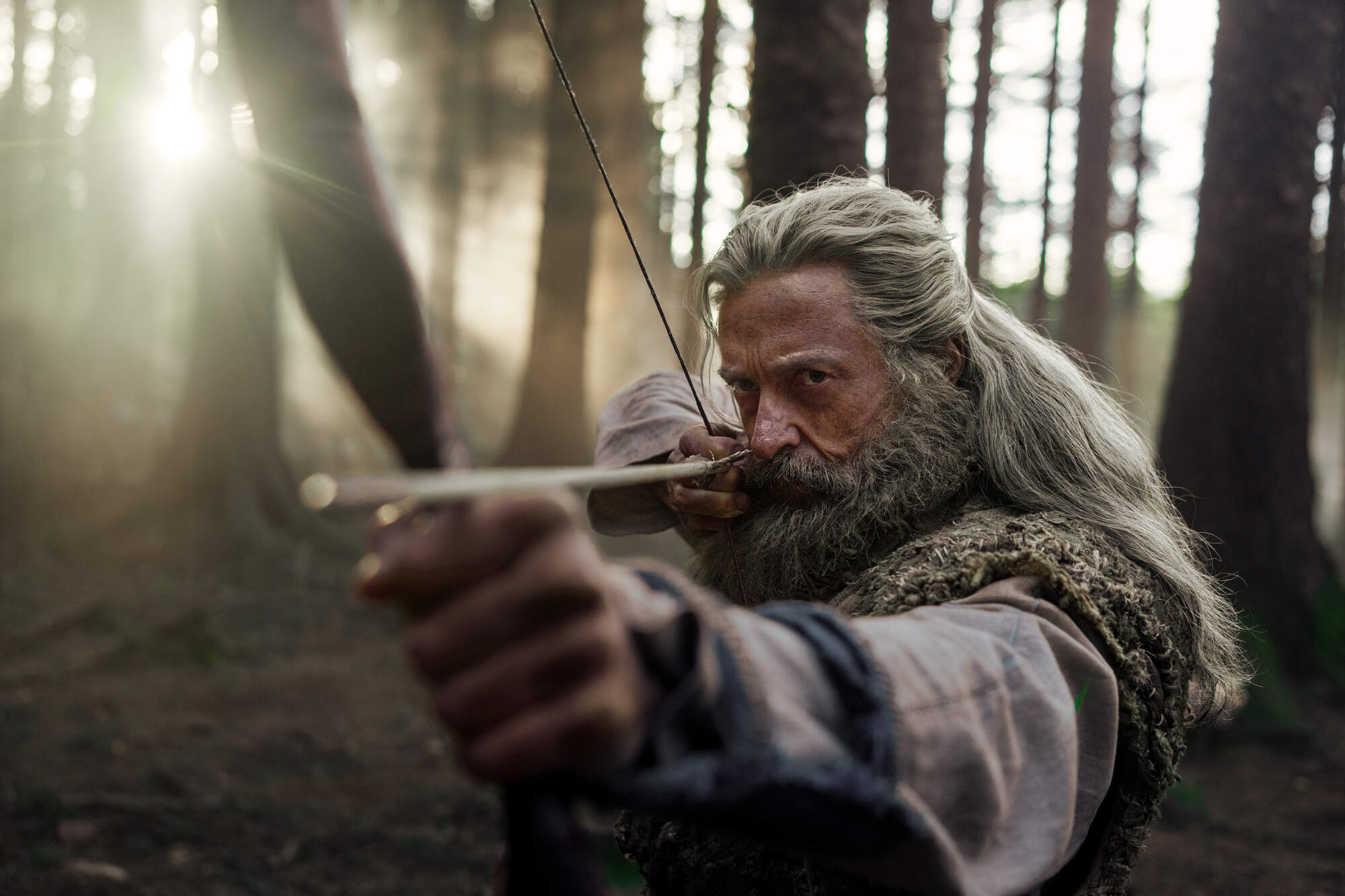
This Robin Hood (a glass-chewing Hugh Jackman) is no rascally swashbuckler, robbing from the rich to help the needy. He’s a grizzled angel of death who, years past his prime, lives in self-imposed exile in the wilds.
Leaving a long trail of death in his wake has made Robin a wanted man in the autumn of his years. Avengers track him down, hoping to mete out their justice. It will not be easily attained, as repeated assassins have learned the hard way.
Old mucker and fellow cut-throat Little John (an unrecognisable Bill Skarsgard) turns up one day seeking help. Posing as Edward – an identity stolen from one of his highway murder victims – Little John needs Robin to help him get back at those who have seized his farm and family (well, the original Edward’s farm and family).
The incursion goes horribly wrong in a number of grim and gory ways. The hacking and screaming and bludgeoning comes thick and fast. “Look, look!” Sarnoski seems to say, but the gruesome detail adds nothing to the story, the characters’ motivations or our sense of the world they move through. Like too much of anything, all it does is flatten the storytelling by the time the second act rolls into view.
If you last through this sadistic entrée, you’ll be spewed out into calmer waters. You might even have enough bandwidth left to see Robin has been severely injured by the skirmish.
Little John rows him out to an island refuge where he’s taken in by the island’s only inhabitants: a convent and priory whose residents tend to the wounded and the weak. It is led by head prioress and healer, the serene and kindly Sister Brigid (Jodie Comer, the first ray of light in the film thus far).
The recent scrap has upped the ante yet again for Robin, so he must assume a new identity while he recovers in the tranquil surrounds. In his own gruff way, he befriends the leprosy-riddled priory caretaker (Murray Bartlett), and watches Sister Brigid from a distance with something like longing.
But news has travelled quick enough, even in this wretched age. Robin is eventually followed on to the island by a couple of former acquaintances, one of whom is more welcome than the other.
The assumption is that Sarnoski (Pig, A Quiet Place: Day One) will press the red button and crank the gore-o-meter back into gear for the final throes – an antiheroic last stand, perhaps. But even the writer-director seems shagged out by this stage. Instead, The Death of Robin Hood lets air out of its own tyres with an ending that is another extreme, this time an anaemic, life-sapping redemption.
Scattered throughout this saga, which is very loosely inspired by a 16th-century ballad, there is the DNA of a very fine film. Jackman and Comer are absolutely top-drawer in chalk and cheese roles, with the former now certified as one of the most dynamically ranged leading men in the game. The costume design by Fermanagh’s Lorna Ó Ríordáin is incredible, as is cinematographer Pat Scola’s rendering of the Northern Ireland filming locations.
The problem here is one of leavening. Too much manic brutality upfront, not enough life force in the finale, with a middle section that has too much work to do. At least Game of Thrones had some sense of timing.