
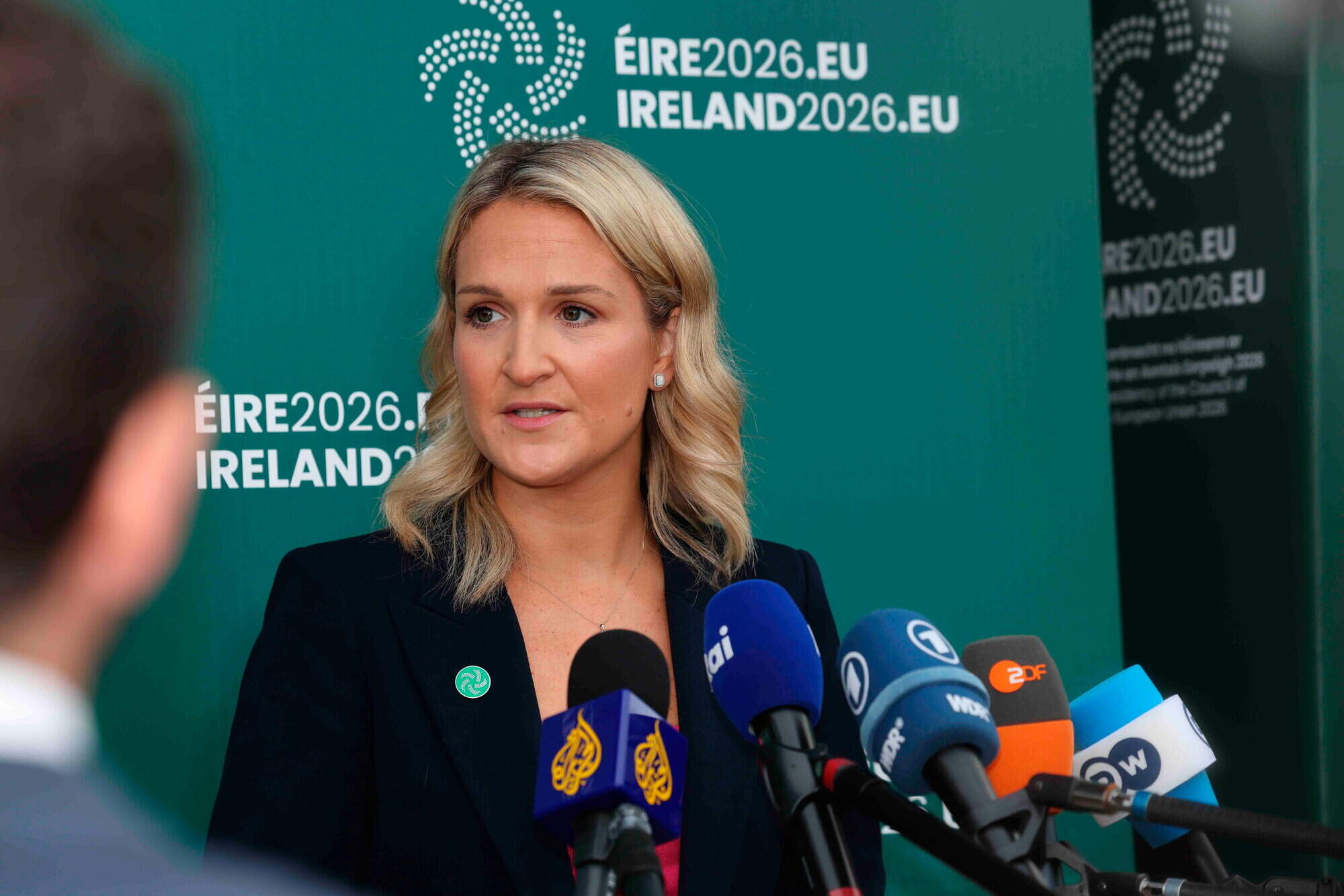
Russia’s attempt to “divide the EU is moving further and further away from the battlefield” in Ukraine, the Minister for Defence and Foreign Affairs has said.
Helen McEntee has insisted that Europe will “remain united” in its commitment to support Ukraine and “stand up to” Russia.
She was speaking at Gymnich, the meeting of the bloc’s foreign affairs council, in Wicklow on Wednesday as part of Ireland’s presidency of the Council of the European Union.
Her remarks came after the EU’s foreign affairs chief said the Russian representative to the EU had been summoned in the wake of an attempted attack on a German airport, which she said had “hallmarks of state-sponsored terrorism”.
Russia said it “categorically rejects” allegations made by Germany that it was responsible for the incident at Leipzig/Halle Airport on August 4 where a drone laden with explosives was discovered.
Ms McEntee said: “What I think was also clear today is that the attempt by Russia to divide the EU is moving further and further away from the battlefield, so to speak, from Ukraine and further beyond the neighbouring member states.
“What we are very clear of is that we will remain united in our response, in our absolute commitment, to support Ukraine, but to stand up to these types of activities.
“I think, importantly, the decision to increase our engagement with international partners in that regard is very important.”
Kaja Kallas, the EU’s foreign affairs chief, also told reporters at Gmynich – named after the foreign affairs council’s first meeting at Gymnich castle in Germany – that Leipzig “was not an isolated incident”.
She said: “Since 2022, we have seen systematic attacks across Europe.
“Sabotage, cyber attacks, espionage are becoming more frequent and more brazen.
“The EU stands in full solidarity with Germany. We have summoned the Russian representative to the EU and we are moving ahead with more sanctions.”
Asked about reports that a suspect in the Leipzig incident had entered the EU through an Italian tourist visa, Ms Kallas said many member states have flagged that tourist visas are being used for acts of sabotage.
She said the Gymnich meeting had involved “broad support” on EU visa entry ban for Russian ex-combatants and “tougher” restrictions for Russian tourists.
She said: “If it is true, I hope that this also convinces certain member states who have been against moving on the visa restrictions that this is actually our security that is in concern as well as Ukraine’s.”
Ms McEntee said the use of Italian tourist visas had not been confirmed.
But she added: “We need to use every tool available to us while at the same time expressing absolute solidarity with Germany and making sure, in the immediate term, we can take these types of actions to prevent individuals coming in, be it through holiday visas, be it through any other format, and making sure that those actions are taken as quickly as possible.”