
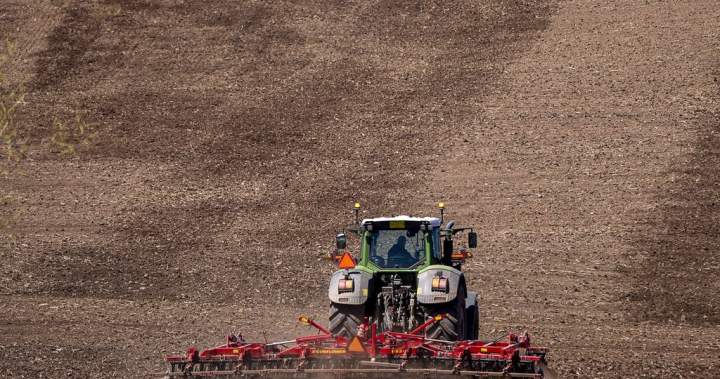
A year after a severe drought left farms hurting across the East Coast, some Maritime growers say they’re on the road to recovery.
A mix of rainfall and sunny conA year after a severe drought left farms hurting across the East Coast, some Maritime growers say they’re on the road to recovery.ditions across the region has helped a number of crops regain their footing, some farmers say. But there are still signs of damage from the hot and dry summer of 2025.
Danny Dill, a giant pumpkin grower and owner of Howard Dill Enterprises, in Windsor, N.S., said it’s hard to describe the severity of what happened last year.
“It was a historic drought. Never seen nothing like it in my lifetime. I’m in my 60s now, and some of the people that are in their 90s saying they’ve never seen nothing like it,” he said in a recent interview.
Story continues below advertisement
Scientists say climate change is responsible for more frequent and more intense storms, droughts, floods and fires. It’s a new reality that farmers like Dill may be experiencing on the ground.
Dill said last fall he had no choice but to turn away pumpkin customers due to a shortage of stock, but this year he’ll be able to accommodate all their orders.
“The pumpkins are coming on, because we’ve had some good, timely rains this year,” he said.
However, Dill said their large pumpkin varieties are smaller than they would typically be at this time of year, and he wonders if last year’s drought has played a role in that.
“Maybe it’s something to do with that drought, the moisture level in the soil,” he said.
1:41
Wild blueberry season sees improved crop after last years drought
Trevor Hadwen, an agroclimate specialist with Agriculture Canada, said last year’s drought was significant in a region that doesn’t typically experience prolonged dry conditions.
Story continues below advertisement
The federal department said Nova Scotia, eastern Newfoundland, southeastern New Brunswick and portions of Prince Edward Island were all under severe drought conditions last August.
Get daily National news
Get daily Canada news delivered to your inbox so you’ll never miss the day’s top stories.
By providing your email address, you have read and agree to Global News’ Terms and Conditions and Privacy Policy.
“We see significant rainfall throughout the region each year, so when we look at how dry it was last year, certainly an anomaly in the climate cycle,” he said in a recent interview.
Patrick O’Neil, Executive Director of the Wild Blueberry Association of North America, which represents Canadian growers and producers, said that last year’s drought was “devastating.”
“We saw almost no rain in July and oppressive heat in New Brunswick. Some farmers weren’t even allowed to harvest during peak season because of fire bans and restrictions,” O’Neil said in a recent interview.
Wildfires also burned in Newfoundland and Labrador, Nova Scotia and New Brunswick last summer, prompting some provincial governments to implement restrictions on activity.
In a summary of climate change impacts on farming published in 2020, Agriculture Canada said rising temperatures and extreme weather would affect the industry across the country.
It also said the Atlantic region would likely experience a range of impacts, including extended drought patterns that may put pressure on yields and water availability, as well as milder winters that could have an impact on pests and diseases. It also said the area is at risk to rising sea level, storm surges and erosion.
Story continues below advertisement
2:07
Maritime farmers still determining impacts of last year’s drought as summer season starts
Scientists say that humans are contributing to climate change primarily through the burning of fossil fuels and land-use changes.
- Thunderstorms, rain looming for Toronto as heat warnings hit southern Ontario
- Tumbler Ridge shooting survivors among 30 new plaintiffs suing OpenAI
- Ontario threatened to cut off U.S. critical minerals supply. Sudbury isn’t panicking
- Progressive Conservative MPPs say they have repaid thousands in hotel room expenses
-
DeGroote professor dissects intensifying Canada-U.S. trade war
-
‘Lake Ontario, actually’: Adam van Koeverden responds to Trump’s ‘Lake America’ name change
-
‘What an embarrassment’: Eby derides controversial Hegseth post about B.C. cadets
-
Eby thinks B.C. NDP candidate will beat ‘hateful, divisive’ Kerry-Lynne Findlay in byelection
Dill said he first began to notice the impacts of climate change on his farm about 15 years ago, but over the past five years there’s been a sharp increase in extreme weather conditions, with flooding, storms, wildfires and drought.
“I knew the shift, the gradual change in the seasons, just because (I’ve) always been working with the land … But in the last five years, the dramatic weather events, there’s just no words to describe it,” he said.
It’s a shift that has caused some anxiety for Dill and other farmers in the region.
Jordan Eyamie, the manager of Webster Farms Ltd. in Cambridge, N.S., which harvests strawberries, raspberries, rhubarb and dry beans, said “morale wise, there was definitely the fear that this might happen again.”
Story continues below advertisement
Last year’s drought caused the loss of about 20 per cent of their yield and affected the growth and flowering of some of their plants that are producing this year, she said, but the frequent rain provided some relief.
“Watering beans is very, very expensive because it uses a lot of fuel,” she said, adding that this year they were able to rely mostly on rain to keep the beans healthy.
“I was touring the beans today and they all look pretty good,” Eyamie said.
For wild blueberries, O’Neil said the plants that are now producing experienced stress during last year’s drought, because the berries are harvested on a two-year cycle.
“The plants overall were healthy, but they just didn’t grow out around the outskirts, new growth just didn’t make it … But the crop is doing very well, all things considered,” he said.
Hadwen said the dry heat resulted in water supply shortages that meant many producers struggled with crop yield. “From tree fruits, to berries, to potatoes, to traditional grains,” all felt the impact.
“When you talk to producers, I’m sure they’re going to tell you that going into this season, they were very concerned for another repeat,” Hadwen said.
Some of those concerns started to lift in May, when rain fell consistently throughout the entire region, replenishing lakes, reservoirs and adding moisture to the soil.
Story continues below advertisement
Hadwen said while it’s too early to assess the success of yields this season, he would expect to see a fairly slow recovery.
“It wasn’t a typical wet year, it was up and down, wet and dry. So depending on when those rains came … depending on the critical periods there are for individual crops, some crops may have done really well and recovered quite quickly with those rains,” while others may not have, he said.
Hadwen added that some areas still experienced drier-than-normal conditions, particularly the Northumberland Shore area in northern mainland Nova Scotia.