
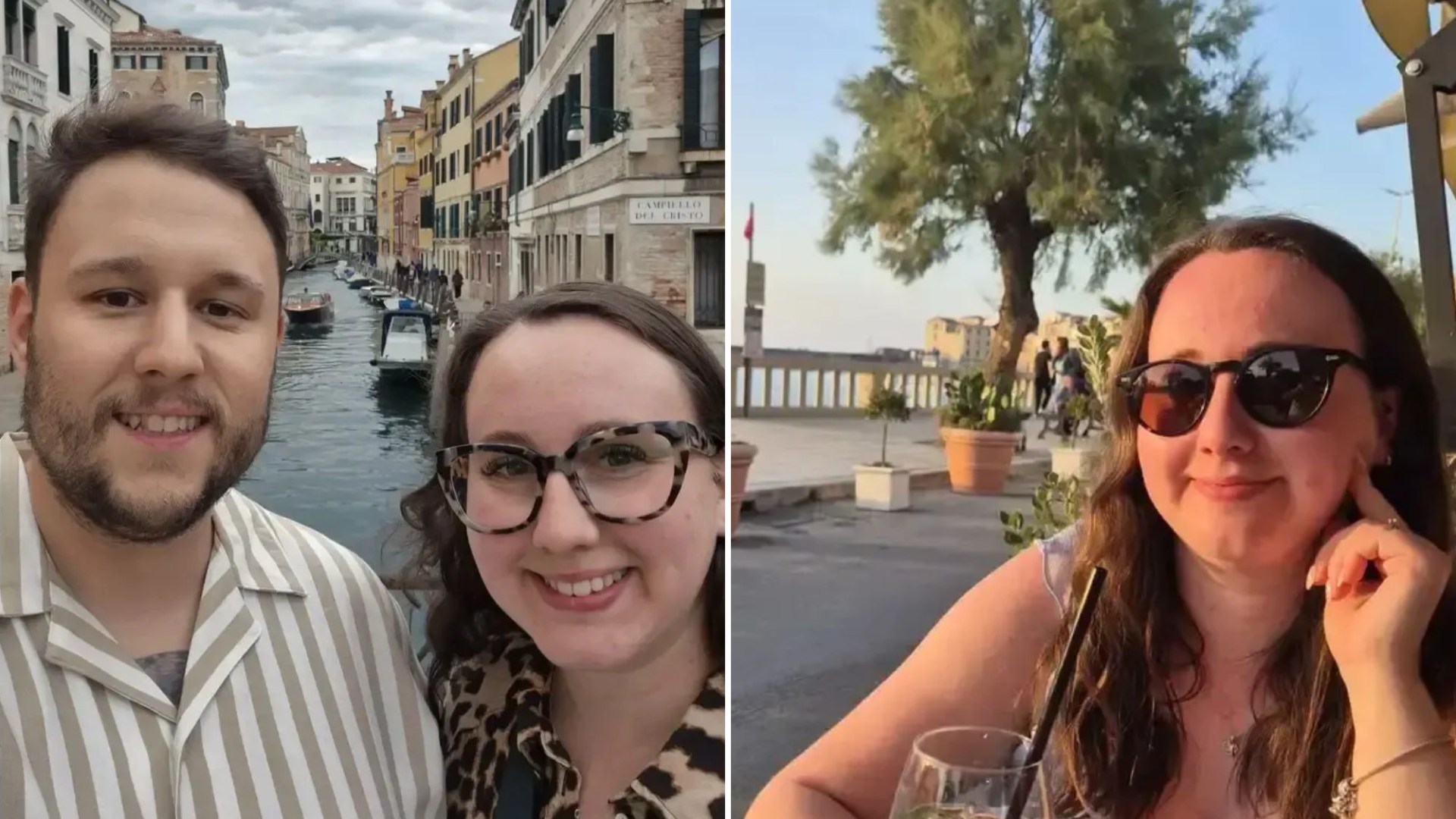
A WOMAN has told how unusual bruising on her legs, which she noticed on her honeymoon, led to a life-changing cancer diagnosis.
Rosie Meiklejohn-Cribdon, 29, was on a flight to her honeymoon in Italy in May 2025 when she noticed her legs feeling “a bit weird [and] tingly”.
5
5
Over the following weeks, she proceeded to notice huge bruises all over her legs, despite not having bumped into anything or injured herself.
Along with this, Rosie felt like she had been “hit by a steamroller” throughout her honeymoon and had to spend lots of time resting in her room due to the exhaustion.
When she returned home to Leicestershire, she got a blood test and in August, she was given the heartbreaking news she had essential thrombocythaemia – a type of blood cancer.
During this appointment with a hospital consultant, Rosie was told her life expectancy was around 20 years, and that she would never be able to have children.
Read more on health
CRISIS
NHS drug warning as 2 new meds used by millions face shortage – are you affected?
KIDS CRISIS
Thousands of kids as young as six treated in A&E for ‘mental health crises’
The news was “extremely shocking” to the couple and Rosie’s husband Nathan encouraged her to get a second opinion just to double check her prognosis was right.
After seeing a private doctor, Rosie was told that while her cancer was incurable, there was every chance she could live a long and happy life.
“I really thought I was going to be dead by the time I was 50, having not really experienced much, so I now take every day as a bit more of a blessing,” she said.
Essential thrombocythaemia (ET) is a type of rare blood cancer that affects the bone marrow.
Most read in Health
CRISIS
NHS drug warning as 2 new meds used by millions face shortage – are you affected?
AISLE BE DAMNED
Worst ‘healthy’ baby food revealed – as 1 in 5 ‘putting health at risk’
KIDS CRISIS
Thousands of kids as young as six treated in A&E for ‘mental health crises’
LISTEN UP
The 3 times to see a GP – as Scott McTominay to have heart surgery for arrythmia
The disease usually develops slowly and doesn’t cause symptoms at first, meaning many people find out they have the cancer while getting a blood test for something else, Cancer Research UK says.
As it progresses, symptoms begin to appear and these can include tiredness, headaches, burning and tingling in hands and feet and bruising more easily.
Rosie first noticed unexplained bruising all over her body shortly before her honeymoon in May 2025.
She went to urgent care and had some blood tests, but was told the bruising was likely caused by a virus.
5
5
This left her not thinking much of it and she “assumed all was fine”.
But on the flight to Italy with her husband, she started experiencing a strange tingling sensation in her legs, and the following day she noticed heavy bruising on her legs.
Over the course of her honeymoon, the bruises kept appearing and she said she felt “exhausted” and “incredibly ill”, prompting her to push for more answers when she got home.
Rosie finally secured an appointment with a specialist at a hospital in July 2025 and the next month, she was called back to discuss her results.
There, she was given her devastating blood cancer diagnosis and told that her blood tests revealed a mutation of the JAK2 gene, which causes blood cells to multiply out of control.
Rosie was also told that her life expectancy was around 20 years, so she decided to seek a second opinion after this.
Two weeks later, she had an appointment with a private doctor at Spire Leicester Hospital.
But while she waited for this, she began to spiral and was unable to go back to work as she said she “just couldn’t concentrate”.
Rosie continued: “I just wanted to sit on my sofa and cry, and just work out how I wasn’t going to die in 15 years.
“It was horrific. I thought I’m not even going to make it to 50.”
But thankfully, Rosie saw a second doctor at the end of August and she said that appointment “completely changed our trajectory”.
Rosie explained: “She [the doctor] answered all the questions that we had, and said: ‘You don’t need to worry more than somebody with diabetes’. I’m on that level.
“She said: ‘You’re not going to die tomorrow. It isn’t going to kill you. Yes, you’re going to die with it, but that could be in 80 years’…
“Nathan and I both walked out of there like the weight had just been lifted.”
5
What is essential thrombocytosis?
Essential thrombocythaemia (ET) is a rare blood cancer that affects the bone marrow.
In people with ET, their body makes too many platelets. Platelets are cells in the blood that cause it to stick together and form clots to stop bleeding.
Having too many platelets increases the risk of having unwanted blood clots. If platelets in the blood do not work properly, it increases the risk of bleeding.
ET usually develops very slowly. For most people, having the cancer does not shorten their life. ET is more common in people aged over 60, but it can affect people at any age.
Possible symptoms of ET include:
- persistent headaches
- dizziness or ringing in the ears (tinnitus)
- numbness or tingling in the hands and feet
- burning pain, changes in feeling, or redness in the hands or feet
- cold or blue fingers or toes
- tiredness
- difficulty concentrating
- changes in vision
- itchy skin
- bone pain
- bruising more easily
Some people also develop symptoms because of the complications of ET, including blood clots.
Symptoms of a blood clot include:
- throbbing pain, redness or swelling in a leg or an arm
- suddenly feeling breathless or coughing
- sharp chest pain, which may be worse when you cough or take a deep breath
If you have any of these symptoms, contact the hospital straight away. If you cannot speak to your doctor, call the NHS urgent advice number on 111.
Source: Macmillan
Despite blood cancer being the fifth most common cancer, as well as the third biggest cancer killer in the UK, it is widely misunderstood.
Blood Cancer UK – a charity which offers support and funds research into the condition – says it can affect everyone differently – some will need treatment such as chemotherapy while others can live a normal life but will need regular monitoring.
Luckily for Rosie, she didn’t have to go through chemotherapy and her symptoms have remained fairly mild.
Rosie said: “The weird thing is that it could stay the same as it is now, relatively stable, for 40 years, or it could change tomorrow. We just don’t know.
“I’d probably say I get more tired than your average 29-year-old – I do have a tremendous capacity for sleep these days, and I think that’s the only thing I’ve noticed that’s slightly different.”
She said she feels “quite lucky” that her symptoms aren’t any worse.
Rosie takes low-dose blood thinners, which help reduce bruising, and she has given up alcohol and started paying more attention to her diet and exercise routine.
Now, a year on from her diagnosis, Rosie said: “It feels like it has been the longest, but also the shortest year ever”.
“It has made me see life differently – grab every moment, don’t sweat the small stuff and make an impact in the world.
“That means raising awareness of the symptoms of blood cancer and travelling the world.
“My cancer was lurking through my honeymoon, but it won’t stop me living my life.”
RECOMMENDED STORIES
Rosie is sharing her story to support Blood Cancer UK’s ‘Here for This’ campaign for Blood Cancer Awareness Month, this September.
The campaign calls for more funding to be put into blood cancer research.