
Errors including botched currency conversions led the British Columbia government to overstate its forecasted natural gas revenues by about $1.46 billion over five fiscal years, officials confirmed on Tuesday.
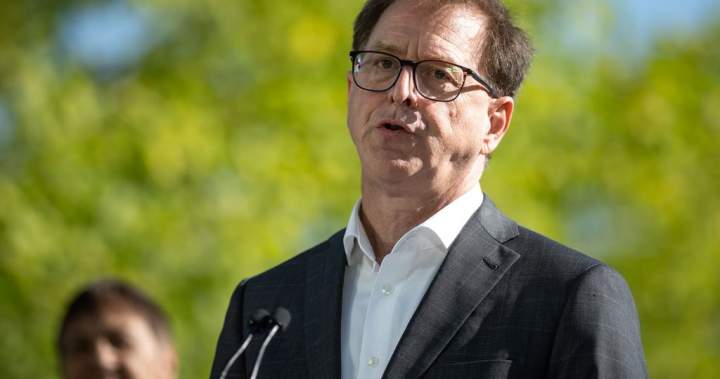
Energy Minister Adrian Dix said the most significant error, a 44-cent overstatement in the forecasted per-gigajoule price of natural gas this fiscal year, was a “serious mistake.”
But he said the errors affect the province’s forecasting, not its actual revenues, which can vary in a given year. Price fluctuations, including the spike and subsequent decline linked to Russia’s invasion of Ukraine, have led the province to both underestimate and overestimate its revenues over the years, Dix said.
“That part is a normal part. What isn’t a part of it is human error that we’re acknowledging today and correcting in the budget,” he told reporters in Vancouver.
Senior staff with the ministries of energy and finance told a technical briefing earlier Tuesday that the errors had been independently verified and corrections would be included in the province’s quarterly fiscal report expected later this month.
Story continues below advertisement
The briefing heard the impact on B.C.’s deficit — last pegged at $7.7 billion for fiscal year 2025-2026 — would be made clear with the release of that report.
The most substantial of the errors made by Energy Ministry staff related to U.S.-Canadian dollar conversions, when a formula was incorrectly applied across a spreadsheet.
The province’s forecasting is based on private-sector estimates of natural gas prices, which are provided in Canadian or U.S. dollars.
Dix said the error involved an incorrect assumption that figures were shown in U.S. dollars, when in fact they were Canadian dollars. The numbers were “again translated into Canadian dollars, leading to an overstatement of revenue,” he said.
2:14
Will budget error cost BC billions in natural gas revenue?
The briefing heard correcting that error resulted in a price decrease of 44 cents per gigajoule of natural gas in B.C.’s forecasting for 2026-2027.
Story continues below advertisement
Budget 2026 shows incorrect forecasted prices per gigajoule ranging from $2.34 to $4.83 at plant inlet, referring to gas that hasn’t yet been processed.
Get daily National news
Get daily Canada news delivered to your inbox so you’ll never miss the day’s top stories.
By providing your email address, you have read and agree to Global News’ Terms and Conditions and Privacy Policy.
“We’re making changes to the way the process happens to ensure that such errors do not occur in the future,” Dix said.
The Opposition B.C. Conservatives did not immediately respond to a request for comment, but last week, their finance critic Gavin Dew called for the auditor general to examine the flawed revenue forecasts, after they were originally reported by Business in Vancouver.
“This isn’t just an accounting error. It’s a credibility problem,” Dew said in a statement, while Opposition Leader Kerry-Lynne Findlay said B.C. could not afford budgets “built on wishful thinking.”
The information in Tuesday’s technical briefing was provided on background, meaning it was not for attribution to an individual.
A second error involving the conversion of energy units amounted to a five-cent decrease in the forecasted price.
- Bank of Canada holds key rate at 2.25 per cent once again
- Cost of living, fuel has Couche-Tard customers cutting back on snacks
- Calgary home sales fall 16% in August, overall prices down year-over-year
- Carney names Dominic Barton as chair of Invest in Canada
-
A clean sweep for the federal Liberals as they win three byelections
-
Coquitlam mayor breaks silence on Metro Van’s governance
-
Churchill grain shipments resume
-
Alberta liquor suppliers facing issues with AGLC payments
Two other errors stemming from the use of data from 2025 instead of this year’s figures resulted in a decrease in the plant inlet price of 1 cent per gigajoule, while adding 3 cents to the outlet price.
Combined, correcting the errors amounted to an average annual decrease in expected revenues of $292 million from this fiscal year to the one starting in 2030.
Story continues below advertisement
The impact for the current fiscal year is $306 million, reducing forecasted revenue by about 24 per cent, from $1.297 billion to $991 million.
The Energy Ministry is working with experts to improve its quality assurance process in forecasting moving forward, staff told the briefing.
The briefing heard Treaty 8 First Nations in northeastern B.C. had alerted government officials to what they believed to be an error in the province’s accounting of processing and transportation costs for natural gas in June.
Staff said the province reviewed its calculations and confirmed those costs were appropriately incorporated into its forecasting, but in July uncovered the series of errors related to the conversion of currency units of natural gas.
The errors come as the province works on an updated framework for collecting natural gas royalties that’s set to come into force on Jan. 1, with the goal of returning 50 per cent of profits after accounting for companies’ production costs.
Staff at the briefing acknowledged concerns among Treaty 8 First Nations that the framework won’t hit that target and said further information would be available this fall.
Dix said officials were confident they were “on the right track.”
He said the goal was to establish a new royalty framework that’s “fair for the taxpayers and the owners of the resources,” including First Nations.
Story continues below advertisement
It must also strike a balance with the industry, he said.
“We have to make sure (there’s) a good return for the people so that we can help pay for things that are really important to me, like health care and education, on the one hand, and you’ve got to ensure that we have an industry that’s in the province.”