
Advertisement
The world has lost any chance of holding global warming to 1.5 degrees as agreed to in Paris Treaty, with temperatures predicted to reach 2.6 degrees by the end of the century if governments continue with current climate policies, according to a new United Nations Environment Program report.
These temperatures would have catastrophic consequences for the world, significantly increasing the risk of crossing irreversible tipping points in critical Earth systems, such as the collapse of the West Antarctic and Greenland ice sheets, the Amazon rainforest, and the Atlantic Meridional Overturning Circulation, the vast ocean current that helps regulate the climate by redistributing heat around the globe.
Addressing the report at the Pacific Islands Forum in Palau, which is being attended by Prime Minister Anthony Albanese and Climate Change and Energy Minister Chris Bowen, Vanuatu’s Climate Minister Ralph Regenvanu called on Australia to stop expanding its fossil fuel extraction and exports.
“Australia is not doing enough. Australia is a major producer of fossil fuels. We all know fossil fuels are the primary driver of the climate crisis, as I said. So, the very least a country like Australia should be doing is stopping future expansion, and it’s not doing that.”
Advertisement
When asked about criticism of new fossil fuel projects, Albanese said Australia’s Pacific neighbours had not raised objections during the Forum talks. “Australia is highly regarded when it comes to climate change, and the talking down of Australia does not happen from outside Australia,” he said.
“The Pacific leaders have respect for the position that we’re taking, and they also understand with the transition because they’re dealing with it as well. That the transition can’t happen overnight. That it requires strategies and policies to be put in place. And one of the things that renewables requires is firming capacity, and gas has a role to play in firming capacity.”
The most optimistic pathway laid out in the report sees the average global temperature arrested at 1.8 degrees later this century, before slowly being driven down, if governments mange to fully implement of all their current national climate plans and meet all long-term net zero targets.
At present there is a persistent gap between the emission reductions countries have pledged and the policies in place to deliver them, says the report, entitled, Limiting Overshoot: Navigating exceedance of 1.5°C and pathways towards return.
Advertisement
“Exceedance of 1.5°C should not be interpreted as safe or acceptable; there are no benign scenarios with global temperature rise above this level,” says the report, which was published as Prime Minister Anthony Albanese and Climate Change and Energy Minister Chris Bowen attend the Pacific Islands Forum in Palau.
Its members are among the nations that successfully lobbied for the world to adopt the 1.5 degree target as crucial to their existence during Paris negotiations, and Australia has championed their cause since, as it seeks to maintain its security influence across the region.
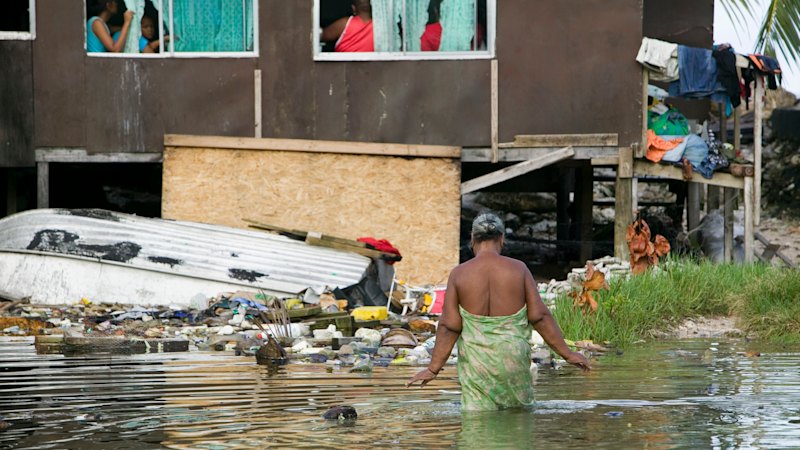
“In Pacific atoll states such as Tuvalu and Kiribati, the loss of habitability is a present reality, occurring well before total physical submersion,” says the report.
The host of the Pacific Island Forum, Palau President Surangel Whipps Jr, said of the report, “It is hard to overstate the depth of emotion for those of us living on the front line after having fought so hard to put the 1.5 degree limit at the heart of the Paris Agreement.
“It is a further glimpse into a perilous future that has already arrived. To continue to have a fighting chance, calls for greater ambition are no longer enough – we need to see an urgent and unprecedented increase in political will and investment in a climate-safe future. Nobody can read this report and conclude otherwise.”
Advertisement
Asked about the report in Palau, Albanese said it was clear that all nations needed to take more action on climate. “Climate change is real, the science is real, the action that is required is real as well, and the economic cost of inaction is real,” he said.
Bowen conceded that the 1.5 degree goal was now unachievable. “UNEP makes it clear, as you correctly say, that 1.5 now will be surpassed. But it makes exact point that the PM just made: the more we miss it by as a globe, the harder it will be to repair that overshoot, and the greater the implications.”
Bowen will serve as president of negotiations at the upcoming UN climate talks in Turkey in November, where vulnerable nations will push for a rapid transition from fossil fuels that is opposed by some major oil-exporting nations.
The report says that even under the more optimistic scenario where warming peaks of 1.8 degrees and temperatures are successfully driven back down, there will be “no return to the previous climatic or societal conditions”. Consequences of overshoot include species extinctions, ecosystem regime shifts and continued sea-level rise, which will persist for centuries regardless of cooling efforts.
Advertisement
Bill Hare, chief executive of Climate Analytics and a former lead author on Intergovernmental Panel on Climate Change (IPCC) assessments, said though the report “does a good job of describing the hole we’ve dug ourselves into, [it does] a poor job of showing us that there is a way out”.
He said by failing to focus on analysis on achievable strategies to mitigate warming, the report risks become a “call to apathy rather than a call to arms”. Hare said the report made “a single passing reference to the need for a fossil fuel phaseout, and not a single mention of the process set in train at last year’s UN climate summit by more than 50 countries to pursue a transition away from fossil fuels”, and refrained from reminding governments of their responsibility to deliver on commitments they have made.
The 12-month average first exceeded 1.5 degrees for a year between February 2023 and January 2024, according to the UN.
Get to the heart of what’s happening with climate change and the environment. Sign up for our fortnightly Environment newsletter.
You have reached your maximum number of saved items.
Remove items from your saved list to add more.
More:
Nick O’Malley is National Environment and Climate Editor for The Sydney Morning Herald and The Age. He is also a senior writer and a former US correspondent.Connect via email.Matthew Knott is the foreign affairs and national security correspondent for The Sydney Morning Herald and The Age.Connect via X, Facebook or email.AdvertisementAdvertisement