
Advertisement
Australia is significantly more likely to be dragged into a destructive conflict with China — and potentially targeted with nuclear weapons — under the AUKUS security pact, two former senior national security figures have warned.
Michael Keating, a former Department of the Prime Minister and Cabinet secretary, and former public servant Jon Stanford argue that the federal government’s current defence posture has “sacrificed considerable sovereignty” to the United States while leaving the country uniquely vulnerable without a guaranteed security safety net.
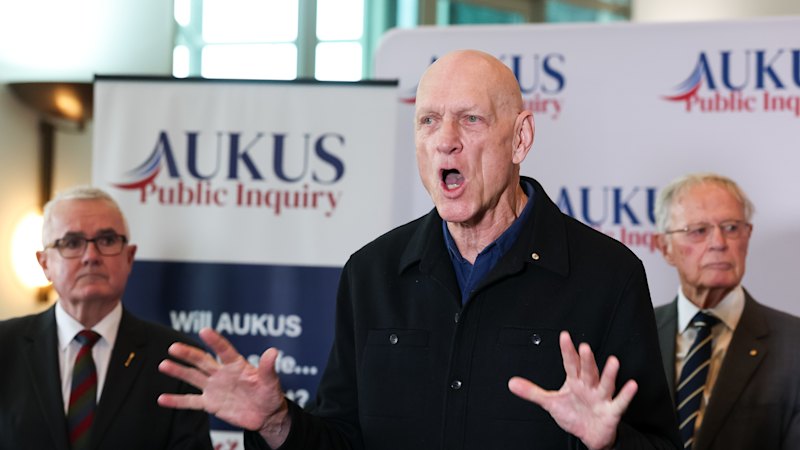
The pair will front a crowd-funded public inquiry into the AUKUS submarine pact on Thursday, urging the federal government to immediately redesign its national strategy, cancel plans to acquire American Virginia-class and British-designed SSN AUKUS nuclear-powered attack submarines, and pivot to low-enriched uranium vessels sourced from France or South Korea.
Keating, the most senior public servant during the Hawke-Keating era, spent 11 years on the Secretaries Committee on National Security – including five years as chairman – while Stanford has extensive background in submarine research and defence policy.
Advertisement
“Under AUKUS, Australia’s security is under greater threat while it has become increasingly clear that we cannot rely on the US for our defence,” they write in their submission. “We are now in a situation where, because of the AUKUS strategy of integrated deterrence in defence of US regional primacy, Australia is more likely to be attacked, potentially with nuclear weapons”.
They cite prescient warnings from former French foreign minister Jean-Yves Le Drian, who noted in 2021 that Australia had made a choice “to the detriment of sovereignty” and predicted it would discover later it had sacrificed both security and self-determination.
According to the submission, the policy of “integrated deterrence” and “pooled sovereignty” effectively converts Australian military facilities into forward operating locations for US forces without giving Canberra oversight or veto power.
They point out that unlike allies such as Japan, South Korea, and the Philippines, Australia lacks a formal US security guarantee, such as NATO’s Article V.
Advertisement
Yet, by developing command and basing infrastructure – such as the US submarine squadron facilities at HMAS Stirling in Western Australia – Australia becomes a prime military target.
“If there is a war between the US and China, Australia will inevitably be involved … even if we do not provide military support,” the submission states, adding that escalating hostilities could leave Australia open to nuclear strikes.
Fronting the first day of the hearings in Canberra on Wednesday, former home affairs secretary Mike Pezzullo called for a deeper military integration with the US, agreeing that Australia could surrender sovereignty under the current AUKUS without gaining a meaningful say in decisions that could draw it into a war with China.
Pezzullo, a national security hawk and former senior public servant under the Abbott, Turnbull and Morrison governments, was sacked by Labor in 2023 after confidential messages between him and Liberal Party powerbroker Scott Briggs were leaked to this masthead. The Australian Public Service Commission subsequently found he had breached the public service code of conduct on 14 occasions.
Advertisement
“If I was a Chinese war planner,” Pezzullo said, “I would flatten every single potential facility that might be used overnight by Americans flying in.”
He said facilities including Tindal, Stirling, North West Cape and Pine Gap could be targeted in such a conflict.
But Pezzullo said AUKUS’s nuclear-powered submarine program would transform Australia’s military options, giving the navy greater speed, endurance and reach while opening the way for a new generation of autonomous underwater systems.
Undersea warfare would be critical in any future conflict, from anti-submarine operations to intelligence gathering, he said.
At the same time, Pezzullo said Australia should not commit to fighting alongside the US in every future conflict.
Advertisement
“Alliances are political documents first and foremost,” he said, arguing that countries must retain the ability to make sovereign decisions when a conflict actually occurs.
But he said those political alliances needed military planning and preparation underneath them.
Australia, he said, could either try to remain outside a future US-China conflict and accept the consequences if Washington lost, or strengthen its alliance with the US in the hope that the combined deterrent would prevent war.
“The only choice would be whether we want to sit it out and hope for the best,” Pezzullo said. “I think that’s not plausible.”
Advertisement
The choice was whether to remain on the sidelines and accept the consequences if Washington lost, or deepen the alliance in the hope that Australian involvement would strengthen deterrence.
“I prefer that latter approach,” Pezzullo said. “The war machine is the thing that prevents the war.”
Cut through the noise of federal politics with news, views and expert analysis. Subscribers can sign up to our weekly Inside Politics newsletter.
You have reached your maximum number of saved items.
Remove items from your saved list to add more.
More:
Rob Harris is the national correspondent for The Sydney Morning Herald and The Age based in Canberra. He is a former Europe correspondent.Connect via email.AdvertisementAdvertisement