
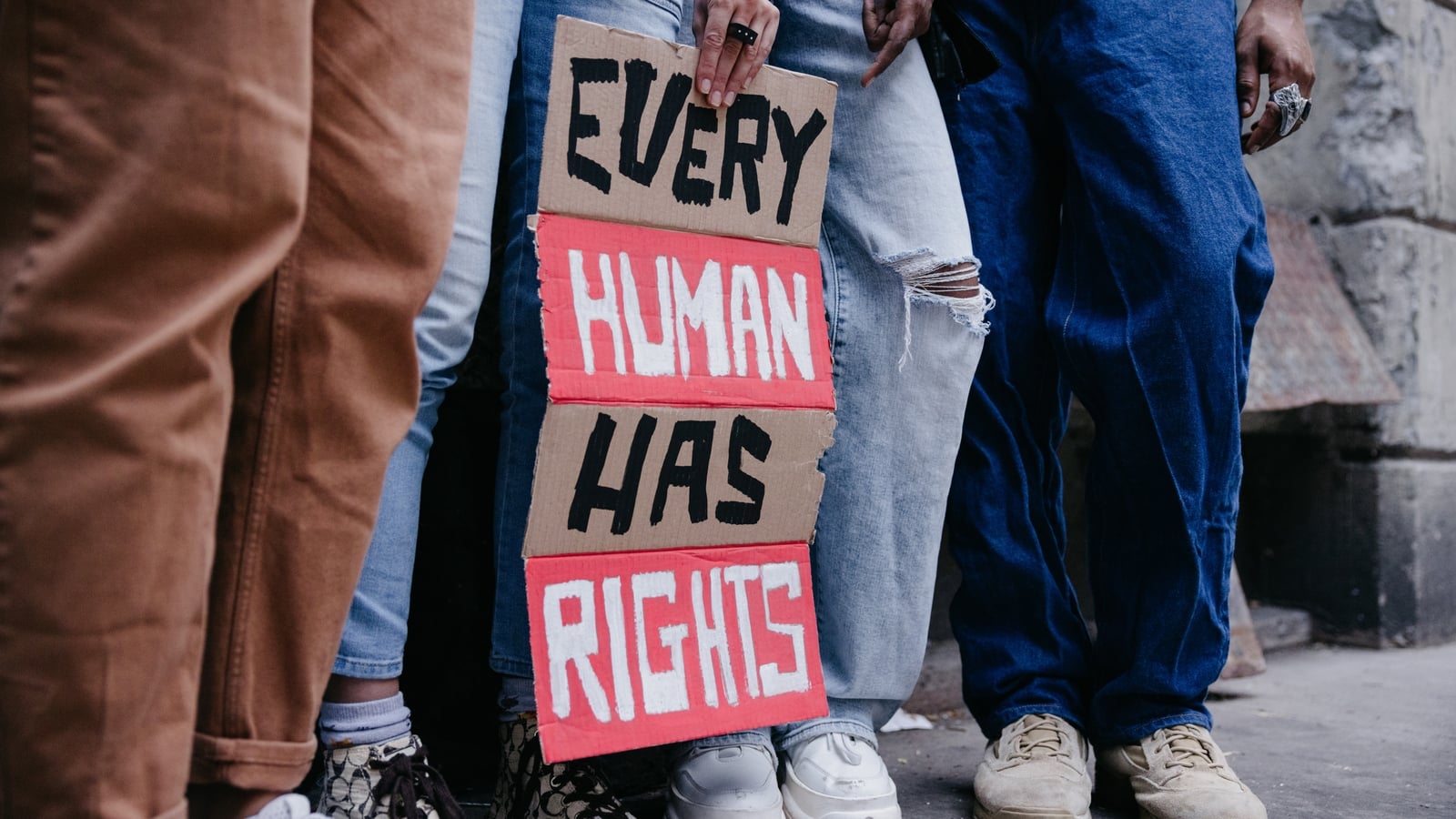
There has been a “sharp fall” in public confidence that human rights are being delivered fairly, according to the latest annual public attitudes poll by the Irish Human Rights and Equality Commission (IHREC).
The survey found that 53% of people believed they had equal opportunities to get ahead in life, compared with 62% last year.
In all, 26% believed efforts to combat discrimination were effective, down from 40% in 2025.
A total of 84% believe everyone should be treated equally regardless of background, while very high majorities regard economic and social rights such as affordable healthcare, housing and adequate earnings as important.
Some 39% believe everyone in Ireland enjoys the same basic human rights, down from 48% in both 2025 and 2024.
IHREC said the findings suggest that public opinion is not turning away from human rights and equality, but people want to see the principles translated into tangible improvements in their lives.
Women are consistently more likely than men to express concern about discrimination, economic insecurity, fairness and the adequacy of government responses.
Women are also significantly less likely to believe that efforts to combat discrimination are effective.
The gender divide is particularly visible in perceptions of economic fairness.
The survey found that 8% of women believed wealth was distributed fairly in Ireland, compared with 15% of men.
Men were also more likely than women to believe that everyone enjoys their basic human rights equally, that the Government was doing enough to address racism, and that Ireland welcomed diversity.
When it came to attitudes based on age, 65% of adults said they had a strong understanding of human rights.
The proportion was highest among 18–24- year-olds at 75%, while adults aged 50 and over had the lowest level, with 63% reporting a strong understanding.
Younger people less confident about experiencing equality
Younger people were much less confident about their ability to experience equality in practice.
A total of 40% of 18–24 year-olds believed they had equal opportunities to get ahead in life, down from 60% last year. By contrast, adults aged 65 and over remained the age group most likely to believe they had equal opportunities.
Younger adults were also significantly more likely to have witnessed racism and disability discrimination. Overall, 26% of 18–24 year olds said they witnessed disability discrimination in the past year, compared with just 4% of those aged 65 and over.
The poll also revealed the realities of everyday life.
87% of respondents were worried about the cost of living. Yet only 12% believe the Government has been doing enough to address cost-of-living pressures, while 72% disagreed. Similarly, only 11% believe wealth has been distributed fairly in Ireland.
Those who considered disability benefits important stood at 89%.
The poll found widespread recognition that discrimination has continued to affect particular groups.
Three quarters (74%) agreed that refugees and asylum seekers experience racism and discrimination. However, confidence in their treatment was considerably lower: Only 49% believed they had access to adequate accommodation and 47% believed they were treated fairly.
Among non-Irish respondents, 25% reported personally experiencing racism in the previous year, while 42% said they witnessed racism.
Women and younger adults were less likely to believe refugees and asylum seekers were treated fairly, while younger people were significantly more likely to report witnessing racism.
‘Strong public support for the underlying principles of equality’
The poll presents a clear challenge for policy makers and public institutions according to IHREC.
“There remains very strong public support for the underlying principles of equality and human rights. But this support is accompanied by declining confidence that institutions are delivering those principles effectively,” it said.
A total of 31% believed the Government has been doing enough to address racism, while 42% disagree.
The same pattern was evident in relation to artificial intelligence.
Majority believe public bodies should register AI systems
As awareness and use of AI has increased, 80% believed public bodies should register AI systems used in delivering public services and 81% believed the Government should regulate AI.
Yet only 13% believed the Government was regulating AI effectively.
IHREC Chief Commissioner Liam Herrick said the gap between rights in principle and rights in practice should concern everyone.
“It is particularly striking among women and younger people, who are more likely to identify discrimination, inequality and economic insecurity, and less likely to believe that current responses are working effectively.
“The message from the public is not that human rights and equality matter less. It is that they matter deeply, and people expect to see them reflected in their everyday lives.
“Whether someone can afford a home, access healthcare, earn an adequate income, participate fully in society or live free from discrimination are all questions of fairness and human rights.
“The challenge now is to turn Ireland’s very strong commitment to equality into greater confidence that people are actually experiencing those rights equally in practice,” he said.
A national representative sample of 1,205 adults in Ireland were surveyed online between 12 and 24 May. The maximum margin of error of the survey administered by Ipsos B&A is +/- 2.8%.