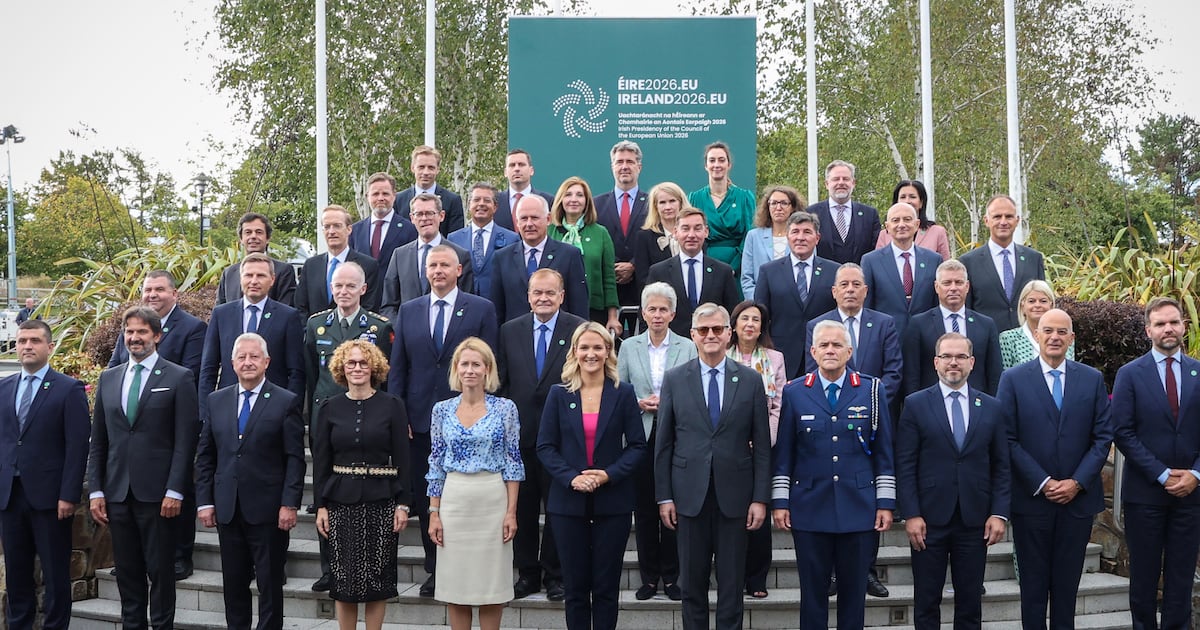
A “significant security operation” has been put in place for the Irish presidency of the Council of Europe, the Minister for Defence said on Tuesday before a meeting with EU counterparts in Co Wicklow.
Helen McEntree, who is also Minister for Foreign Affairs, was responding to recent media coverage of the State relying on French and UK defence forces to provide air and maritime security. The Irish Times reported this week that a UK warship and submarine-seeking helicopter had been deployed off the Irish coast.
She did not confirm the reports, saying she would not discuss security details beyond stating there would be a “significant security operation in place throughout our presidency”.
However, she added: “We have worked closely with international and European colleagues for many, many years on many security matters, and we’re no different to any other member state in that regard.”
READ MORE
‘We rechristened our kitchen the Law Library’: Negligence claim had toll on vindicated surgeon
Man (21) jailed for murder of father of five in Cork golf-club attack
New Government investment scheme: Here’s what we know – and don’t know
Electric Picnic 2026: In pictures
The Minister was speaking before a meeting of EU defence ministers in Druids Glen on Tuesday morning.
The Minister said Ireland had increased its defence spending by 43 per cent over the past two years and was investing significantly in counter-drone technology, radar facilities and air capabilities.
“We’re also investing in our maritime space, and that is why I launched earlier this year a new maritime security strategy,” she said.
The meeting, chaired by McEntee and Kaja Kallas, the EU’s high representative on foreign affairs and security policy, was to discuss the war in Ukraine, maritime security, space defence, the situation in the Middle East and the continuing blockade in the Strait of Hormuz.
Asked about Ireland relying on other countries for security cover during its presidency, Kallas said it was clear Ireland had “much better neighbours than some of the other European countries have. We have, as the European Union, good co-operation with United Kingdom, and I think we are also very like-minded partners.”
Setting out the main discussion points of the meeting, Kallas said Russia had escalated its attacks on civilians in Ukraine during the month of July. She said the big issue for the EU was air defence and the need to help Ukraine acquire more missile interceptors.
McEntee said more than 400 civilians in Ukraine had been killed in air strikes since July and pointed out Ireland had announced €125 million in funding to support air defence and training on the ground.
On the Strait of Hormuz, Kallas said the “freedom of navigation needs to be respected” in the absence of an agreement to end the war.
There would also be a detailed discussion on maritime security during the meeting on Tuesday, with a focus on undersea infrastructure, she said.
McEntee said maritime security would be a priority for Ireland throughout its presidency and referred to hybrid threats on land but also in the maritime space.
On the Middle East, McEntee said the situation on the ground was beginning to escalate. She said the end of the Irish UN mission in Lebanon was a matter of “profound regret for Ireland”.
She said Ireland, Spain and Austria had put together a proposal for a new EU Common Security and Defence Policy (CSDP) mission in the region.
She said the meeting would hear of how that application was progressing.
“What we’re working on at the moment is what that mission might look like. We can be assured that Ireland will be part of a CSDP mission in Lebanon. We have been present and on the ground for many decades.
“It is essential that we have some form of peacekeeping mission on the ground. It is absolutely essential that Irish troops, along with many others, are on the ground to support the Lebanese Armed Forces to support the Lebanese people.”
She added: “It is not for any other country and any part of the world to decide where we put our troops, we have for many, many years a proud tradition and history of peacekeeping, force protection, training missions on the ground, and I hope that that will continue to be.”
However, such a mission might not be possible for Ireland under the current triple-lock mechanism.
Asked about ongoing settler violence in the Occupied Territories, McEntee referred to Ireland’s legislation to ban goods produced in those areas. Asked why there was no co-ordinated EU action against Israel and specifically the vetoes exercised by Germany, Austria, the Czech Republic and Hungary, Kallas said: “Every country has the right to decide on their behalf, and they have to really explain their decisions.
“It illustrates the problems we have in the European Union. There are member states that have different views, and that’s why we haven’t been able to move forward. But at the same time, there are many issues where we are united also regarding Israel and Palestine. So, for example, we support a two-state solution, we are the biggest donors for the Palestinian Authority and supporters of humanitarian aid for the Palestinians,” she said.
Asked about the low spending of Ireland on defence as a proportion of Government budgets compared with other EU states, McEntee said there had been a substantial increase in investment in recent years.