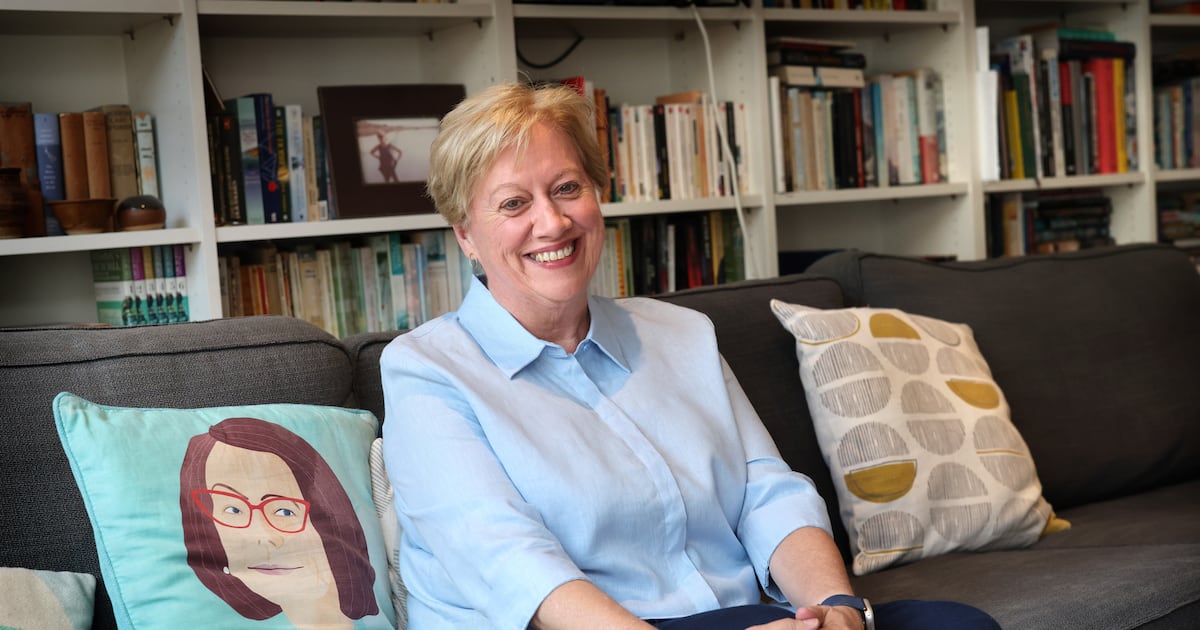
Although she was born to Irish parents in London, Colleen Murrell did not become immersed in Irish culture until adulthood.
Her mother and father, who were from Cork, died before she reached the age of six, and she, the youngest of four, was briefly taken into care as the family did not have any other relatives in the UK. Eventually her oldest sister was able to take her and her other siblings.
Murrell (65), who moved to Dublin in 2020, had been sent to boarding school at age six and “hated it”.
“We used to call it Colditz, and it was run by nuns … It had a terrible history teacher who, every time there was an IRA bombing, would ask me to stand up and tell the class what it was all about,” she says. There were no newspapers in the convent, so Murrell had no idea about the Troubles.
READ MORE
‘We went to the Manorhamilton Agricultural Show. That was an eye-opener’
From Syria to Clonakilty: ‘I feel really proud of what we have built in Ireland’
Moving to Ireland: ‘I told my husband we had made a terrible mistake’
‘I was visiting Ireland every summer during the school holidays but I never really thought about moving there’
Murrell’s older sister believed at the time that Ireland was somewhat backwards in its treatment of women and their careers. ,
Murrell’s family were not wealthy in Ireland, she says. Her father was one of 11 children. Most emigrated to the US, while he alone went to London. Her mother was orphaned at four and was sent to live with various family members before moving to England sometime in the 1930s.
Murrell says her mother, an only child, was “such a mystery”.
During her teens, Murrell moved to Belgium to live with her oldest sister. She returned to the UK for university, studied French and then did a master’s in international journalism in London. Over the next 10 years, she worked in broadcast journalism for international news organisations including the BBC, ITN and the Associated Press.
During this period, Murrell made many Irish friends and began to connect more with Irish culture, particularly around north London.
I’m still a natural journalist who’s terribly curious about things, but I find I’m always the last to know stuff. Things go on behind closed doors and you never really know what’s happening
“We would go to lock-ins on the Holloway Road with friends in Irish pubs and things like that,” she says.
Her reporting often took her to Ireland, which she had not visited much before then.
She married an Australian, had two children and moved to Melbourne for two decades.
Murrell freelanced for public broadcasters in Australia before teaching journalism at universities and completing a PhD.
Then, one day, a job opening at Dublin City University caught her eye. She says she “had not dealt with the Irish issue”.
With her children grown and at university, Murrell moved to Dublin by herself shortly before the outbreak of the Covid-19 pandemic. She had expected her husband Cameron to follow her shortly after she moved – that took six months – but the pandemic restrictions meant she did not see her children for two years. Feeling isolated in Ireland, she considered moving back. However, Cameron talked her out of it after joining her in Dublin in 2021 before starting his job as director of governance at University College Dublin.
Friends had warned Murrell before she moved that the Irish can be difficult to get to know. After living here for six years, she agrees.
“The Irish are very secretive. They don’t tell you stuff. I’m still a natural journalist who’s terribly curious about things, but I find I’m always the last to know stuff. Things go on behind closed doors and you never really know what’s happening,” she says.
This contrasts with Australia where, Murrell says, people are franker, and everything is out in the open.
However, she has reconnected with Irish people she had befriended in London. She has also found community with women on her road who celebrate with a street party every year.
She frequently returns to the UK to visit family there.
Having cycled in Australia, Murrell and her husband did not buy a car after moving to Ireland. She describes cycling in Dublin as “absolutely terrifying” but says it has improved in the years since she arrived.
“When I started cycling here, there just were not so many people cycling. Then they put the cycle paths on Griffith Avenue and that’s been great,” she says
Murrell is unsure what the future holds or where she and her husband will end up. For now, she loves her job in Dublin and wants to do more writing after publishing a book about women journalists at the BBC.
She says she is “totally agnostic at the moment” about their future whereabouts. “I really do think where we live in the future is going to depend on where our kids end up.”
This article was amended on September 1st, 2026.
We would like to hear from people who have moved to Ireland in the past 10 years. To get involved, email [email protected] or send us two lines about yourself using the form below.