
Sept. 9, 2026, 6:00 AM EDTBy David Ingram
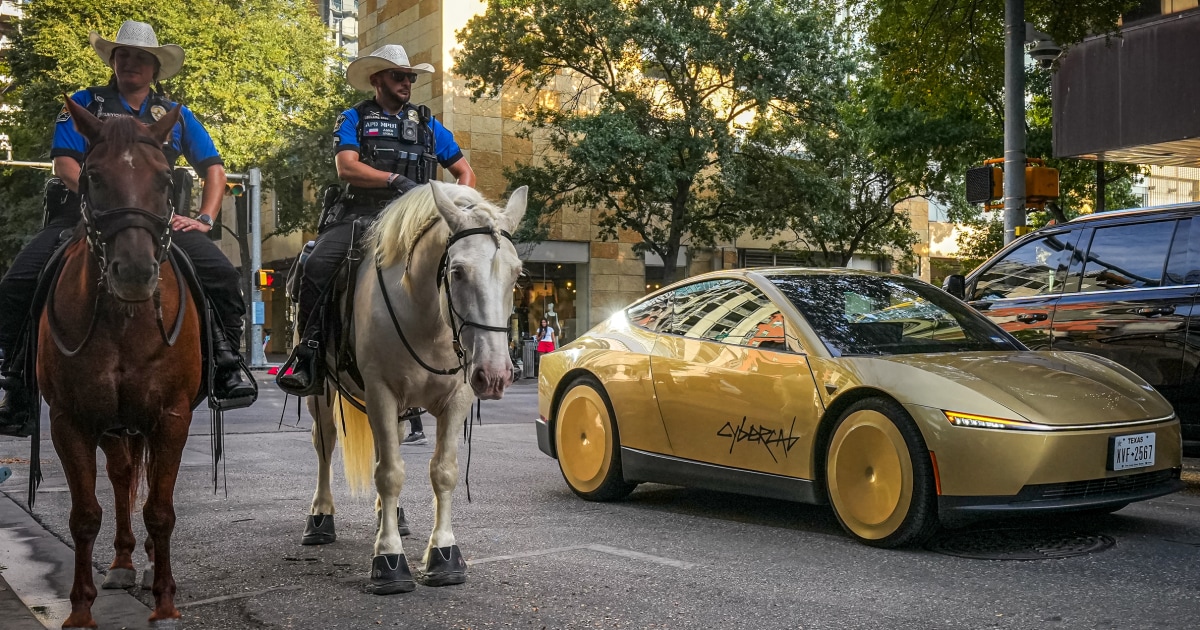
The fire department in Austin, Texas, said Tuesday that it has concerns that Tesla’s new Cybercab could block city streets because the unusual self-driving car does’nt have a steering wheel or other traditional human controls that firefighters would use to move it in an emergency.
“The lack of driver controls, (no ‘pedals’ or steering wheel) can be problematic,” the department told NBC News in a statement, five days after Tesla began putting the vehicle into service for the first time as part of an autonomous taxi fleet in Austin.
In an interview, fire Capt. Matthew McElearney said that Tesla has provided training to the city’s firefighters and other first responders about how to move the Cybercab using a touchscreen on its dashboard but that the technology is unproven and that he doesn’t know how well it will work in the field if, for example, a Cybercab is blocking a fire engine.
“I don’t think it’s the silver bullet to alleviating the concerns first responders have with not having driver’s controls,” he said.
He said he thought the touchscreen could fail a firefighter in an emergency situation in numerous ways, mentioning possible scenarios including gloved hands, sweat, dust, the possibility of the screen’s being cracked or a lack of power.
“Obviously, it has some drawbacks,” he said. “You need power to do that. It does have some limitations on speed. And it does require a little bit of, I would say, training or maybe some finesse to operate.”
McElearney said he’s not aware of any Austin emergency workers’ having to move a Cybercab in the vehicle’s first few days of deployment, and he emphasized that firefighters have multiple options — including floor jacks and wheeled dollies — to move any vehicle in an emergency.
Tesla and its CEO, Elon Musk, didn’t immediately respond to a request for comment Tuesday.
Tesla is rolling out the Cybercab in Austin after a launch event last week at which it presented the stripped-down vehicle as the future of transportation. In recent days, Tesla fans have flooded social media with videos from inside the autonomous taxis, praising its design. Musk has promised to deliver “a Storm of Cybercabs.”
The Cybercab’s lack of human controls has sparked an investigation by the National Highway Traffic Safety Administration, which said last week that it’s examining whether the vehicle meets federal safety requirements.
The car presents unusual challenges for first responders, who sometimes need to move vehicles off the road, especially near fires. In a “first responder interaction plan” for the Cybercab, Tesla says first responders can request assistance from the company and manually move the vehicle using onboard vehicle controls. Tesla has also said the Cybercab may need to be pushed in certain circumstances.
The touchscreen has a digital joystick that is usually not visible to riders but that may allow someone, such as a first responder or a Tesla employee, to move the car by swiping a finger, according to a video a Cybercab customer posted Monday on X.
McElearney, who’s a member of a city government working group on autonomous-vehicle safety, said he first saw the Cybercab touchscreen system two weeks ago at an event Tesla had for Austin’s first responders. He said he came away happy to have the touchscreen option but not convinced that it was a true replacement for a steering wheel.
“What I would not want is for somebody to put their fingertips on it and try to slowly roll it, and then it zigs when it’s supposed to zag,” he said.
Austin police said Friday that they had received the same training.
“We will continue working with Tesla and other autonomous vehicle companies to address public safety concerns and develop training so officers across the department understand how to safely interact with these vehicles during emergency situations,” Assistant Chief JJ Schmidt said in a statement.
The lack of a steering wheel may also affect tow-truck operators as they’re trying to load Cybercabs. Tesla said in its first responder interaction plan that, when they’re loading the cars onto tow trucks, operators may need to “manually turn the front tires by hand to help position the vehicle.”
McElearney said the city’s first responders have also raised safety concerns about Zoox, a self-driving car company owned by Amazon that is testing a vehicle without a steering wheel in Austin.
“Our comment to Zoox was pretty much the same thing: You took away the driver controls. That’s an issue. We would like control of your product if we have an emergency event where we have to clear streets,” he said.
Zoox said in a first-responder plan filed with the state that if its robotaxi can’t be moved using its own power, it “must be towed.” A company representative had no immediate comment Tuesday.
Autonomous taxis — including those from Tesla’s primary rival, Waymo — have sometimes gotten in the way of firefighters, police officers and paramedics in cities where they’ve been deployed. On occasion, law enforcement officers have gotten into the driver’s seat of Waymo vehicles and driven them manually using their steering wheels and pedals when the self-driving cars haven’t responded to instructions quickly enough.
In the phone interview, McElearney also criticized Waymo for failing to meet the needs of first responders. He noted well-documented problems, such as Waymo cars’ passing stopped school buses and driving into flooded streets. He said Waymo hasn’t moved quickly enough to set up geofence blockades so its vehicles don’t drive into active emergency scenes and throttle traffic, as happened in Austin after a shooting in March, and he said Waymo hasn’t shared enough information about geofencing.
“It’s frustrating, because, as a public safety entity, you try to have productive conversations and try to give feedback, and it’s met with ‘There’s nothing; there’s no problem’ or ‘We got it’ or ‘Updates have covered it,’” he said of Austin’s relationship with Waymo.
Waymo spokesperson Nye Davidson said in a statement Tuesday: “We take feedback from Austin’s first responders seriously and continue to work closely with local public safety partners as our operations evolve.” He said he believed Waymo had implemented geofence requirements matching or surpassing the city’s request, and he said Waymo updates its severe weather preparedness on an ongoing basis.
McElearney said he believes the Trump administration should get involved by setting national standards for how autonomous vehicles interact with emergency workers.
“We need the feds to step up to the plate on this,” he said. “I know the administration is very pro-technology, but we also need to be pro-doing it the right way — not just to beat somebody to the autonomous punch.”
Regarding the presence of steering wheels, McElearney said a consortium of experts should look at it from a public safety standpoint and weigh in on alternatives such as touchscreens. The U.S. Transportation Department is updating the Federal Motor Vehicle Safety Standards and adapting them to autonomous vehicles.
In San Francisco, some versions of Tesla’s Cybercab have steering wheels, according to photos posted by local media and social media users. Tesla’s first responder guide says that “a Cybercab equipped with steering wheel, brake pedal, and an acceleration pedal is typically an engineering or test vehicle.”